Highland Cattle: Farming, Needs and Price
Highland is a beef breed that suits suckler herds and grazing. Profit depends mostly on how many calves you rear each year, not on the breed itself. We explain what breeding, feeding and herd health require, and what drives the price of a cow.
verifiedFrom the team that has organised work on poultry farms for years.
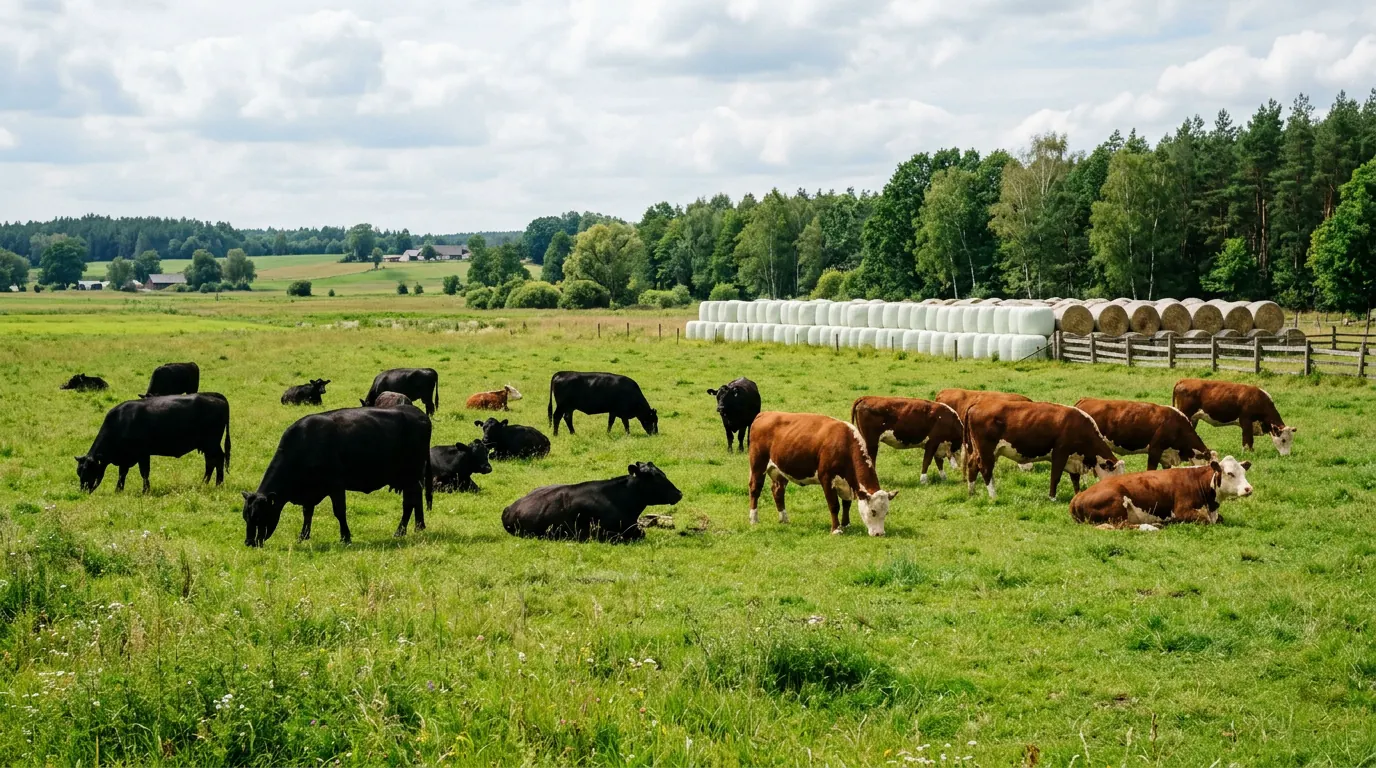
Highland cattle are a beef breed from the Scottish Highlands. They cope well with cool conditions and long periods on pasture, so they are often chosen for suckler herds, where cows rear their own calves for meat. Profit depends less on the breed and more on how many healthy calves you rear each year and how cheaply you produce feed.
Why calf numbers matter
A beef cow earns money mainly through the calf she rears. According to IZ PIB (Poland's Institute of Animal Production, WZ LIII(2015)2), the only income from a beef cow, besides manure, is a calf reared to 6–8 months of age. The same publication notes that beef produced on farms is expensive meat, and its taste and nutritional value offset the high price only in wealthy societies. So the whole result of the herd rests on breeding: a cow that does not calve regularly earns nothing.
Highland in a beef herd
Breed traits
Highland cattle have long, dense hair that protects them from rain and cold. The animals are usually calm and settle easily into life on pasture. Performance is judged by weight, gain and pedigree, so check the breeding documents when you choose a bull or heifer. A well-documented animal is easier to sell and easier to include in the herd's breeding work.
Housing system
Highland cows are most often kept on pasture, with a barn or a cattle shelter for winter. This lowers the cost of concentrate feed but increases your reliance on the season and on winter feed stocks. Results depend on how you feed cows and calves, so record every change in ration and pasture. After a year you will see what really improved gains and herd condition.
Heat, calving and first service for heifers
Heat about every 21 days
Heat, the period when a female is sexually active, is short and lasts around a dozen hours on average. The interval between heats is about 21 days (18–24 days), according to a WMODR Olsztyn leaflet (a Polish regional agricultural advisory center). A healthy cow that has not been served or inseminated shows heat roughly every three weeks. Bulls are sexually active all year. Write down heat observations right away, because a short window is easy to miss. You can keep heat and calving dates in cycle and stocking planning.
Heifer age and weight at first service
Teagasc (Beef Manual, section 4) reports that in Ireland the average calving age of suckler heifers is just over 32 months, according to ICBF data. Heifers calving at three years of age are less economically efficient over their lifetime than those calving at two. The advice is that a heifer should reach at least 60% of mature cow weight at service. For a mature cow weighing 600 kg, that is about 360 kg. This weight gives a good chance that the heifer will be cycling at around 15 months. Puberty depends more on weight than on age, so good feeding of young animals matters more than the calendar.
Seasonal calving
According to WMODR Olsztyn, seasonal calving is especially important on farms where cows spend most of the time on pasture. The keeper's goal is one calf from each cow per year. Choose calving dates so that the peak need for feed and labor does not fall in the hardest time of the year. Keep herd data in a system that links to the IRZplus register (ARiMR's online animal register), for example through IRZplus and sensor integrations.
Feed and winter stocks
Pasture wedge: a map of your paddocks
Teagasc (Beef Manual, section 6) describes a simple way to assess grass supply. You measure the grass cover of each field, then plot the fields from highest to lowest cover on a chart. The result looks like a staircase, called a pasture wedge or feed wedge. When the line drops below the target cover, the herd has a feed deficit. Then you must decide: shorten grazing on some fields, buy feed, or change the grazing order. Repeat the measurements regularly, because grass cover changes fast within a week.
Winter supplementary feeding
Teagasc (section 4) advises giving weaned heifers concentrate feed at the start of winter, up to 2 kg per head per day, depending on silage quality. For calves with their dams, IZ PIB (WZ 2014, organic farming) describes feeding concentrate in separate creep feeders that only calves can reach. According to that publication, this raises daily gain by 100 to 300 g for each kilogram of concentrate fed. Decide on supplementary feeding after you work out the costs. Keep an eye on silage and hay stocks with feed silo monitoring.
Worming, disease and welfare
Worming heifers
Teagasc, in section 4, says weaned heifers need to be dosed against fluke and roundworms, and that they need attention from the time they are brought into the shed. The vet chooses the exact product and timing. After every treatment, observe the withdrawal period and record it in the treatment and withdrawal records, so no animal goes to slaughter before the period ends.
Lumpy skin disease (LSD)
Lumpy skin disease (LSD) is an infectious cattle disease described in a PODR Szepietowo leaflet (a Polish regional advisory center). If you suspect skin lesions, fever or loss of condition, do not wait. Report it to your vet, who will assess the situation and tell you what to do next. Do not move animals between farms without consultation. Check the rules on control and animal movement in ISAP, Poland's online legal database, as of 22.11.2026.
Calf welfare
Minimum standards for calf protection are set by Council Directive 2008/119/EC. Check its Polish implementation in ISAP as of 22.11.2026. In practice, inspectors look at clean bedding, access to water and the condition of the animals. Record procedures such as ear tagging, worming and vaccinations in one place. This makes inspections easier and lets you answer your vet's questions quickly.
Cow price and herd profitability
What drives the price
The price of a Highland cow depends on age, weight, pedigree and breeding documents, health, and whether the animal has entered breeding. A young heifer before service is priced differently from a cow after several calvings. Prices change often, so we give no amounts. Check current prices in breeders' association listings, at livestock markets and with local ODR advisers (Poland's agricultural advisory centers), who know the regional market.
Profitability calculation
When you calculate, set three items side by side: the cost of pasture and winter feed, the cost of the vet and medicines with withdrawal periods observed, and the value of the calves you rear. PODR publications, for example the sample income calculation for beef cattle from ODR Lubań, show how the result changes with production intensity. Also count the loss when a cow does not calve in a year. The more detailed your records, the easier it is to work out the real result of the herd.
Frequently asked questions
How many calves does a Highland cow have per year?add
The keeper's goal is one calf from each cow per year, as WMODR Olsztyn states. The real result depends on heat, cow condition and service date. Work out calf numbers from your own records, because averages from other farms do not carry over automatically to your herd.
How much does a Highland cow cost?add
We give no amounts, because prices change often. The price depends on age, weight, breeding documents and health. Check current offers in breeders' association listings and with ODR advisers in your region.
At what age should a heifer be bred?add
Weight counts, not age alone. Teagasc advises that a heifer should reach at least 60% of mature cow weight at first service. In Ireland the average calving age of suckler heifers is just over 32 months. Set the exact timing with your vet and adviser.
How often does a cow come into heat?add
The interval between heats is about 21 days, in a range of 18–24 days, according to WMODR Olsztyn. Heat is short, around a dozen hours on average, so you need to watch regularly. A healthy cow that has not been served returns to heat roughly every three weeks.
Do heifers need worming?add
Teagasc advises worming weaned heifers against fluke and roundworms. The vet, who knows your herd, chooses the product and timing. After treatment, record the withdrawal period before the animal goes to slaughter.
Can Highland cattle be kept on pasture only?add
The breed copes well with pasture, but in winter the cows need a feed reserve. The pasture wedge method helps you judge whether there is enough grass for the season. Set the feeding plan with an adviser, because it depends on silage quality and weather.
Sources & resources
- linkIZ PIB — WZ — Current state and prospects of beef cattle farming and breeding in Poland (H. Grodzki et al.), WZ LIII(2015)2:77–87
- linkWMODR Olsztyn (gov.pl) — Breeding in beef cattle herds (leaflet)
- linkTeagasc — Teagasc Beef Manual — Section 4: Breeding
- linkTeagasc — Teagasc Beef Manual — Section 6: Nutrition
- linkIZ PIB — WZ — Feeding beef cattle in organic farming (K. Bilik et al.)
- linkPODR Szepietowo — Lumpy skin disease (LSD) in cattle — leaflet (Z. Marciniak)
Prepared by: DlaFerm Team based on data from the sources listed · Publisher: INSTA-TECH sp. z o.o.
Planning calvings and heifer service?
The stocking and cycle planning module helps you set service and calving dates across the whole herd. Create a free farm account in DlaFerm.pl and enter your first data, or get in touch and we will show you how it works in practice.
Phone
+48 796 258 151