How much does a cow or bull weigh? Weight by age
The weight of a beef cow or bull depends on breed, age, body condition and feeding, so there is no single number for every animal. We put together values from the Teagasc and AHDB manuals and explain how to check weights in your own herd. A vet or an adviser always sets feed rations and treatment.
verifiedFrom the team that has organised work on poultry farms for years.
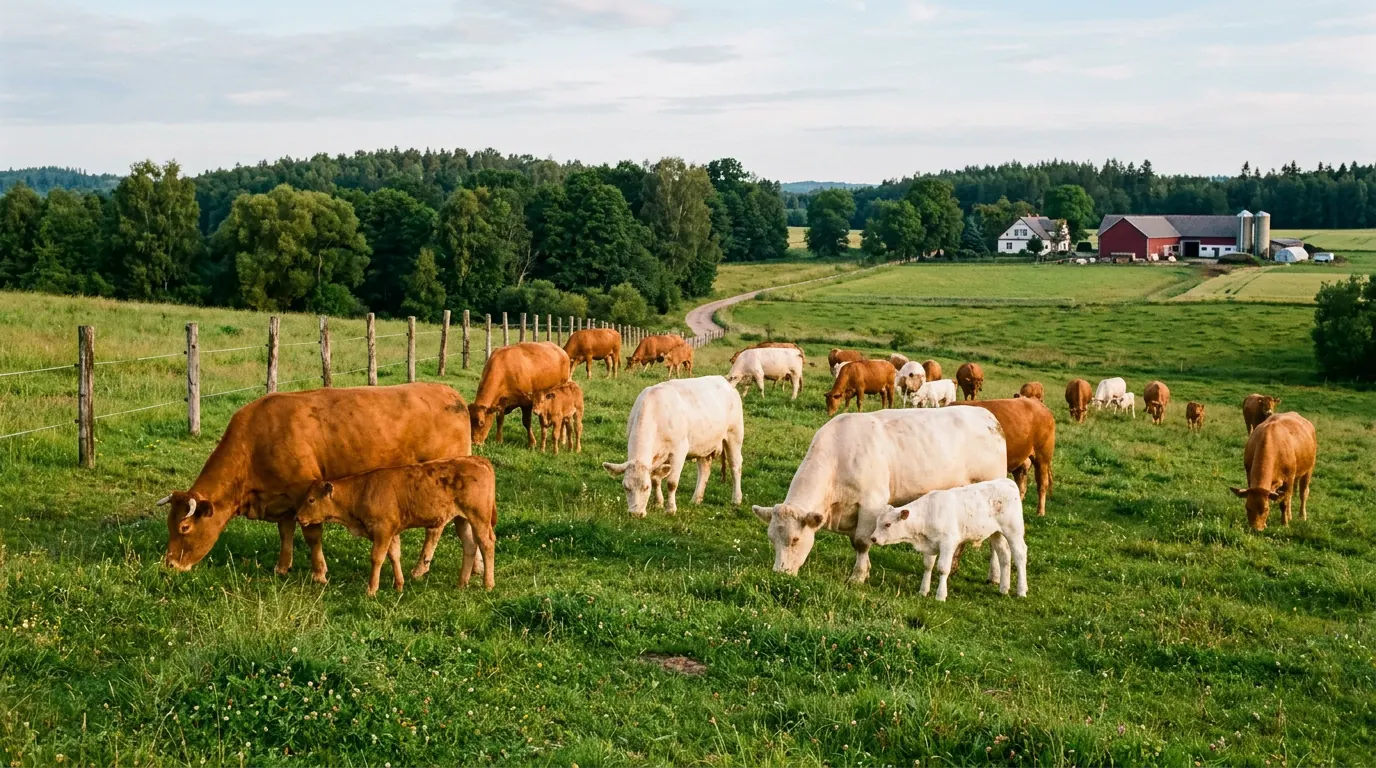
How much does a beef cow or bull weigh? There is no single number, because weight depends on breed, age, body condition and feeding. Below we set out ranges and values from farmer manuals and institutes, and explain how to check weight in your own herd instead of guessing by eye. Each number comes with its source, and with the year of the data when the source gives one.
How to read the tables
Manual values are mostly growth targets or example weights for the system described, not an average for the whole population. The same weight at a given age can mean good progress in one animal and a delay in another. Treat the tables as a reference point and compare them with your own weighing. We cover weighing rules in a section below.
Cattle weight by age: values from the Teagasc manual
Weanling-to-bull system
The Teagasc Beef Manual (Ireland), in its section on beef production systems, gives weight targets for suckler-bred cattle sold as bulls. A calf weighs about 50 kg at birth. At 7 months, after weaning, it is 315 kg. At 8 months, after housing, it is 335 kg, and at 12 months, after grazing, 415 kg. At 15 months it reaches 535 kg, and at 18 months, at finishing, 695 kg. The carcass target in this system is 400 kg. The authors note that the growth targets are high and need good management, so the table does not guarantee a result in every herd.
Steer system
In the same manual, a steer in a suckler system weighs 225 kg at 5 months, 375 kg at 9 months, 475 kg at 12 months and 650 kg at 16 months, at finishing. The carcass target here is 380 kg. Bulls are finished younger and at a lower weight, so when you compare animals, always check sex and feeding system. Comparing a steer with a bull without this distinction leads to wrong conclusions about growth rate.
How to use these numbers in practice
The table values describe the weight an animal reaches at a given rate of gain. When daily gain drops, the animal reaches the same weight later than the plan assumes. That is why weighing every few weeks tells you more than age alone. Match weights with age in your records, and look into any departure from the growth curve at the first signs of slowing gain.
Bull weight and condition in the breeding season
Condition scoring before the season
The AHDB Beef & Lamb manual (UK) advises body condition scoring bulls around eight weeks before the breeding season. The target is BCS 3: a bull in healthy flesh but not fat. A bull carrying too much fat moves less well and copes worse with mating. Condition scoring takes practice, so ask an adviser for help if you are unsure.
Bull weight and feed ration
The AHDB table for mature bulls uses live weights from 700 to 1000 kg and gains of 0.40 to 0.55 kg a day over a 180-day winter. For example, a 700 kg bull received 30 kg of grass silage and 1.5 kg of concentrates, and a 1000 kg bull 40 kg of silage and 2.3 kg of concentrates. The assumption is that dry matter intake is 1.5% of body weight. This is a worked example, not a recommendation for your herd. Feed amounts are set after condition scoring, with a nutrition adviser.
Too much concentrate
The AHDB authors advise against high levels of concentrates for breeding bulls, because they can lead to problems with locomotion, reduced semen quality and diminished libido. A bull that fattens during the breeding season does not become a better sire. If weight rises faster than you expected, check the ration and the condition score before you increase the feed.
Cow weight and condition at calving and breeding
Condition at calving
The Teagasc manual (breeding section) lists cows with a condition score below 2.0 at calving among the groups that more often have delayed heat after calving. Together with young cows and cows that had twins, they are the main source of late calvers. The lower the condition at calving, the higher the risk that the cow does not return to cycling on time. So judge a cow's weight together with her condition, not by the scale alone. Set the feeding plan before calving with a vet or an adviser.
Breeding period and late calvers
Teagasc advises limiting the breeding period to 12 weeks. For cows that calve late, the manual describes restricting the calf's suckling: separation starts when the cow is 30 days after calving and lasts 2–3 weeks, with the calf fed morning and evening. According to this source, about 85% of cows show fertile heat by day 50 after calving. Plan the breeding cycle together with other dates in the herd, and record calving and service dates in placement and cycle planning.
Weight and breed
The weight of an adult cow depends on breed and production type. We give no figures for specific breeds here, because reliable tables for adult cows need to be checked at the source. Publications of IZ PIB (Poland's National Research Institute of Animal Production) on breeding work in beef herds describe performance assessment and body weight, so you will find ranges for Polish breeds there.
Feed, growth rate and weight
Forage intake on pasture
IZ PIB data from organic beef research (K. Bilik et al., Wiadomości Zootechniczne 2014) give the pasture forage intake of a cow-calf unit, averaged over two seasons: 72.6 kg a day on pasture N and 71.6 kg on pasture E. Pasture yields were 29.8 t/ha and 19.5 t/ha of green forage respectively. Differences between sites affect how much feed an animal eats without supplements, so when planning weights it pays to know the yield of your own pastures.
Gains and the growth plan
The Teagasc manual links higher gain to higher weight at a given age. When gains fall in winter, the animal drops off the planned curve. The first step is to check how much forage the group actually eats, and only then change the concentrate ration. Indicators such as FCR and EPEF help compare feed use between groups, and in FCR and EPEF production indicators you can see them next to weights.
How to check animal weight in your own herd
Weighing and recording
Weigh at the same intervals and on the same scale, for example at weaning, at housing, before the breeding season and before sale. Record the date, age and sex of the animal. That lets you compare the animal with the growth curve in the table and quickly spot a group that lags behind the rest of the herd.
Condition scoring
Condition is judged by touch and eye on the BCS scale. A bull should aim for BCS 3 before the breeding season, and according to Teagasc a cow should have a condition score of at least 2.0 at calving. Condition scoring needs no scale, but it complements weighing data and shows whether weight comes from fat or from muscle.
Data in one place
Keep weighing and condition records together with treatments and animal movements. At a herd review or a sale it is easier to show where your weight data come from. You can keep records in the farm management system, and pass data to IRZplus, ARiMR's online animal register, through IRZplus and sensor integrations.
Frequently asked questions
How much does an adult beef bull weigh?add
The weight of an adult bull depends on breed, age, condition and feeding. In the AHDB manual, example rations were calculated for bulls with a live weight of 700 to 1000 kg. Find the exact weight of your animal by weighing it on a scale.
How much does a suckler cow weigh?add
The weight of a beef cow depends on breed and condition. We give no figure for specific breeds, because reliable tables for adult cows need to be checked in IZ PIB publications. When judging a cow, always combine weight with condition.
How much does a calf weigh at weaning?add
According to the Teagasc table, a calf weighs about 50 kg at birth, and in the bull system it is 315 kg at 7 months, at weaning. These values are growth targets in that specific system, so compare them with weights from your own herd.
Can a bull be too heavy for breeding?add
Yes. AHDB advises against high levels of concentrates for breeding bulls, because they can lead to problems with locomotion, reduced semen quality and diminished libido. The aim is BCS 3 about eight weeks before the breeding season.
How often should you weigh cattle?add
The manuals give no single frequency. In practice it is worth weighing at weaning, at housing, before breeding and before sale. Regular records give a better picture than one weighing a year.
Where can I find weight ranges for Polish breeds?add
Start with IZ PIB publications on breeding work in beef herds, and with advisers at the ODR and PODR agricultural advisory centers. If growth or condition problems appear, talk to a vet, who will find the cause and decide on any treatment. Do not choose a drug or dose yourself, and when treating, keep treatment and withdrawal period records.
Sources & resources
- linkTeagasc — Teagasc Beef Manual — Section 3: Beef Systems
- linkAHDB Beef & Lamb (UK) — Beef BRP Manual 5: Feeding suckler cows and calves for Better Returns
- linkTeagasc — Teagasc Beef Manual — Section 4: Breeding
- linkIZ PIB — WZ — Feeding beef cattle in organic systems (K. Bilik et al.)
- linkIZ PIB — WZ — Current state and prospects of beef cattle breeding in Poland (H. Grodzki et al.), WZ LIII(2015)2:77–87
Prepared by: DlaFerm Team based on data from the sources listed · Publisher: INSTA-TECH sp. z o.o.
Want to keep cattle weights and condition in one place?
The farm management module collects animal records, weighings and treatments in one system. Create a free farm account at DlaFerm.pl and record your first herd weighing.
Phone
+48 796 258 151