Berkshire pigs: a breed for pasture and premium meat
The Berkshire is an English pig breed with dark coloring. Farmers keep it for good-quality meat, and it suits outdoor housing. In Poland it has a special place in history: Berkshire boars were used to create the Pulawska breed. We describe what is known about the breed and how to assess it before you buy.
verifiedFrom the team that has organised work on poultry farms for years.
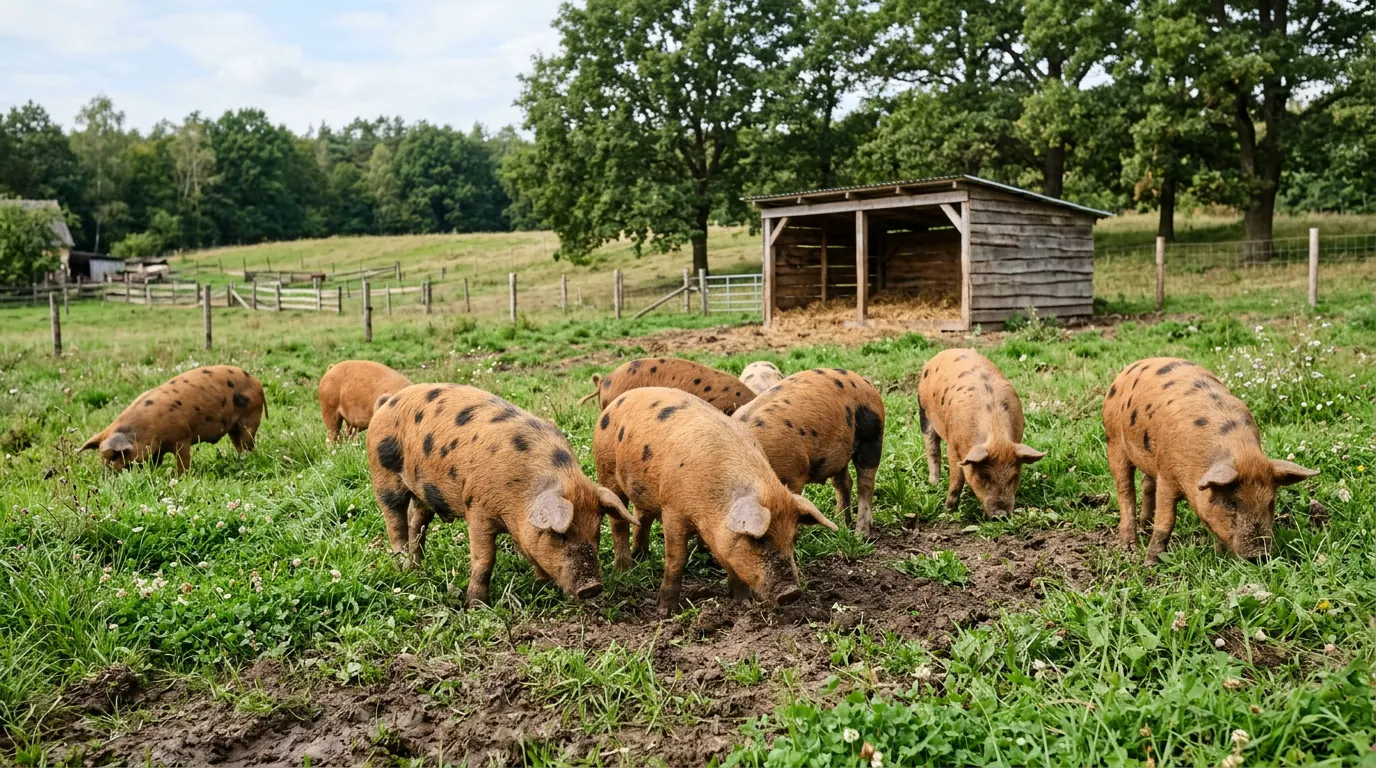
The Berkshire comes from England. Niche producers value it for meat quality and for how well it copes with life outdoors. Farmers choose it when they sell meat directly and want a product that stands out, rather than compete on price with large-scale fattening. The breed is not meant for intensive, large-scale finishing. If you want animals for that, see our pages on the Pietrain and Duroc.
Berkshire in the history of Polish pig breeding
In Poland, Berkshire is known mainly from the history of the Pulawska breed. According to IZ PIB (the National Research Institute of Animal Production), work on creating it began in 1926 at the Zootechnical Station in Borowina (Lublin voivodeship). The starting stock was a herd of crosses between the primitive Polish lop-eared pig and Berkshire. The breed was then improved by adding blood of the English Large White and the Polish Large White. The result was pigs of a fat-and-meat type. Read more in our article on the Pulawska pig.
What to know about the Berkshire breed
Appearance and production type
The Berkshire is a dark pig, usually with pale markings on the face, legs and tail tip. Its ears are erect. It is a meat-and-fat type, less meaty than modern sire breeds. So it cannot match them on carcass results; its strength is meat quality. Exact performance, such as daily gain or lean meat content, depends on the line and the housing conditions. Check it with the breeder you buy from and ask for pedigree documents.
Berkshire meat
The meat of this breed is sold as a higher-class product, usually through short supply chains such as direct sales or restaurants. Quality depends not only on genes but also on slaughter weight, feed, welfare and how animals are handled before slaughter. We do not give meat prices, because they depend on region, sales channel and season. Check them with local buyers and in the markets where you want to sell. Breeders of Mangalica and Iberian pigs take a similar route.
A less prolific, slower-growing breed
Compared with maternal and sire breeds, the Berkshire gives less meat in the carcass and grows more slowly. Slower growth means longer rearing and a higher feed cost per kilogram of live weight. This model pays only if you sell the meat for more than a standard finisher pig. Before you buy, work out feed cost, rearing time and a realistic selling price. You will find our comparison of popular breeds in the article on the domestic pig.
Berkshire outdoors: requirements and welfare
Why traditional breeds suit outdoor systems
According to IZ PIB, native breeds such as the Zlotnicka Spotted are well adapted to local conditions, have modest feed needs and do well in free-range systems. The KPODR manual (the Kujawsko-Pomorski agricultural advisory center in Minikowo) says the Pulawska breed, which descends from crosses with Berkshire, is resistant to stress and harsh conditions and is long-lived. Do not transfer this data automatically to the Berkshire. Treat it as a hint that traditional breeds usually tolerate outdoor life better than highly specialized breeds.
What to provide outdoors
A paddock is more than a fenced piece of field. You need a roofed shelter, shade in summer, a dry bed, fresh water and a place to root. Dark-coated pigs sunburn and overheat more easily in the open, so shade and a way to wet the skin matter. Minimum standards for pig protection are set by Council Directive 2008/120/EC. IZ PIB studies on pig welfare also describe welfare rules.
Biosecurity for outdoor pigs
Outdoor housing raises the risk of contact with wild animals, so with African swine fever (ASF) it is the weakest point of a farm. According to EFSA, 585 ASF outbreaks were recorded on pig farms in the EU in 2025, 76% more than in 2024. Measures to fight the disease in Poland are set by a Ministry of Agriculture regulation of 12.03.2026 (Dz.U. 2026 poz. 344, Poland's Journal of Laws), as of 23.11.2026. Confirm the requirements for your own farm with the county veterinary officer (powiatowy lekarz weterynarii). You can prepare a protection plan in the biosecurity plan generator.
Does keeping Berkshires make sense on your farm
Who the breed suits
Berkshire makes sense if you sell meat directly, have customers ready to pay more for pasture-raised pork and can tell the story of your animals. It does not pay if you deliver finisher pigs to a large buyer who pays by lean-meat grade. Before buying animals, make sure you have a market. National quality schemes described by PODR Szepietowo and KPODR can also help.
Keeping pigs for your own use and formalities
If you want to keep a few animals, check the rules for small farms in our article on keeping pigs for your own use. Every animal must be registered under current rules, and selling meat brings extra sanitary requirements. Check the details with the Chief Veterinary Inspectorate (Główny Inspektorat Weterynarii) and with ARiMR (Poland's Agency for Restructuring and Modernisation of Agriculture). For losses, for example from disease, look at livestock insurance.
Compare with other niche breeds
If you are weighing several breeds, compare them on outdoor suitability, size and market. The Kunekune is a small grazing pig, Vietnamese pigs are small, and the Zlotnicka is a Polish conservation breed with a genetic resources protection program. Breeds in the program can bring subsidies, but Berkshire is not a native Polish breed, so do not assume such support without checking with ARiMR.
Berkshire in crossbreeding
The breed's role in creating others
The most important Polish example of Berkshire use is the Pulawska breed, created by crossing local pigs with Berkshire boars and then improved. According to KPODR, Pulawska pigs have a medium-length body, strong legs and well-developed hams. The literature gives finisher daily gains of 400–590 g and a meat content of 48.70–56.45%. This is data for the Pulawska, not the Berkshire, but it shows what you can expect from breeds of this type.
Commercial crossing
Producers selling premium meat sometimes cross traditional breeds with better-fleshed ones, for example Duroc or the Polish Large White. A crossbred may grow faster than a purebred, but it loses some of the traits customers pay for. Decide what you sell: a purebred brand, or good-quality meat at a lower cost. Discuss your crossing plan with an adviser from an agricultural advisory center.
Frequently asked questions
What is a Berkshire pig?add
It is an English pig breed with dark coloring, kept mainly for meat quality and well suited to outdoor housing. In Poland it is known mostly for its part in creating the Pulawska breed.
Is Berkshire a native Polish breed?add
No. Poland's native pig breeds are the Pulawska, Zlotnicka Spotted and Zlotnicka White. The Pulawska was created by crossing local pigs with Berkshire boars.
Is Berkshire pork better?add
Farmers value it for quality, but taste and juiciness also depend on feed, slaughter weight and housing. Set your price based on the local market and how you sell.
Are Berkshire pigs good for outdoor systems?add
Traditional breeds usually tolerate outdoor life well, but you must provide shade, shelter and biosecurity. With dark coats, protect pigs from overheating and sunburn.
Is outdoor housing safe during ASF?add
Outdoor housing raises the risk of contact with wild boar, so it needs extra safeguards. Confirm the current requirements in your area with the county veterinary officer, under the Ministry of Agriculture regulation of 12.03.2026 (Dz.U. 2026 poz. 344).
Sources & resources
- linkIZ PIB — Livestock keeping and breeding over 70 years. Pig Breeding Department, Horse Breeding Department
- linkKPODR Minikowo (RDP 16 Cooperation) — A quality system as a guarantee of good pork
- linkIZ PIB (copy at zlotnickieksiegi.up.poznan.pl) — Genetic resources protection of native pig breeds: state of breeding and evaluation results for 2024 (issue 20)
- linkEFSA — Epidemiological analysis of African swine fever in the European Union during 2025
- linkMinistry of Agriculture / Journal of Laws — Regulation of 12.03.2026 on measures to control African swine fever (Dz.U. 2026 poz. 344)
Prepared by: DlaFerm Team based on data from the sources listed · Publisher: INSTA-TECH sp. z o.o.
Run your niche pig herd in the pig farmer app
DlaFerm's <a href="/hodowca-trzody-chlewnej">app for pig farmers</a> helps you keep animal records, results and rearing costs in order. Create a free farm account or get in touch.
Phone
+48 796 258 151