Złotnicka pig, white and spotted: a Polish heritage breed
The złotnicka is a native Polish breed under a genetic resources conservation program, kept in two varieties: white and spotted. We cover how many herds and sows there are, what the breed suits and how to keep it. Figures come from IZ PIB, Poland's National Research Institute of Animal Production.
verifiedFrom the team that has organised work on poultry farms for years.
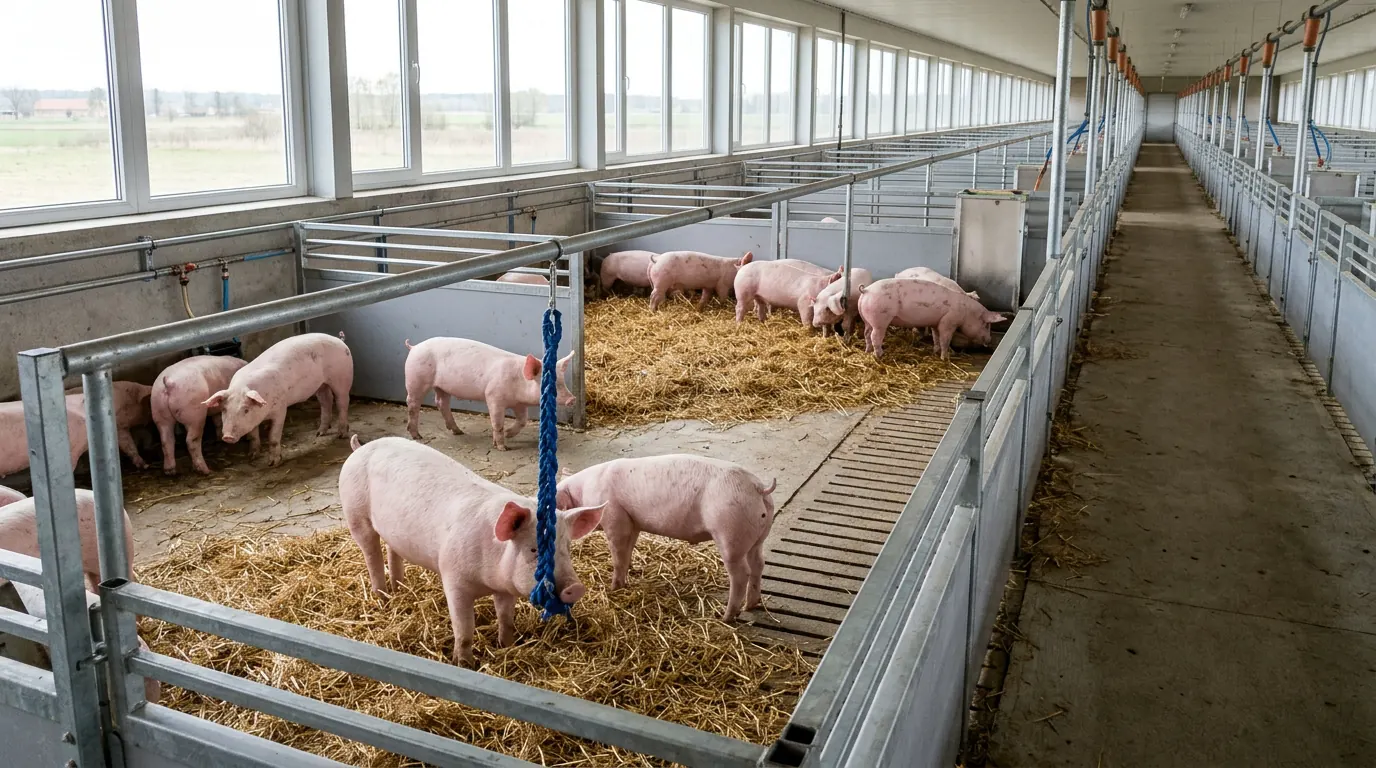
The złotnicka pig is a native Polish breed with two varieties: złotnicka white (złotnicka biała) and złotnicka spotted (złotnicka pstra). Both are covered by Poland's national program for the conservation of pig genetic resources. Together with the Puławska pig, they make up the three native breeds that the institutes assess and describe in yearly reports. According to IZ PIB, all three are well adapted to local conditions, have low feed demands and resist some specific disease agents.
Two varieties of one breed
The names describe the coat: złotnicka white has light bristles, złotnicka spotted has a patched coat. In breeding records they are two separate entries, each with its own herds, performance assessment and tables. When you search, you will usually find "złotnicka white" or "złotnicka spotted", less often the general "złotnicka pig". This article brings them together so you can compare the varieties and decide whether either suits your farm.
How many złotnicka pigs there are in Poland
Status on 1 November 2019
According to an IZ PIB monograph on 70 years of livestock breeding, on 1.11.2019 breeding assessment covered 34 herds of złotnicka white with 1285 sows and 33 herds of złotnicka spotted with 1039 sows. For comparison, the Puławska pig had 71 herds and 1735 sows. The three native breeds together came to 138 herds and 4059 sows. These are assessed sows, not the whole population, so the real number of animals may differ.
Assessment results for 2025
The IZ PIB report "Stan hodowli i wyniki oceny świń w roku 2025" (status of breeding and pig assessment results in 2025) gives 894 assessed sows and 1176 litters for złotnicka white, which is 11.04% of assessed sows. For złotnicka spotted it is 795 sows and 925 litters, or 9.82%. The Puławska had 2784 sows (34.38%). The data show that both złotnicka varieties are small populations, so every good herd matters for protecting the breed. Compare 2019 and 2025 with care, because they are different summaries.
How the złotnicka differs from commercial breeds
Adapted to local conditions
IZ PIB describes native breeds as well adapted to Polish conditions, with low feed demands and resistance to some disease agents. Smaller farms and low-input feeding systems value these traits. This does not mean the animals need no care: a vet still sets the prevention and treatment program, and biosecurity applies as for any other breed. Breed resistance is a breeding argument, not an exemption from hygiene.
Different genetics from modern breeds
A presentation by KPODR (the Kujawsko-Pomorskie agricultural advisory center) and IZ PIB on the benefits of keeping native breeds stresses their genetic and phenotypic difference from modern breeds. In practice this is a different type of animal from the high-muscle Pietrain or the Duroc, which are bred for lean meat or for use in crossbreeding. The złotnicka is not judged by the same expectations as commercial breeds. For specific values such as meat content or daily gain, check the current IZ PIB assessment reports rather than general descriptions.
Złotnicka white or złotnicka spotted: which to choose
Złotnicka white
In IZ PIB data złotnicka white has a slightly larger population than the spotted: 894 sows assessed in 2025 against 795. Its light coat makes it easy to tell apart from the spotted variety. The institute describes it, together with the spotted, as a breed well adapted to local conditions with low feed demands. If you want to buy breeding animals, start with herds covered by performance assessment, because only for them do you have documented ancestry and results.
Złotnicka spotted
According to the IZ PIB study on genetic resources conservation for 2024, złotnicka spotted, like the white, is well adapted to local conditions and resistant to specific disease agents. The institute notes that the spotted variety does particularly well in free-range keeping. The patched coat also makes the animals easier to spot outdoors. Whether the spotted or the white variety gives better results in your herd will only be settled by performance assessment and your own experience.
How to keep złotnicka pigs
Outdoor and organic keeping
The IZ PIB guide to organic pig keeping lists złotnicka white and złotnicka spotted among the breeds recommended for organic production, along with the Puławska, the Polish Large White (wielka biała polska) and the Polish White Lop-eared (polska biała zwisłoucha). The spotted variety suits outdoor keeping especially well. Outdoor access does raise the risk of contact with wild animals, so fencing and entry rules must be strict. You can draft a protection plan in the biosecurity plan generator.
Feed and welfare
The breed has low feed demands, but that does not mean you can feed anything. Always watch the quality of grain and feed, because molds produce toxins dangerous to every breed, as we explain in our article on mycotoxins in feed. Minimum standards for pig protection, including housing conditions, are set by Council Directive 2008/120/EC. Check its text for space and flooring details before you plan a building or run.
Why keep the złotnicka
Genetic resources conservation and the "RASY RODZIME" mark
The złotnicka varieties are in the genetic resources conservation program, and the IZ PIB and KPODR presentation discusses the "RASY RODZIME" (native breeds) mark, meant to help promote products from these breeds. Rules on joining the program, on support and on selling under the mark change, so check them with ARiMR (Poland's Agency for Restructuring and Modernisation of Agriculture) and the Institute of Animal Production rather than in old studies. Keeping a heritage breed is above all a job for a farm that can keep records and have its animals assessed.
Comparison with other heritage breeds
If you are weighing several low-input breeds, compare the złotnicka with the Mangalica, Berkshire and Kunekune. They differ in origin, market and legal requirements. The złotnicka's advantage is its status as a native Polish breed and assessment by a national institute. Before you buy animals, also check what duties apply to anyone keeping pigs, even for own use: we describe them in our article on keeping pigs for your own use.
ASF rules when keeping native breeds
A heritage breed gets no relief from the rules on African swine fever (ASF). Measures to combat ASF are set, among others, by the Regulation of the Minister of Agriculture and Rural Development of 12.03.2026 (Dz.U. 2026 poz. 344, Poland's Journal of Laws), as of 23.11.2026. Your duties depend on the zone where your farm lies, and decisions in a specific case are made by the county veterinary officer (powiatowy lekarz weterynarii). Before you buy animals or switch to outdoor keeping, ask the vet about current requirements and check the act's text in ISAP, Poland's legal database. Consider livestock insurance as well.
Frequently asked questions
What is the złotnicka pig?add
It is a native Polish pig breed, kept in white and spotted varieties. It is covered by the national genetic resources conservation program. IZ PIB describes it as well adapted to local conditions, with low feed demands.
What is the difference between złotnicka white and złotnicka spotted?add
Mainly the coat: the white is light, the spotted is patched. IZ PIB runs a separate performance assessment for each. According to the institute, the spotted does particularly well in free-range keeping.
How many złotnicka sows are there in Poland?add
In the 2025 assessment IZ PIB counted 894 złotnicka white sows and 795 złotnicka spotted sows. In 2019 it was 1285 and 1039 sows respectively. These are assessed sows, not the whole population, and summaries from different years are not fully comparable.
Is the złotnicka suitable for organic production?add
Yes, the IZ PIB guide lists both varieties among breeds recommended for organic production. Check certification requirements and housing conditions in current rules and with your certification body.
Is a native breed resistant to ASF?add
No. IZ PIB writes about resistance to specific disease agents, but that does not mean protection against ASF. The same biosecurity principles and rules apply as for other breeds. Your county veterinary officer can give details.
Where can I find current data on the breed?add
In the yearly IZ PIB reports on the status of breeding and pig assessment results, and in the study on genetic resources conservation. ARiMR describes the support available to breeders of native breeds.
Sources & resources
- linkIZ PIB (copy at zlotnickieksiegi.up.poznan.pl) — Conservation of genetic resources of native pig breeds — breeding status and assessment results for 2024 (issue 20)
- linkIZ PIB (National Animal Breeding Center / trzoda.izoo.krakow.pl) — Status of breeding and pig assessment results in 2025
- linkIZ PIB — Livestock keeping and breeding over 70 years. Pig Breeding Department, Horse Breeding Department
- linkIZ PIB — Guide to organic pig keeping (ed. E.R. Grela)
- linkKPODR / IZ PIB — Benefits of keeping native pig breeds and the RASY RODZIME mark (presentation, M. Szyndler-Nędza, P. Radomski)
- linkMRiRW / Journal of Laws — Regulation of the Minister of Agriculture of 12.03.2026 on measures to combat African swine fever (Dz.U. 2026 poz. 344)
Prepared by: DlaFerm Team based on data from the sources listed · Publisher: INSTA-TECH sp. z o.o.
Keeping a native-breed pig herd? Record it in the pig farmer app
With the DlaFerm <a href="/hodowca-trzody-chlewnej">module for pig farmers</a> you keep your herd records in one place, even when you raise several breeds. Create a free farm account or get in touch, and we will show you how it works in practice.
Phone
+48 796 258 151