Mangalica pigs: raising, meat and price
Mangalica is a Hungarian fat-type pig. It grows more slowly than lean meat breeds, and its value lies in cured meat products and fat. We explain how to keep mangalica, what biosecurity requires and what drives the price, without quoting amounts that change every week.
verifiedFrom the team that has organised work on poultry farms for years.
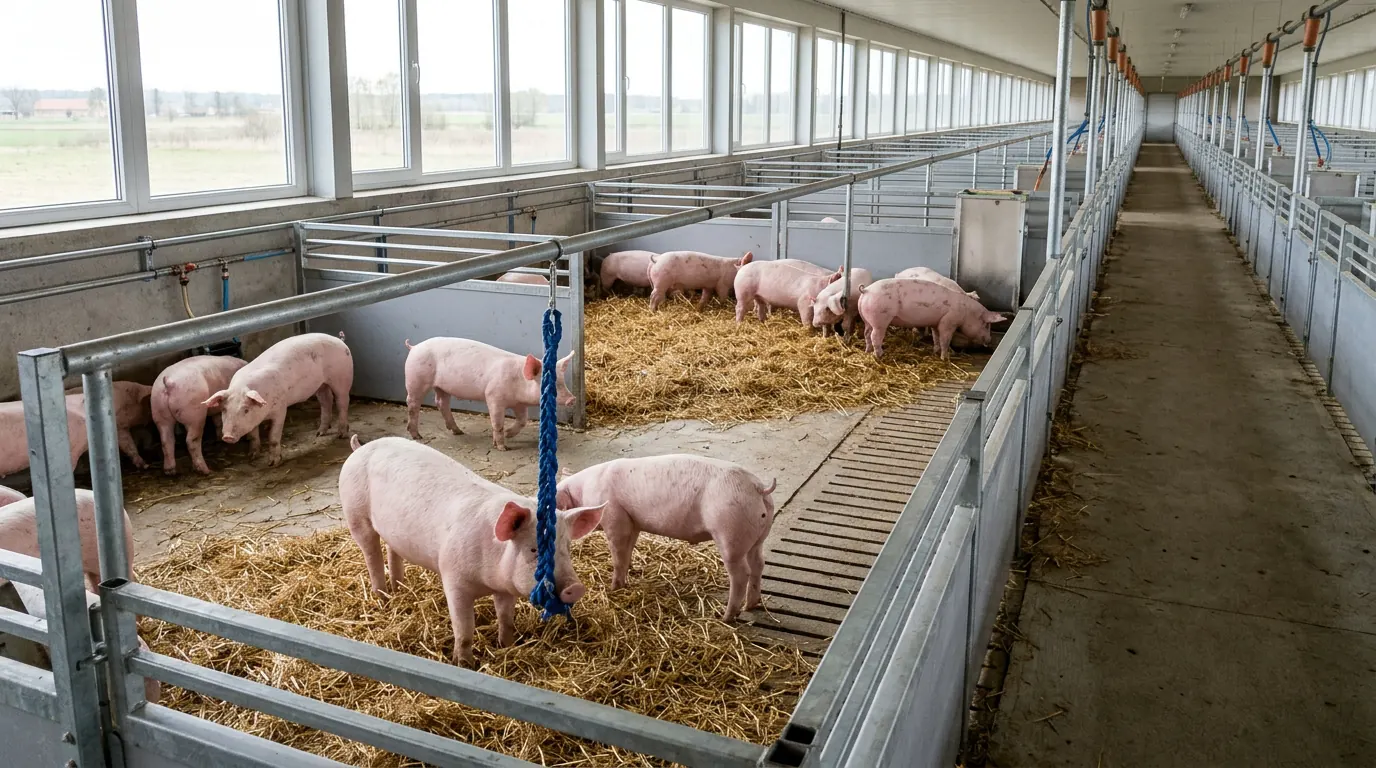
Mangalica is a Hungarian fat-type pig with a thick, curly coat and dark, heavily marbled meat. It is not one of Poland's native breeds. Keeping it pays mainly when you have a market for fat, meat and cured products, not when you want fast weight gain. Profit depends on piglet price, feed cost, fattening time and how you sell. Below we cover the breed's origin, housing, biosecurity, meat quality and record keeping.
How mangalica differs from lean meat breeds
Mangalica is a fat-type breed. Lean meat breeds are raised for lean meat and fast growth, while mangalica lays down more fat and grows more slowly. That means fattening takes longer, and the cost of each kilogram of gain is usually higher than with lean breeds. Before you decide, work it out on paper. Include the piglet price, feed use, how long the pen is occupied and the expected selling price of your products. Figures from your own farm will give you a result closer to reality than general tables. For comparison with other pigs bred for quality, see <a href='/swinia-berkshire'>Berkshire</a> and <a href='/swinie-iberyjskie'>Iberian pigs</a>.
Where mangalica comes from and its place in Poland
A Hungarian breed
Mangalica comes from Hungary, where it was kept as a fat pig valued for lard and cured products. Its thick, curly coat protects against cold and lets you keep the animals outdoors. According to KPODR Minikowo (a regional agricultural advisory center in Poland), three native pig breeds are kept in Poland: Puławska, Złotnicka Spotted (złotnicka pstra) and Złotnicka White (złotnicka biała). Mangalica is not one of them. Before buying, check that the animals have pedigree papers and are entered in the herd register, and ask the seller for information on the herd's health.
Native breeds as a point of reference
The <a href='/swinia-pulawska'>Puławska pig</a> is one of Poland's oldest breeds. According to KPODR Minikowo, its fattening pigs reach daily gains of 400–590 g and a meat content of 48.70–56.45%. Today they are kept mainly on organic farms, up to a body weight of 125–130 kg. These figures show what a breed aimed at quality, not maximum output, looks like. We have no comparable research data for mangalica, so work out results with other breeders and in breed clubs, and do not carry over other people's numbers to your herd. You can also read about the <a href='/swinia-zlotnicka'>Złotnicka pig</a>, another Polish conservation breed.
Keeping mangalica on your farm
Free range
IZ PIB (Poland's National Research Institute of Animal Production) notes that Złotnicka Spotted pigs do well in free-range systems, and in its material on conservation breeds it stresses their suitability for agritourism farms. Mangalica has a thick coat, so it tolerates cold well. Its fat build, however, makes it more sensitive to heat. Provide shade, constant access to water and a place to rest during hot spells. In cold, wet weather, check for dry bedding and shelter from the wind. Fence the run solidly, because mangalicas are heavy animals and can damage weak fences.
Records and treatment
Record every treatment with the date, product name and dose. This lets you easily show the withdrawal period before slaughter or sale. A vet always chooses medicines and doses, and you make sure the withdrawal period is counted from the last administration. Also keep a log of people and vehicles entering the farm, because an entry record is the basis of a biosecurity check.
Biosecurity and the ASF threat
What the rules say
Guidelines from the PIW in Wągrowiec (a county veterinary inspectorate), prepared on the basis of guidance from the Chief Veterinary Inspectorate (Główny Inspektorat Weterynarii, GIW), describe how to put into practice the biosecurity rules in Annex II to Commission Implementing Regulation (EU) 2021/605. They apply to farms keeping pigs in restricted zones I, II and III from which pigs, biological material, animal by-products (UPPZ) or fresh meat and meat products are shipped. National ASF control measures are set by a regulation of Poland's Ministry of Agriculture (MRiRW) of 12.03.2026 (Dz.U. 2026 poz. 344, Poland's Journal of Laws). The legal state is as of 22.11.2026. Before any decision, check the current version in ISAP (Poland's online legal database) and with your county veterinarian.
What this means in practice
The guidelines focus on controlling entry to the site, keeping vehicles and equipment clean, handling feed and bedding, and the rules for moving animals and meat off the farm. In practice that means clearly marked zones, a visitor log and a written action plan. Write the plan down on paper and post it at the entrance to the pig house, then adapt it to your own layout of buildings and runs.
Welfare as part of herd health
In its opinions on pig welfare on the farm, EFSA (the European Food Safety Authority) states that housing conditions, space, access to water and the care of the animals directly affect herd health. For mangalica this means a well-planned run, a daily check of the animals and a quick response to the first signs of disease. Make every decision on treatment, vaccination and reporting a suspected disease together with your vet. Do not wait for the problem to grow.
Mangalica meat and what drives the price
Meat quality
IZ PIB writes that the meat of conservation breeds has special taste and nutritional value. With mangalica, the key trait is different: the meat is darker and fattier than the meat of lean breeds. That is why it works best in cured products, pâtés and lard, not in lean chops. If you want to sell meat under your own brand, look at the quality system described by KPODR Minikowo. It is meant to guarantee good pork from native breeds, and its rules are worth carrying over into your own batch records. If you plan to process and sell on a small scale, see our guide on <a href='/swinie-na-wlasny-uzytek'>keeping pigs for your own use</a>.
What drives the price
Prices change every week, so we do not quote amounts. The result depends on the type of product (live pigs, meat, fat, cured products), direct sales or sales through a middleman, the cost of feed and piglets, fattening time and whether the meat carries a quality certificate. Current quotations can be found in ODR publications (ODR are Poland's agricultural advisory centers) and in market data. ODR Lubań publishes example calculations of income from pig production, and their layout lets you run your own assumptions, for example different fattening intensity levels.
Records and planning for a mangalica herd
What to record
For each animal or group, record the date of birth, origin, vaccination and treatment dates and the date of sale. If you use ID numbers or ear tags, record them against the animal. Without this data it is hard to prove origin at sale and to show the withdrawal period. Keep all entries together in the <a href='/hodowca-trzody-chlewnej'>app for pig farmers</a> and schedule procedures by the animals' age, not by the calendar.
Planning the cycle
Mangalica fattening pigs grow more slowly than lean breeds, so each cycle lasts longer and takes up pig house space. Plan placements and pen occupancy in advance, so you do not mix batches of different size and age. With several groups running in parallel, it is easy to get selling dates wrong. A cycle plan shows when each group will reach its target weight. Compare with a faster-growing cross partner such as the <a href='/swinia-duroc'>Duroc</a> if you consider crossbreeding.
Frequently asked questions
Is mangalica a native Polish breed?add
No. According to KPODR Minikowo, three native pig breeds are kept in Poland: Puławska, Złotnicka Spotted and Złotnicka White. Mangalica comes from Hungary, so check the pedigree papers when you buy.
How long does it take to fatten a mangalica?add
Mangalica fattening pigs grow more slowly than lean breeds, so fattening takes longer. The exact time depends on the line, the feed and the target weight. Settle it with the breeder or a feeding adviser, not from general tables.
How does mangalica meat differ from lean breed meat?add
Mangalica meat is darker and fattier, so it suits cured products, pâtés and lard better. Lean chops from a meat breed give a different yield and taste.
How much does a mangalica cost?add
The price depends on the animal's age, origin, papers and whether you buy a piglet, a young gilt or a breeding boar. Amounts change, so check current offers from reputable breeders and compare them with your own calculation.
Can mangalica be raised free range?add
Yes, as long as there is shade in hot weather, a dry bed and shelter from the wind. Free range needs solid fencing and a biosecurity plan, especially in areas with ASF restrictions.
Do I have to register my pig herd?add
Register the herd in IRZplus (ARiMR's online animal register) according to the rules in force in Poland. Check the current requirements with your county veterinarian, because the rules on reporting animals can change.
Sources & resources
- linkKPODR Minikowo (PROW 16 Cooperation) — Quality system as a guarantee of good pork
- linkPIW Wągrowiec (GIW guidelines) — Guidelines on practical implementation of biosecurity requirements on farms keeping pigs (Annex II to Regulation 2021/605)
- linkIZ PIB — Album of farm animals covered by genetic resources conservation programs in Poland
- linkMRiRW / Journal of Laws — Regulation of the Minister of Agriculture of 12.03.2026 on African swine fever control measures (Dz.U. 2026 poz. 344)
- linkODR Lubań (PODR publication) — Example calculation of farm income from pig production (piglet purchased, different intensity levels)
- linkChief Veterinary Inspectorate — gov.pl/web/wetgiw
Prepared by: DlaFerm Team based on data from the sources listed · Publisher: INSTA-TECH sp. z o.o.
Keeping a mangalica herd or planning your first?
The pig farmer app in DlaFerm.pl keeps herd records, treatments with withdrawal periods and your biosecurity plan in one place. Create a free farm account and see how it works in practice, or get in touch with us.
Phone
+48 796 258 151