Pig breeds in Poland: WBP, PBZ, Duroc, Pietrain, Hampshire
The native breeds WBP and PBZ have the most breeding evaluation results at IZ PIB, Poland's National Research Institute of Animal Production. Farmers use them mainly as maternal breeds. The sire breeds Duroc, Pietrain and Hampshire improve growth rate and leanness in the offspring. We explain how these groups differ and how to read the evaluation results.
verifiedFrom the team that has organised work on poultry farms for years.
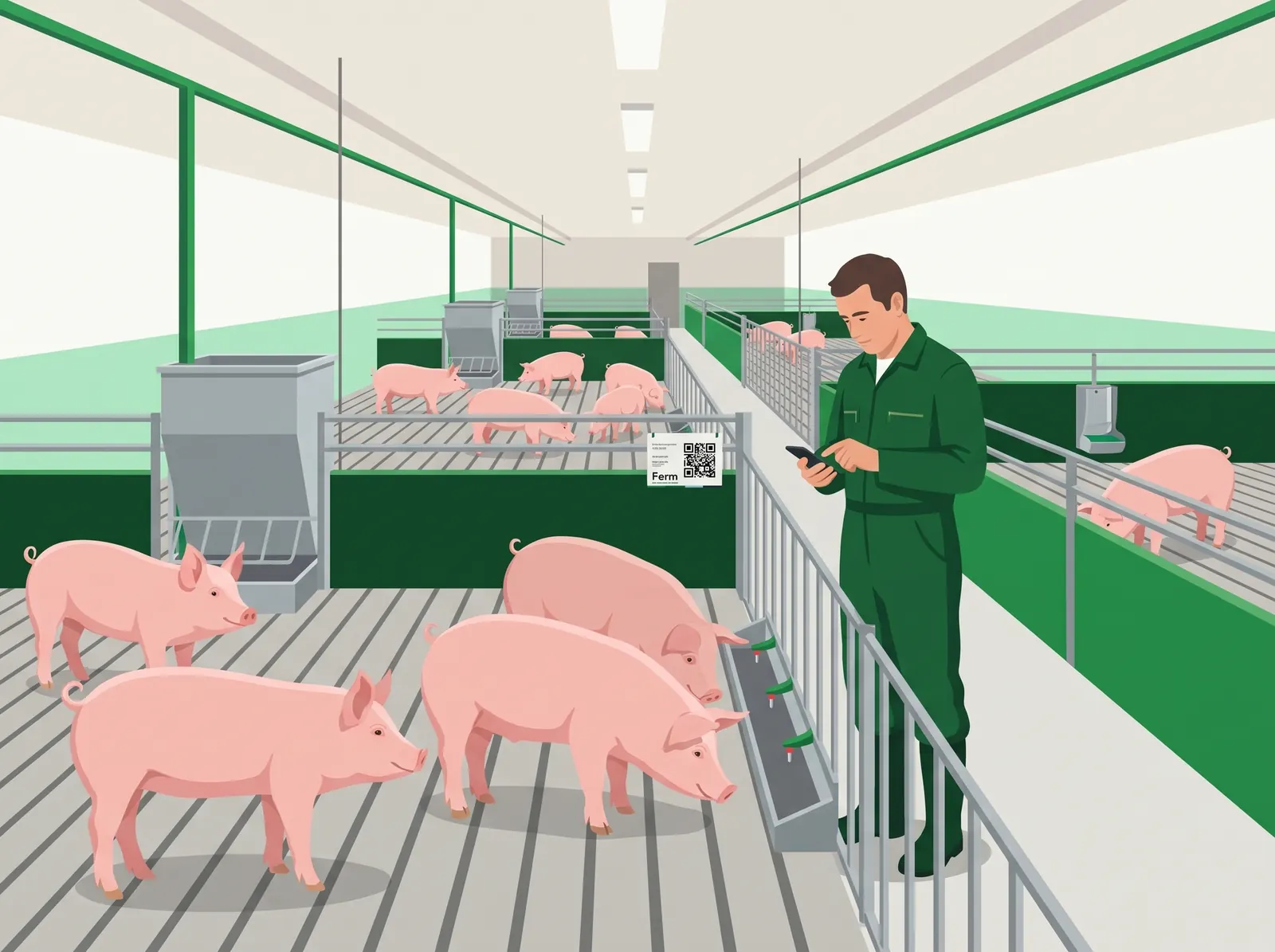
The most common pig breeds in Poland are WBP (wielka biała polska, the Polish Large White) and PBZ (polska biała zwisłoucha, the Polish White Lop-eared). Both are maternal breeds: the sows supply the piglets that go to fattening. Farmers use the sire breeds Duroc, Pietrain and Hampshire in crossbreeding to improve growth rate and leanness in the offspring. The third native breed in the evaluation is the puławska. According to IZ PIB, in March 2026 the breeding evaluation database held 164,335 sow results for all breeds and lines, including 80,708 results for PBZ and 52,475 for WBP. Read more about WBP and PBZ and the Landrace breeds on separate pages.
What these groups mean in practice
Maternal breeds are judged mainly on reproductive performance: piglets born and piglets raised. Sire breeds are judged on daily gain and leanness. In a presentation by KPODR (the Kujawsko-Pomorski Agricultural Advisory Center) and IZ PIB, native breeds are described as bred less intensively, with long-lived sows and heavier, more vigorous piglets. So the differences are about function, not just looks. Before you choose a breed for your herd, write down your goals: number of piglets, fattening speed and how you sell.
WBP and PBZ: the base of the maternal herd
Goals for maternal breeds
According to IZ PIB, the breeding programs for WBP and PBZ in force since November 2018 set a daily gain of 680 g for gilts and 750 g for boars. Leanness goals are 58% for gilts and 60% for boars. The reproduction goal is 14 piglets born per litter and 13 raised to day 21. Live evaluation relies on models from 2008, so compare your results with these goals with care.
Selection for piglets raised
In evaluating maternal breeds, the most weight goes to the number of piglets raised to day 21. This trait correlates more strongly with the sow's economic fertility and carries a smaller evaluation error. Improvement in carcass traits is slower, because carcass leanness in these breeds has already reached a high level. You can compare the growth rate of piglets and finishing pigs in the FCR and EPEF online module.
Duroc, Pietrain and Hampshire in crossbreeding
Goals for sire breeds
For sire breeds the program uses different proportions: 70% of the weight goes to fattening and carcass traits and 30% to reproductive traits. The goals are 750 g daily gain for Duroc and Hampshire gilts, 700 g for Pietrain gilts, 800 g for Duroc and Hampshire boars and 750 g for Pietrain boars. These goals come from the IZ PIB breeding programs in force since November 2018. When you buy a boar, ask the breeder for the live evaluation results of that individual animal, not only for the breed.
Scale of the 2025 evaluation
According to IZ PIB, testing stations evaluated 240 matings in 2025: 98 for PBZ, 45 for line 990, 44 for puławska, 29 for Pietrain, 21 for Duroc and 2 for Hampshire. The numbers are small, especially for Hampshire, so be careful about drawing general conclusions. The breeding evaluation database from March 2026 gives a wider picture: 7,953 Duroc sow results, 4,142 for Pietrain and 637 for Hampshire. You can collect data from your own farm in the app for pig farmers.
How to read BLUP evaluation results
Periods and publication thresholds
IZ PIB publishes BLUP evaluation results for two half-year periods: October to March and April to September. The latest publication covers measurements from 1 October 2025 to 31 March 2026. The publication includes results for all evaluated boars, plus selected young boars and gilts that reached a minimum overall BLUP breeding value (BLUP_ZWH) of 12.00 for WBP and PBZ and 10.50 for the other breeds and lines.
What this means when you buy
A breeding value rates an animal against the population. It does not guarantee a result on your farm. When you buy a boar or gilt, compare its result with the threshold, check that the evaluation covers the right period and ask about its pedigree. Keep pedigree and result records in your herd register so you have them at hand for the next choice. You can manage settlements and purchase plans in the farm management software.
Native breeds in practice: piglets, fat, longevity
KPODR and IZ PIB materials present native breeds as bred less intensively. Their sows are long-lived, and the piglets are heavier and more vigorous. The comparisons of age at first farrowing and farrowing interval use IZ PIB data from the 2019 reproductive performance evaluation. The presentation also reports better intramuscular fat deposition in native breeds than in modern ones. This data is older than the 2025 results, so treat it as a picture of the traits, not of the current level.
Fat and quality schemes
Better intramuscular fat deposition gives the loin a marbled look, and according to the presentation native breeds also have firm, white backfat. These traits matter when you sell meat under a quality label. A leaflet from PODR Szepietowo (a regional agricultural advisory center) describes Poland's national food quality schemes for pigs. Check the rules of a given scheme with its organizer. The breed alone does not give you a certificate.
Protecting the herd when you change breeds
Buying animals
Every new animal in the herd, whether a boar, a sow or a young boar, can bring in disease. When you buy, ask for health documents, isolate new animals and limit contact with outsiders. You can build a biosecurity plan in the biosecurity plan generator. Keep treatment records and withdrawal periods in the treatment and withdrawal records. A vet always chooses the medicine and the dose.
African swine fever
The rules on controlling ASF (African swine fever) are set by the regulation of the Ministry of Agriculture and Rural Development (MRiRW) of 12.03.2026 on measures to control African swine fever (Dz.U. 2026 poz. 344, Poland's Journal of Laws), legal state as of 22.11.2026. Before you move animals, check the current text in ISAP (Poland's online database of legal acts). Ask your vet or the county veterinary officer (powiatowy lekarz weterynarii) about the requirements in your region. Read the EFSA analysis of ASF in the EU in 2025 before you buy animals from other regions.
Frequently asked questions
What pig breeds are kept in Poland?add
The most common are the native breeds WBP and PBZ and the puławska. In commercial crossbreeding, farmers use the sire breeds Duroc, Pietrain and Hampshire. IZ PIB data from March 2026 shows the number of breeding evaluation results for each of them.
What is the difference between a maternal and a sire breed?add
Maternal breeds WBP and PBZ are judged mainly on reproductive performance: piglets born and piglets raised to day 21. Sire breeds are judged mainly on daily gain and leanness. Their trait weights are 70% for fattening and carcass traits and 30% for reproductive traits.
What daily gain is the goal for gilts of maternal breeds?add
IZ PIB programs in force since November 2018 set 680 g daily gain for WBP and PBZ gilts and 750 g for boars of these breeds. For Duroc and Hampshire gilts the goal is 750 g, and for Pietrain gilts 700 g. These are breeding goals, not a guaranteed result on every farm.
What does the BLUP_ZWH breeding value mean?add
It is an overall rating of an animal, calculated with the BLUP method from live measurements. IZ PIB publishes results for animals that passed the threshold of 12.00 for WBP and PBZ and 10.50 for the other breeds and lines. A higher value means a better rating against the population.
Does raising native pig breeds pay?add
It depends on feed cost, fattening speed and how you sell. ODR Lubań, a regional agricultural advisory center, gives a sample income calculation for pork production in a PODR publication. Rework it with your own costs, because purchase and feed prices change over time.
Where can I check current pig evaluation results?add
IZ PIB publishes BLUP and performance evaluation results, among others on trzoda.izoo.krakow.pl. You can check the legal acts in ISAP and veterinary notices on gov.pl/web/wetgiw.
Sources & resources
- linkIZ PIB (National Animal Breeding Center / trzoda.izoo.krakow.pl): State of breeding and pig evaluation results in 2025
- linkIZ PIB: BLUP breeding evaluation results, reproductive performance, 2026 issue 1
- linkIZ PIB: BLUP breeding evaluation results, fattening and carcass traits, 2026 issue 1
- linkIZ PIB: Livestock keeping and breeding over 70 years. Pig Breeding Department, Horse Breeding Department
- linkKPODR / IZ PIB: Advantages of breeding native pig breeds and the RASY RODZIME label (presentation, M. Szyndler-Nędza, P. Radomski)
- linkMRiRW / Journal of Laws: Regulation of the Minister of Agriculture of 12.03.2026 on measures to control African swine fever (Dz.U. 2026 poz. 344)
Prepared by: DlaFerm Team based on data from the sources listed · Publisher: INSTA-TECH sp. z o.o.
Do you run a maternal or a sire herd?
The DlaFerm app for pig farmers keeps the work of your breeding herd in one place. Create a free farm account or get in touch, and we will show you how it works in practice.
Phone
+48 796 258 151