Iberian pigs: breed, farming and meat
Iberian pigs come from the Iberian Peninsula. They are raised traditionally in Spain and Portugal and valued for marbled meat and dry-cured products. They are rare in Poland, so keeping them takes a solid feeding plan, a good outdoor run and proper records. We explain where they come from, how to keep them and what to watch for on biosecurity.
verifiedFrom the team that has organised work on poultry farms for years.
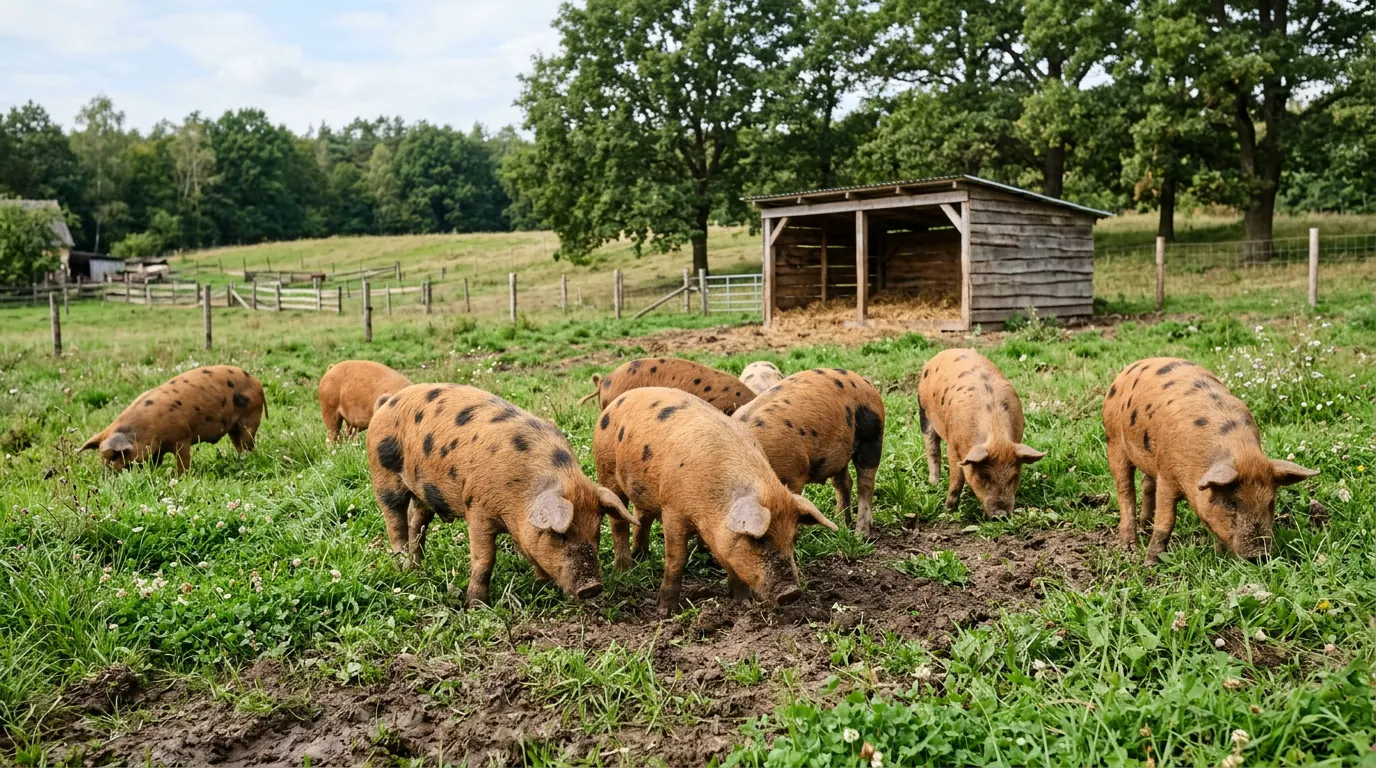
Iberian pigs are a group of breeds and lines from the Iberian Peninsula, meaning Spain and Portugal. They have dark skin, grow more slowly than commercial breeds and carry fat inside the muscle, which gives marbled meat. Most of it is made into dry-cured products. A farmer in Poland has to take care of feeding, an outdoor run and records, and of the biosecurity rules that apply to every pig.
Who this guide is for
This guide is for farmers who are considering Iberian pigs as a separate line or as an add-on to fattening. Our sources contain no figures that apply only to this breed, so we give no prices or fattening parameters. We show how to set your own benchmarks, how to work out profitability and which rules to check before you start.
Where Iberian pigs come from
Dehesa and traditional rearing
Iberian breeds developed in Spain and Portugal. They were traditionally kept in the dehesa system: open, wooded land where the animals grazed grass and gathered acorns. This way of rearing shaped the fat composition of the meat. In practice Iberian pigs handle free movement well, but they need a different feeding plan from high-yield breeds. For comparison, our article on the Puławska pig describes a native Polish breed.
Their place in Poland
Iberian pigs are not a native Polish breed. According to a publication of the Instytut Zootechniki PIB (National Research Institute of Animal Production), the native pig breeds in Poland are the Puławska, the Złotnicka Spotted and the Złotnicka White. So an Iberian breeder has no local breeding tradition to lean on. Start by checking the origin of the breeding stock and the documents that come with it, before you build a production plan.
Looks and character of Iberian pigs
Color and build
The most recognizable trait is the dark coat and dark skin, and in many animals dark hooves too. The pigs are usually shorter and more compact than commercial breeds. Their build favors fat inside the muscle rather than fast weight gain. Start your assessment with general condition, an even gait and healthy hooves. You can judge these easily in the run, without special equipment.
Growth rate
Iberian pigs grow more slowly than fatteners from commercial farms. A longer fattening period is not a flaw if your plan is to sell a premium product. According to literature data collected by KPODR (a regional agricultural advisory center), Puławska fatteners reach daily gains of 400–590 g and a meat content of 48.70–56.45%. Our sources have no figures for the Iberian breed, so base your fattening plan on your own records in FCR and EPEF indicators.
How to feed and keep Iberian pigs
Acorns and feed
In traditional rearing, Iberian pigs use acorns and dehesa grasses in the final fattening period. This stage is called montanera. On a Polish farm, acorns are usually a supplement to the diet. In excess they can do harm, so agree the amount with your vet or a feeding adviser. Change feed gradually, because a sudden change in composition easily upsets digestion. Store acorns and feed in a dry place, because damp feed quickly goes moldy.
Outdoor run and welfare
Iberian pigs need space, movement and shade. The fence must be tight and tall, because the animals root hard in the soil. The Instytut Zootechniki PIB describes pig welfare in a publication on sustainable production, and a guide to organic pig rearing covers outdoor keeping. In practice this means access to bedding, fresh water and a place to rest. Huddled pigs, pacing along the fence and loss of appetite are signs to call a vet quickly. You can read more about pig behavior in our article on pig facts.
Meat and cured products from the Iberian breed
Marbling and fat
The most prized feature of Iberian meat is the fat inside the muscle, known as marbling. The fat of these breeds contains a lot of oleic acid, which affects the flavor and texture of dry-cured products. Fat composition also depends on feeding and fattening time, so the final quality is set by the diet, not by the breed alone. For direct sales, keep your feeding records and origin documents, because they make talks with the buyer and the processor easier.
Quality measured by pH
In its materials on a pork quality system, KPODR describes pH measured in the longissimus muscle (the loin muscle) as an indicator of meat quality. For Puławska pigs it gives pH45 of about 6.20 and pH24 of about 5.60. These figures are for another breed, but the measuring method is the same. If you sell meat to a processor, ask whether they measure pH and how they record the result. The measurement shows how the process went after slaughter, not just the traits of the breed.
Biosecurity and rules you cannot skip
Biosecurity requirements
Biosecurity rules for farms keeping pigs come from Annex II to Implementing Regulation (EU) 2021/605 of 7 April 2021. Guidelines of the Chief Veterinary Inspectorate (GIW), prepared by the county veterinary inspectorate in Wągrowiec (PIW Wągrowiec), describe how to put them into practice. They apply to farms in restricted zones and to farms from which pigs, biological material or fresh meat leave those zones. Write down your biosecurity plan and keep it on the farm. The biosecurity plan generator can help.
Rules for 2026
The legal state as of 22.11.2026 includes the regulation of the Ministry of Agriculture and Rural Development (MRiRW) of 12.03.2026 on measures to control African swine fever (Dz.U. 2026 poz. 344, Poland's Journal of Laws). Check the current text in ISAP (Poland's online database of legal acts) and agree the requirements for your county with the county veterinary officer. Medicines and doses are chosen by a vet. Record every treatment and its withdrawal period in the treatment and withdrawal records, so you have complete data at an inspection.
Profitability and comparison with other breeds
What drives the result
Profitability depends on the price of the piglet, the cost of feed, the length of fattening and the selling price. With a premium breed, finding a buyer also counts. Prices change regularly, so we give no fixed amounts. Check current rates with your buyer or processor. ODR Lubań (an agricultural advisory center) published an example calculation of income from pork, with a bought-in piglet and different intensity levels. You can use the same method and enter data from your own fattening.
Other breeds with a similar profile
Farmers often compare Iberian pigs with breeds that grow more slowly and give high-quality meat. With the Mangalica and the Puławska pig, the differences are mainly in meat and fat composition, not only in body weight. Vietnamese pigs, described in a separate article, have a different growth profile. Put the traits side by side in one table and check which profile suits the market where you sell.
Frequently asked questions
What are Iberian pigs?add
They are a group of breeds and lines from the Iberian Peninsula, raised traditionally in Spain and Portugal. They have dark skin, slower growth and marbled fat in the meat. Their meat mostly goes into dry-cured products.
Are Iberian pigs a native breed in Poland?add
No. The native pig breeds in Poland are the Puławska, the Złotnicka Spotted and the Złotnicka White. Check the origin and documents of Iberian breeding stock before you buy it.
What do Iberian pigs eat?add
In traditional rearing they eat acorns and grasses in the final fattening period. On a farm, acorns are usually a supplement, and you should agree the amount with a specialist, because too much can do harm. Change the diet gradually.
How much does Iberian pork cost?add
The price depends on the cut, the way it is processed and whether you sell fresh meat or dry-cured products. We give no amounts because they change. Check current rates with your processor or buyer.
What rules apply to pig farming in Poland in 2026?add
Biosecurity rules apply, along with the MRiRW regulation of 12.03.2026 on measures to control African swine fever (Dz.U. 2026 poz. 344). Check the legal state as of 22.11.2026 in ISAP. Agree the details for your county with the county veterinary officer.
Can you keep Iberian pigs for your own use?add
The rules for keeping pigs for your own use differ from those for a commercial farm. Always confirm the requirements with a vet before you buy.
Sources & resources
- linkPIW Wągrowiec (GIW guidelines) — Guidelines on the practical implementation of biosecurity requirements on farms keeping pigs (Annex II to Regulation 2021/605)
- linkKPODR Minikowo (PROW 16 Cooperation) — A quality system as a guarantee of good pork
- linkIZ PIB — Pig welfare in a sustainable animal production system (eds. A. Rekiel, G. Żak)
- linkIZ PIB — Guide to organic pig rearing (ed. E.R. Grela)
- linkMRiRW / Journal of Laws — Regulation of the Minister of Agriculture of 12.03.2026 on measures to control African swine fever (Dz.U. 2026 poz. 344)
- linkODR Lubań (PODR publication) — Example calculation of farm income from pork production (bought-in piglet, different intensity levels)
Prepared by: DlaFerm Team based on data from the sources listed · Publisher: INSTA-TECH sp. z o.o.
Do you keep pigs and want to get your herd records in order?
The pig farmer app in DlaFerm.pl helps you keep herd records in one place. Create a free farm account and see whether the system fits your production.
Phone
+48 796 258 151