Vietnamese pigs: raising, growth rate and meat
Vietnamese pigs are small, slow-growing breeds. They usually give less lean meat than the high-lean hybrids of large farms, but the meat carries more fat. We give no daily gain figures for this breed, because there are no reliable data. We show you how to measure growth in your own fattening.
verifiedFrom the team that has organised work on poultry farms for years.
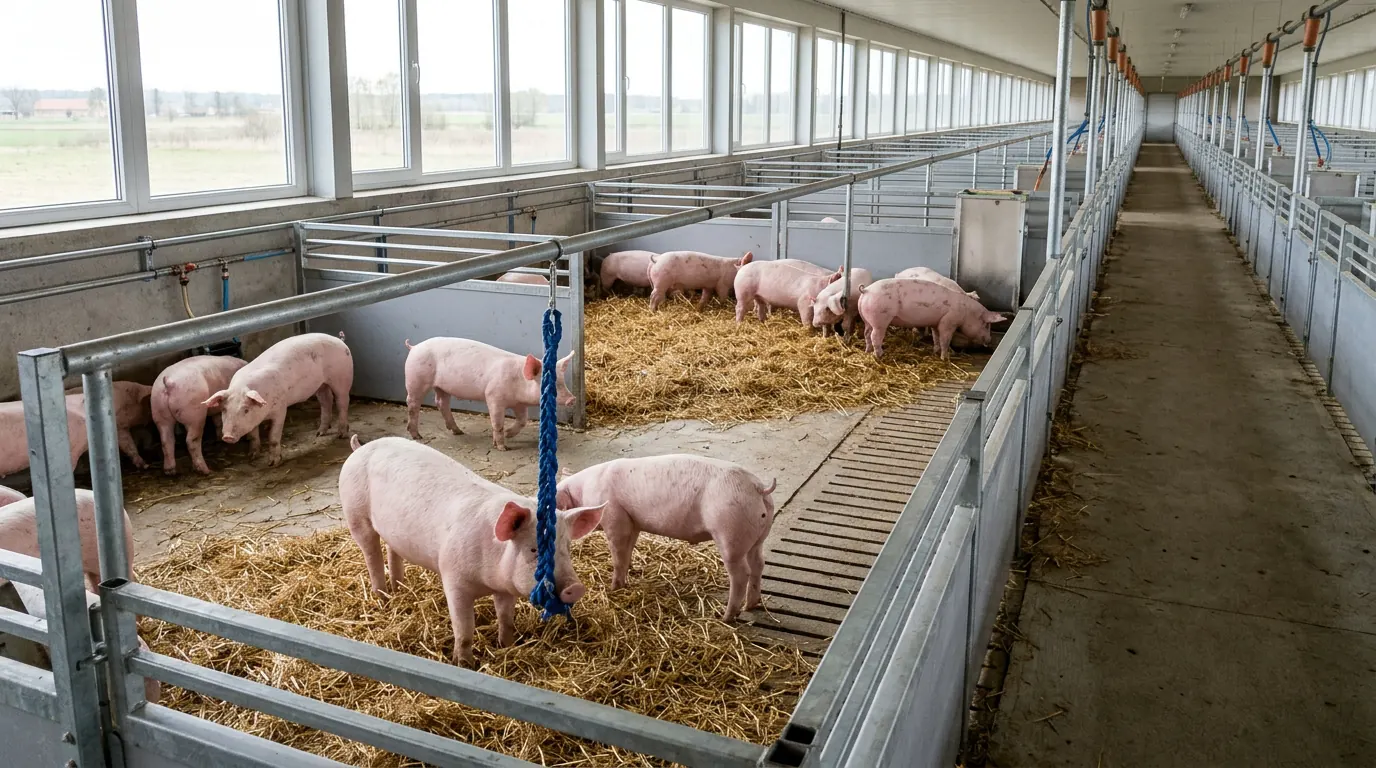
Vietnamese pigs are small, slow-growing breeds. In fattening they give less lean meat than the high-lean hybrids used on large farms. We give no daily gain figures for this breed, because there are no reliable data on Vietnamese pigs. The numbers below come from native Polish breeds. Use them as a point of reference, not as a promised result.
Your goal sets the breed
According to the Institute of Animal Science (IZ PIB), organic farms often keep slow-growing native breeds, while large-scale farms are dominated by fast-growing, high-lean hybrids. Before you choose a breed, define your goal: selling live animals, meat of a set quality, direct sales or a branded product. The goal decides the pace of fattening, the feeding method and whether a slower gain pays off. A Vietnamese breed works where customers pay for flavor and fat, not for weight per day. If you are comparing slow-growing breeds, see also the Złotnicka pig and the Puławska pig.
Raising Vietnamese pigs: where to start
Piglet origin and health
Buy piglets only from a breeder who can show health documents and the health status of the herd. Ask your vet to assess the herd before you bring animals home. When you buy breeding sows and boars, check the live performance results that IZ PIB describes for gilts and boars. Do not buy from an unknown source just because it is cheaper. A disease bought with the piglet costs far more than the price difference.
Native breeds as a reference
Native breeds show what the fattening parameters of slow-growing pigs look like. According to a study by KPODR Minikowo (a regional agricultural advisory center), Puławska fattening pigs reach daily gains of 400–590 g. They are kept mainly on organic farms up to a body weight of 125–130 kg. We use this breed only as an example, not as a model for Vietnamese pigs. When you plan your own fattening, compare results with your own data, not with other people's tables.
How fast do Vietnamese pigs grow
Why we give no number
There are no reliable gain figures for Vietnamese pigs. If we copied a figure from a random forum, we would mislead you when you plan fattening. The surest reference is data from a breeder who keeps this breed, plus the results of your own herd from the first cycle. Establish them before you sell, and do not build your budget on estimates.
How to measure growth in your own fattening
Record the weight at placement and at regular intervals, not only before sale. This shows whether the animals grow as planned and lets you react faster when appetite drops. Also compare feed use per kilogram of gain. FCR and EPEF indicators show whether fattening is economical, not just good-looking on the scale. Keep your herd records in the app for pig farmers so the data does not sit in notebooks.
Feeding in practice
Hybrid producers such as PIC or Topigs Norsvin publish feeding manuals. They are written for their own genotypes, so do not apply their advice directly to Vietnamese pigs. Set the feeding plan with an adviser and check it against changes in animal weight. Always change feed gradually during fattening, because a sudden switch cuts appetite and lengthens the cycle.
Vietnamese pig meat and its quality
Fat and carcass yield
Vietnamese pigs usually give less lean meat than modern hybrids. According to KPODR Minikowo, Puławska fattening pigs have a lean meat content of 48.70–56.45%. For the Vietnamese breed we have no comparable figure from a reliable source, so when you sell for slaughter, ask for the slaughter result of the specific batch. Carcass yield is not the only value: in direct sales, customers often buy a particular flavor and fat.
Meat quality and pH
The pH values measured in the longissimus dorsi muscle (the loin muscle) tell you about meat quality. For the Puławska breed, KPODR gives pH45 of about 6.20 and pH24 of about 5.60. The first measurement is taken about 45 minutes after slaughter, the second after 24 hours. A pH that falls too fast while the carcass is still hot worsens color and water-holding capacity. This applies to every breed, so learn it before you sell meat as a special product.
Selling as a quality product
Native breeds often enter quality schemes, which KPODR and PODR Szepietowo describe in a leaflet on national food quality schemes for pork. Before you join one, check the rules on feed origin, the age of slaughtered animals and the paperwork. Only then do you know whether a brand makes sense at your scale and in your sales channel. For comparison with premium breeds, see Berkshire pigs and Mangalica pigs.
Welfare, biosecurity and treatment
Pig welfare
According to EFSA, pig welfare on a farm depends on housing, feeding, stocking density and the chance to show natural behavior, such as rooting or lying together. Slow-growing pigs often stay longer in fattening, so bedding quality and ventilation matter more than in a short cycle. Watch the herd's behavior every day. Changes in appetite and movement are the first sign of trouble.
Biosecurity and zones
The Ministry of Agriculture (MRiRW) regulation of 12.03.2026 on measures to control African swine fever (Dz.U. 2026 poz. 344, Poland's Journal of Laws) sets the rules for farms in restricted zones. Legal state as of 22.11.2026. The guidelines of the Chief Veterinary Inspectorate, prepared by the district veterinary office in Wągrowiec (PIW Wągrowiec), show how to apply these requirements in practice, especially when pigs or meat leave the zone. Before moving animals, check the current status of your county with the veterinary inspectorate. You can build your biosecurity plan in the biosecurity plan generator.
Medicines and withdrawal period
A vet always chooses the medicine and dose. You keep a record of each treatment and observe the withdrawal period. The withdrawal period is the time from the last dose of a medicine until the animal may go to slaughter. Record every treatment with its date and batch number, because without it you cannot show the meat is clean during an inspection. Keep treatment and withdrawal records in the DlaFerm module so you do not hunt for dates in notes.
Does fattening Vietnamese pigs pay
What goes into the calculation
A sample calculation of income from pig production by ODR Lubań (an agricultural advisory center) shows that the cost of a bought piglet and the intensity of fattening change the result a lot. For Vietnamese pigs, include a longer fattening time, the cost of keeping animals for more days and a lower carcass yield. Slower fattening has to earn on quality or price, or it will not turn a profit. You can work out a simple model with the tools for farmers. If you plan a bigger herd, see also the rules on keeping pigs for your own use.
Prices and where to check them
Live animal and meat prices change often, so we give none in the text. They depend on the market, weight, carcass class and whether you sell through a slaughterhouse or directly. You can find current market information from the Ministry of Agriculture and Rural Development, and animal market data from ARiMR (Poland's Agency for Restructuring and Modernisation of Agriculture). Compare quotes over several weeks, not from a single day.
Frequently asked questions
How fast do Vietnamese pigs grow?add
We give no daily gains for Vietnamese pigs, because our sources hold no reliable data for this breed. Growth rate depends on genetics, feeding and housing. Establish it from your own fattening and from data from a breeder who keeps this breed.
How much do Vietnamese pigs weigh at the end of fattening?add
Final weight depends on the breed, the goal of fattening and the feeding plan. For the Puławska breed, kept mainly on organic farms, KPODR gives a body weight of 125–130 kg. For Vietnamese pigs, ask about the weight at the slaughterhouse and record the results of each batch.
Does Vietnamese pig meat taste better?add
Meat from the Vietnamese breed is sometimes valued for flavor and fat, but we have no reliable comparative data to back this with numbers. Meat quality depends on pH, feeding and post-slaughter handling. Test it on samples from your own sales.
Can I keep Vietnamese pigs in a backyard pigsty?add
Yes, but you must meet the requirements for housing and biosecurity. Check the registration duties with ARiMR and the district veterinarian. If your farm lies in a restricted zone, extra rules apply.
Who decides on treatment of Vietnamese pigs?add
A vet always chooses the medicine and dose. You keep a record of treatments and observe the withdrawal period before slaughter. Missing records make inspections harder and can stop the sale of a batch.
Sources & resources
- linkPIW Wągrowiec (GIW guidelines) — Guidelines on practical implementation of biosecurity requirements on farms keeping pigs (Annex II to Regulation 2021/605)
- linkIZ PIB — Guide to organic pig farming (ed. E.R. Grela)
- linkKPODR Minikowo (RDP 16 Cooperation) — A quality scheme as a guarantee of good pork
- linkIZ PIB — Livestock keeping and breeding over 70 years. Pig Breeding Department, Horse Breeding Department
- linkMRiRW / Journal of Laws — MRiRW regulation of 12.03.2026 on measures to control African swine fever (Dz.U. 2026 poz. 344)
- linkODR Lubań (PODR publication) — Sample calculation of farm income from pig production (bought-in piglet, different intensity levels)
Prepared by: DlaFerm Team based on data from the sources listed · Publisher: INSTA-TECH sp. z o.o.
Do you fatten pigs in a few pens or over several rotations?
The DlaFerm module for pig farmers helps you keep herd, treatment and performance records in one place. Create a free farm account or get in touch, and we will show you how it works for fattening.
Phone
+48 796 258 151