Domestic pig: how much it weighs, lives and eats
How much a domestic pig weighs, how long it lives and how much it eats depends on the purpose of production, age and feeding, not on one fixed number. We describe what decides weight, time in the herd and feed intake, and where to check current data. We give only figures that come from IZ PIB and PIC publications.
verifiedFrom the team that has organised work on poultry farms for years.
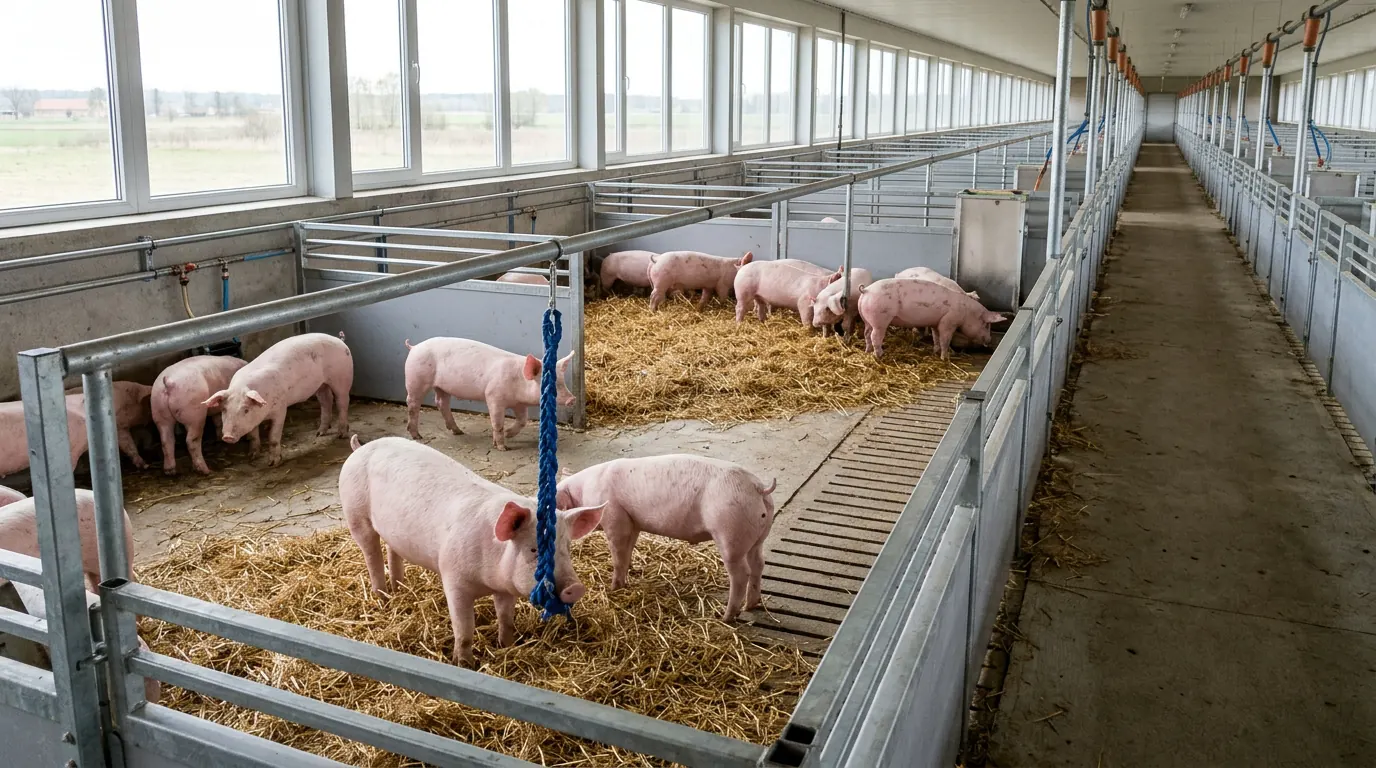
A domestic pig weighs what its category, breed, sex and age dictate. A breeding sow, a boar, a weaned piglet and a finisher sold for slaughter all weigh differently. The publications we rely on give no single figure for the weight of a domestic pig, so we do not print one here. Questions about lifespan and feed intake depend on the same split: is the pig being fattened, or does it stay in the breeding herd? Below we separate these questions and show where to get data for your own herd.
Why one number is not enough
A farmer usually asks for one value, but a farm needs several. Weaning weight, finisher sale weight and sow weight are three different measurements. Each applies to a different group of animals and a different feeding program. When you compare results, check that you mean the same category. Keep data by group, not as one average for the whole herd. Records and production indicator modules help with this, and the feeding rules are covered further down.
How much a domestic pig weighs
Weight depends on the purpose of production
Domestic pigs are kept in three main categories: breeding sows and boars, piglets reared for fattening, and finishers sold for slaughter. Each category has its own weight and its own role in the cycle. Breeding evaluation run by IZ PIB (Poland's National Research Institute of Animal Production) rests on measurements of fattening and carcass traits and of reproductive performance, not on one reference weight. Breed, crossbreeds and feeding also make a difference. So the question about pig weight needs narrowing down: which pig, at what age, in which production system.
Where to check current data
The most reliable figures come from breeding evaluation and slaughter evaluation results. IZ PIB publishes results of pig performance testing and BLUP summaries for fattening and carcass traits, for example for 2026. For your own herd, what counts is the weight recorded for the group at set weighings. An IZ PIB monograph on animal husbandry and breeding describes the carcass dissection method, with weighing of half-carcasses, loin and hams. That lets you compare your farm with results measured the same way. Record weights in the app for pig farmers and calculate indicators in the FCR and EPEF online module.
How long a domestic pig lives
Finishers and breeding animals
A finisher usually goes to slaughter before it reaches adulthood. So the question of how long a pig lives on a farm mostly concerns sows and boars, which stay in the herd for several cycles. Live evaluation of breeding gilts and boars, run by IZ PIB, describes the traits used to choose animals for further breeding. Time in use depends on fertility, litters, leg health and herd assessment. We give no number of years, because there is no reliable figure.
Welfare and survival
A 2026 IZ PIB monograph on pig welfare reminds us that stress, distress and pain affect an animal's immune and hormonal systems. This shows up in herd results and in deaths. The domestic pig has high cognitive abilities and specific behavioral needs, so how you assess housing conditions directly affects the herd. Record deaths and their causes, so that after a quarter you can see a trend. A vet always chooses the medicine and dose, and in your records you note the dates of administration and the withdrawal period. The treatment and withdrawal module helps with this.
How much a domestic pig eats
Intake by stage
Daily feed intake rises with weight and changes through the cycle. PIC guidelines stress that weaned piglets depend heavily on energy intake. Higher feed intake in the first week after weaning increases the flow of digesta through the gut, limits bacterial growth in the digestive tract and reduces the frequency of diarrhea. Amounts per head are set by the feeding plan for a given mix and weight group, so we give no ration tables here. Record feed use so you can calculate real intake per head.
Feed mix composition in practice
The IZ PIB guide to organic pig production lists feed mix compositions per 1000 g. Dry matter in the listed variants ranges from 872.1 to 882.3 g per kilogram, metabolizable energy from 12.08 to 12.93 MJ, and crude protein from 129.2 to 164.6 g. The differences come from the choice of grains, bran, oilcakes and meal. Do not carry these values straight over to your farm, because they depend on the ingredients. Enter the values from your feed analysis in your records and compare them with the plan. When setting the cycle, also consider batch planning, because a group's needs grow with its weight.
Weaning age and fattening results
Effect of weaning age
Weaning age affects weaning weight, later growth, survival and immunity. A 2020 study by Faccin et al., cited in PIC guidelines, compared weaning at 18.5, 21.5 and 24.5 days. Each extra day of lactation gave an additional 0.70 kg per pig sold. The result comes from a commercial system and does not carry over automatically to every farm. You decide weaning age with your vet, taking pen space into account. Record litter data in the app for pig farmers.
Rearing piglets
Keep weaned piglets in pens with access to water and feed, and change feed gradually. The Polish agricultural advisory center KPODR describes the basic rearing rules in its booklet "ABC in rearing piglets", so read it before you change your feeding method. Results change fastest at this stage, so observe daily and note weight and feed intake in your records. Records from several litters will show whether the change helped.
Documents and rules in pig keeping
African swine fever
The Regulation of Poland's Minister of Agriculture and Rural Development (MRiRW) of 12.03.2026 on measures to control African swine fever (Dz.U. 2026 poz. 344, Poland's Journal of Laws), legal status as of 22.11.2026, sets out measures you must follow. We describe them only in general terms, because the details depend on the zone and on decisions of the county veterinary officer. Check the current text in ISAP (Poland's online legal acts database) and confirm the rules in your county with the county Veterinary Inspection (Inspekcja Weterynaryjna). A biosecurity plan helps you organize entry, transport and clothing, and the biosecurity plan generator walks you through each point.
Identification and records
You report herd numbers in IRZplus, ARiMR's online animal register (ARiMR is Poland's Agency for Restructuring and Modernisation of Agriculture), and your farm records must match the number of animals in the pig house. Keep shipping and purchase documents with the herd, because compliance checks rely on them. The integrations with IRZplus and sensors module helps move data without retyping. If you have doubts about animal numbers or a report, contact the county veterinary officer before you decide.
Frequently asked questions
How much does a domestic pig weigh?add
Weight depends on category: sows, boars, piglets and finishers differ a lot. We give no single figure, because there is no general weight value for a domestic pig. You can find data for a specific group in IZ PIB evaluation results and in your own herd records.
How long does a domestic pig live?add
On a farm, lifespan depends on whether the pig is fattened or stays in the breeding herd. Finishers go to slaughter earlier, while sows and boars stay longer if they remain healthy and fertile. We give no number of years, because there is no reliable figure.
How much does a pig eat per day?add
Daily intake rises with weight and changes through the production cycle. Amounts per head are set by the feeding plan for a given mix, because compositions differ by ingredient. Record intake in your feed records so you can calculate real use.
How much does a piglet eat after weaning?add
The first week after weaning is the most demanding, because piglets depend heavily on energy from feed. PIC guidelines say higher feed intake at this time limits diarrhea. Change feed gradually and discuss the plan with your vet.
Do pig feed mixes differ in composition?add
Yes. In the IZ PIB listing, dry matter, energy and protein differ between variants, because grains, bran and oilcakes are used in different shares. When buying feed, compare analysis results, not just the name of the mix.
Where can I check current ASF rules in Poland?add
The basis is the MRiRW Regulation of 12.03.2026 (Dz.U. 2026 poz. 344), legal status as of 22.11.2026. You can find the current text in ISAP, and the county veterinary officer gives the rules for your county. Do not base decisions on old versions of the rules.
Sources & resources
- linkIZ PIB — Organic pig production guide (ed. E.R. Grela)
- linkIZ PIB — Pig welfare in a sustainable animal production system (ed. A. Rekiel, G. Żak)
- linkIZ PIB — BLUP breeding evaluation results: fattening and carcass traits, 2026 issue 1
- linkPIC — PIC Wean to Finish Guidelines
- linkMRiRW / Journal of Laws — Regulation of the Minister of Agriculture of 12.03.2026 on measures to control African swine fever (Dz.U. 2026 poz. 344)
- linkInternet System of Legal Acts (ISAP) — isap.sejm.gov.pl
Prepared by: DlaFerm Team based on data from the sources listed · Publisher: INSTA-TECH sp. z o.o.
Do you keep finishers or sows?
The DlaFerm module for pig farmers keeps weights, groups and withdrawal periods in one place. Create a free farm account or get in touch, and we will show you how to enter your own herd.
Phone
+48 796 258 151