Dairy Cow Farming: How to Start and Whether It Pays
You start dairy farming with feed, a building and a buyer for your milk, and only then buy animals. We show what drives the price of a cow, how to work out profit and what decides the result in the first years.
verifiedFrom the team that has organised work on poultry farms for years.
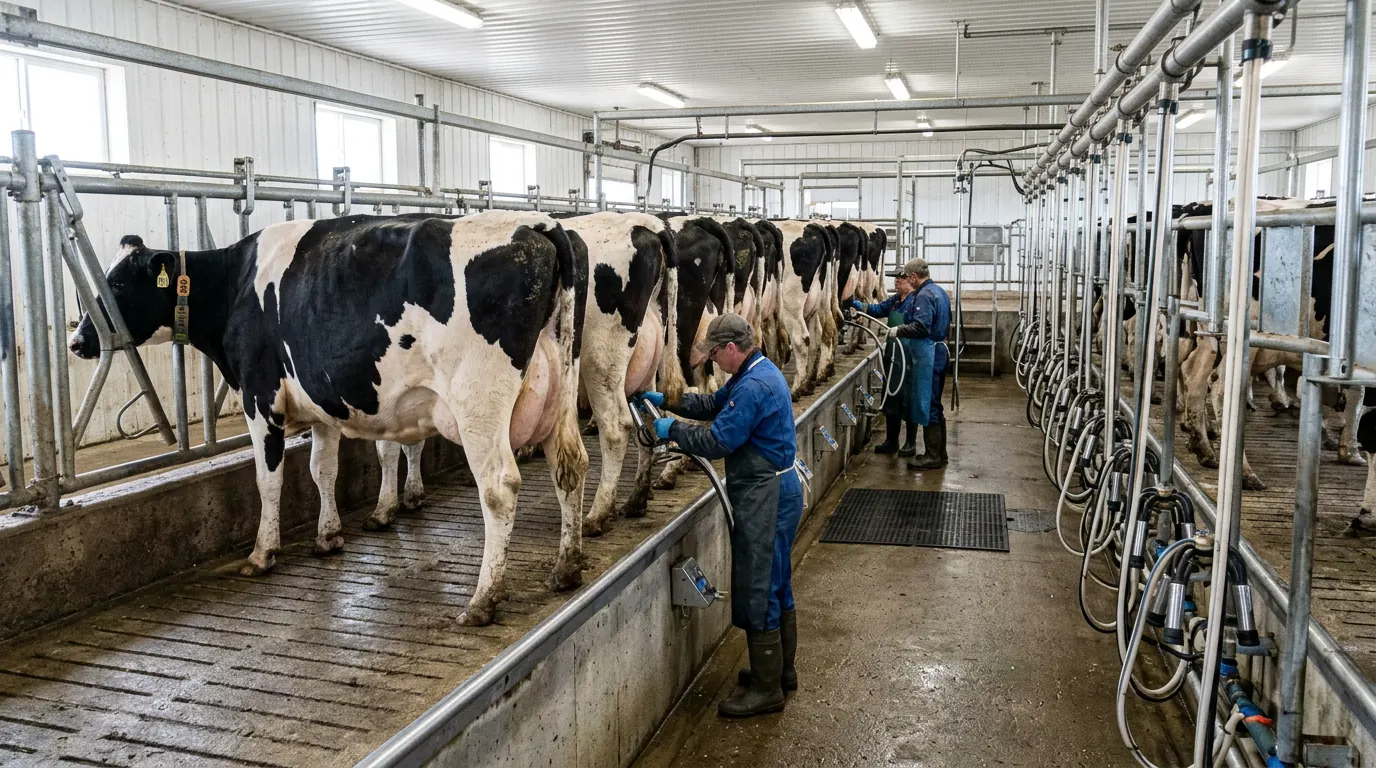
You start dairy farming with three things: a steady supply of forage (corn silage, grass silage), a building where you can milk, and a buyer for the milk. Only then do you buy animals. It pays when cow yield, feed cost and the milk price at your dairy leave a positive margin after labor, vet and insemination costs. Anyone who looks only at the milk price is usually wrong.
How much a dairy cow costs
The price of a dairy cow depends on breed, age, yield in the last lactation, stage of pregnancy and pedigree papers. A pregnant heifer is priced differently from a cow in full lactation. Amounts change from month to month, so we do not give them here. You will find current ranges in our overview of what a cow, bull and calf cost, and prices of males in the article on bull prices. Before buying, ask for performance recording results and veterinary certificates.
Is dairy cow farming profitable?
A sample calculation from an IZ PIB publication
In a 2015 study (Wiadomości Zootechniczne, H. Grodzki et al.), the Institute of Animal Production (IZ PIB) compared the yearly production value of a dairy cow and a beef cow. For the dairy cow it assumed 6000 kg of milk at 1.2 PLN (7200 PLN) and a 40 kg calf at 10.0 PLN (400 PLN), 7600 PLN in total. This calculation is years old, so use it only as a template: take your own yield and the current milk and calf prices, then subtract costs. Note that income comes from milk and a calf, while a beef cow gives only a reared calf.
Costs that are easy to miss
Besides feed, count insemination, veterinary care, bedding, energy for milking and milk cooling, herd replacement and your own labor, because you must milk every day, holidays included. Manure handling adds to this: we describe the spreading equipment in the article on choosing a manure spreader. IZ PIB points out that functional traits such as fertility, health and length of productive life do not raise milk yield directly, but they indirectly decide profitability.
How to start dairy cow farming
Feed, building and milk buyer
First work out how much forage you can grow on your own land and how much you must buy in. Then check the collection terms with the dairy: milk quality, collection frequency and tank requirements. The building must provide lying stalls, water, ventilation and space for calving. Check with the county veterinary inspectorate and with Poland's ARiMR (Agency for Restructuring and Modernisation of Agriculture) which formalities apply to herd registration and animal identification as of 23.11.2026.
Choosing a breed
Pick the breed to suit your feed and your goal: high yield needs strong feeding, while smaller or dual-purpose breeds cope better with a leaner ration. You will find a comparison in the article on dairy and dual-purpose cattle breeds. If you want a small cow with milk high in solids, see the description of the Jersey breed. For breeding, plan insemination of cows and heifers, because the choice of bull affects production traits for generations.
Calf rearing decides your future herd
The "rule of twos" from KPODR Minikowo
The KPODR Minikowo handbook (ed. S. Pater) gives a "rule of twos" for calf rearing: the calf must start breathing in the first 2 minutes, drink 2 l of colostrum within 2 hours, the first 2 days decide further rearing, the issue of scours is settled in the first 2 weeks, and within the first 2 months the calf must become a ruminant. Then: the first 2 years decide yield, and by her second birthday a heifer should have her own calf.
Conditions and rules
Calf housing is governed by Council Directive 2008/119/EC on minimum standards for the protection of calves; check its text and national rules for details on free space and feeding. In its brochure on the dry period and calf rearing, PODR Szepietowo stresses that good feeding, prevention and conditions in this period limit losses and treatment costs, and so improve profitability. A healthy calf is the first expense that pays back fastest.
Feeding cows in lactation and in the dry period
Sample rations from Minikowo
KPODR Minikowo shows that lactating and dry cows can get the same feeds in different proportions. For a cow giving 38 l it lists, among others, 18 kg of corn silage, 6 kg of grass silage, 10 kg of beet pulp, 11 kg of concentrate and 0.7 kg of straw, 23.5 kg of dry matter in total. For a dry cow: 10 kg of corn silage, 3 kg of grass silage, 4 kg of beet pulp, 3.5 kg of concentrate and 3.5 kg of straw, 12.5 kg of dry matter in total. These are rations from a single example; you build your own with a feeding adviser.
Health and treatment
A vet treats the cows: the vet chooses the medicine and dose. You keep to the withdrawal period, the time when milk from a treated cow cannot be sold. Record the date given, the name of the medicine and the animal's number. Understanding digestion helps with feeding, and we describe it in the article on how many stomachs a cow has.
Dairy or beef cows
According to IZ PIB, a beef cow gives only a reared calf (up to 6–8 months) and manure, but needs much less work than daily milking. If you lack hands or a milking building, consider beef breeds in a shelter, for example Highland, covered in the article on a cattle shelter. Milk, on the other hand, brings steady monthly income from the dairy, which makes it easier to plan loan repayments.
Frequently asked questions
How much does a dairy cow cost?add
The price depends on breed, age, yield, pregnancy and pedigree. Amounts change every month, so check current ranges in a cow price overview or directly with breeders and at livestock markets.
Is dairy cow farming profitable?add
It pays when income from milk and the calf exceeds the cost of feed, vet, insemination and labor. In a 2015 example, IZ PIB put the yearly production value of a dairy cow at 7600 PLN, but today you work it out afresh with your own prices.
How do I start dairy cow farming?add
With a feed base, a building where you can milk and a contract with a dairy. Then you choose a breed, buy heifers or cows and register the herd as ARiMR and the Veterinary Inspection (Inspekcja Weterynaryjna) require.
How much colostrum does a calf need to drink?add
KPODR Minikowo gives the rule: 2 l of colostrum within the first 2 hours of life. The first 2 days decide further rearing, so watch feeding and hygiene during that time.
Do I need a special breed for milk?add
No, but dairy and dual-purpose breeds differ in milk yield and feed needs. Choose one you can feed well on your own forage.
What is a withdrawal period after treating a cow?add
It is the time after treatment ends when milk cannot be sold. The vet gives the length of the withdrawal period based on the medicine used.
Sources & resources
- linkIZ PIB — Wiadomości Zootechniczne — Current state and prospects of dairy cattle breeding in Poland (T. Piechowska, PFHBiPM), WZ LIII(2015)2:36–45
- linkKPODR Minikowo — Modern technologies in dairy cattle rearing and breeding (ed. S. Pater)
- linkPODR Szepietowo — The dry period and calf rearing as a key aspect of animal production (M. Kacprzak)
- linkIZ PIB — WZ — Current state and prospects of beef cattle rearing and breeding in Poland (H. Grodzki et al.), WZ LIII(2015)2:77–87
- linkEU Publications Office — Council Directive 2008/119/EC laying down minimum standards for the protection of calves
Prepared by: DlaFerm Team based on data from the sources listed · Publisher: INSTA-TECH sp. z o.o.
Keep cow treatment and withdrawal records in DlaFerm
The "Treatment and withdrawal period" module in DlaFerm helps you record when and with what you treated animals, and when the withdrawal period ends. Create a free farm account or get in touch and we will show you how it works in practice.
Phone
+48 796 258 151