How many stomachs does a cow have?
A cow has four stomach compartments, but only the last one, the abomasum, works like the stomach of a human or a pig. The rumen, reticulum and omasum ferment roughage with the help of microbes. This layout decides what you feed, how much, and how fast you can change the ration.
verifiedFrom the team that has organised work on poultry farms for years.
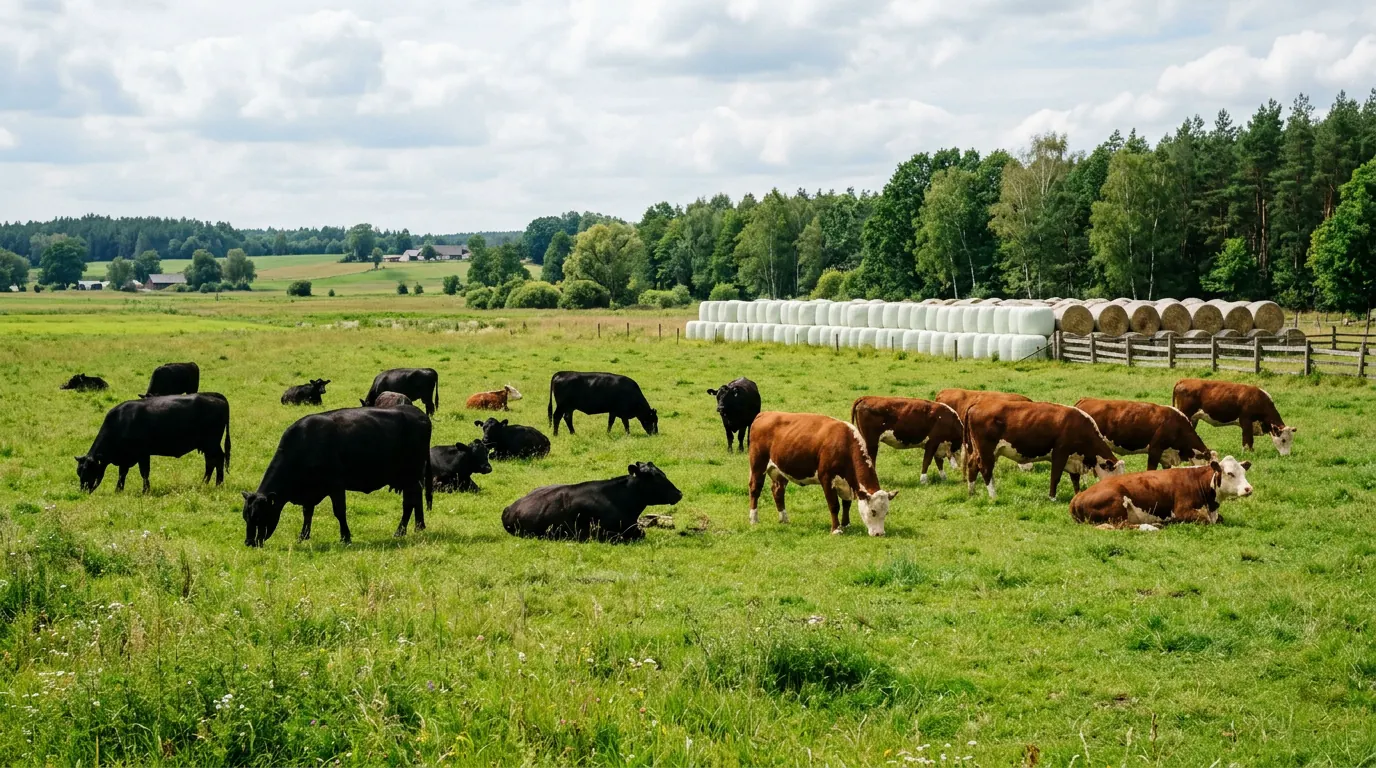
A cow has four stomach compartments: the rumen (the first and largest), the reticulum, the omasum and the abomasum. The first three are forestomachs, where bacteria and protozoa ferment the feed before it moves on. True digestive juices are only secreted in the abomasum, which works much like a single-chamber stomach. A cow is a ruminant: grass, hay and silage are the base of her ration, not an add-on.
Why this matters on the farm
The stomach's structure decides what and how much cattle can eat, how fast they grow and when health problems appear. A cow whose diet changes too abruptly can suffer rumen fermentation disorders, and you see the result in appetite and in the condition of the whole herd. So start by understanding these four compartments, and only then build rations and a feed plan. When you set up herd records, write down every feed change at once, because digestive trouble most often follows one. You will find the tools for this in farm management software.
Four compartments and their roles
Rumen
The rumen is the largest compartment, where the main fermentation takes place. Bacteria and protozoa live here and break down the cellulose fiber in grass and hay into volatile fatty acids. The cow uses these acids as her main source of energy. The rumen works nonstop, so you must never change feed suddenly. Rumen contractions mix the contents and release the gases produced during fermentation.
Reticulum and omasum
The reticulum sits right next to the rumen. It holds back smaller, heavier feed particles and foreign objects, such as pieces of wire eaten with the feed. The omasum has many folds like the pages of a book, and its job is to absorb water and some nutrients from the digesta. You see these two compartments less in daily observation, but how well they work decides how much of the feed the cow actually uses.
Abomasum
The abomasum is the fourth compartment and the only one with glands that secrete true digestive enzymes. The contents arrive here already largely fermented, and the microbial protein is digested as an important protein source for the cow. Changes in the abomasum can appear quickly, so when an animal is seriously unwell, call a vet before you try anything yourself.
Digestion step by step
Eating
A cow eats quickly, hardly chewing, and swallows the feed into the rumen. There it is softened and soaked with saliva. Later, usually while resting quietly, the cow brings portions of the contents back up into her mouth. This is called rumination, and it takes a long time because the cow grinds the fibers thoroughly before swallowing them again.
Why rumination matters
Chewing again increases the fiber surface that microbes can work on. The saliva produced during rumination buffers acidity in the rumen and protects its lining. Cows that get too little roughage ruminate less and more often have problems with rumen pH. That is why you never feed a cow concentrates alone, without fiber.
Fermentation and gases
Fermentation in the rumen produces gases, mainly carbon dioxide and methane. A healthy cow belches them out regularly and without effort. When belching stops and the left side of the belly visibly swells, you are dealing with bloat, which can be life-threatening. Bloat needs an immediate response from a vet, not home remedies.
What the stomach means for feeding
Roughage in numbers
According to data from IZ PIB, Poland's National Research Institute of Animal Production (K. Bilik et al., Wiadomości Zootechniczne 2014), in an example calculation a medium-frame beef suckler cow of about 500 kg body weight, rearing a calf up to 250 kg, eats roughly 14 kg of dry matter a day. Young fattening cattle weighing 200–350 kg take in about 5.9 kg of dry matter a day, and cattle weighing 350–540 kg about 8.7 kg. The rumen has to hold a lot of fiber, not just concentrate. Treat these values as a reference point, not a ready-made standard for every herd.
Appetite while nursing a calf
AHDB (Beef BRP Manual 5) states that the calf's suckling keeps the cow's appetite at about 2.3% of body weight in dry matter. Late in lactation milk yield can be very low, but appetite still depends on suckling. When finishing cull cows for slaughter, raise the concentrate gradually, because a sudden change upsets rumen fermentation and causes diarrhea or loss of appetite.
Minerals
Teagasc (Beef Manual, Section 6: Nutrition) states that a suckler cow has clearly lower mineral needs than a dairy cow, and molasses licks usually do the job. Magnesium must be topped up during the period of grass tetany risk after calving. For deficiency, the manual gives indicative ranges of 150–300 mg a day for copper and 3–5 mg a day for selenium, with the lower value for routine use. A vet or feed adviser sets the actual dose after analyzing the feed.
Pasture and cattle growth
Sward height before and after grazing
AHDB (Beef BRP Manual 5) gives indicative sward heights for lactating cows in rotational grazing: in May, 10 to 14 cm before grazing and 5–6 cm after, and in June–July, 12 to 15 cm before and 7–8 cm after. For young fattening cattle in May the values are similar: 10–12 cm before and 5–6 cm after grazing. Measure the height in several places in the paddock, not in the one best spot, because pasture grows unevenly.
Rate of gain
For a suckler-calf-to-bull system, Teagasc (Beef Manual, Section 3: Beef Systems) gives these figures: a calf weaned at 9 months weighs about 375 kg and gains about 1.25 kg a day. At 16 months, at finishing, it reaches about 650 kg with a gain of about 1.45 kg a day. The manual notes that the growth targets are high and need good management. Compare these values with your own weighings and record them in your herd records.
Welfare on the range
The EFSA review of beef cattle welfare covers pasture seeking, shelter and shade as areas for assessing animal behavior. For a farmer this means cattle outdoors need protection from wind, rain and heat. Do not overcrowd the paddocks, because crowding makes it harder for cows to ruminate in peace and to eat.
Watching digestion in the herd
What to check every day
A good farmer notices changes before the vet does. Check whether cows ruminate quietly after feeding, whether they belch gas, whether appetite is steady and whether the manure has a normal consistency. Write down any deviation at once, with the date and the animal's number. Such notes let you compare the following days and decide faster together with your vet. In a bigger herd, it helps to know how to choose farm software that keeps these records without spreadsheets.
Medicines and withdrawal periods
A vet must always treat a cow and choose the medicine and dose. The farmer is responsible for keeping to the withdrawal period, the time during which milk and meat cannot enter the food chain. The period is counted from the last dose, and its length comes from the medicine's documentation and the vet. Records in the Treatment and withdrawal module help you stay in order at inspections and when you sell animals.
Feed indicators
When feed use rises and gains fall, calculate the FCR, the kilograms of feed per kilogram of gain. This shows whether a ration change really worked. With many animals, also keep an eye on silo stocks, because sudden feed shortages force abrupt ration changes, and those harm digestion. You can track stocks with silo monitoring.
Frequently asked questions
How many stomachs does a cow have?add
A cow has one stomach with four compartments: the rumen, reticulum, omasum and abomasum. The first three are forestomachs, where the feed ferments. The abomasum works much like the stomach of a human or a pig.
Which cow stomach compartment is the biggest?add
The rumen is the biggest. The main fermentation of roughage takes place there. It works nonstop and holds a lot of contents, so it feels ration changes most.
Why do cows chew cud?add
Chewing cud grinds the fibers and increases the surface that microbes work on. The saliva from rumination buffers acids in the rumen. A cow that ruminates little usually gets too little fiber in her ration.
How is a cow's digestion different from a pig's?add
A pig has a single-chamber stomach, where digestion relies mainly on enzymes. A cow digests fiber with the help of microbes in the forestomachs. That is why roughage is the base of her ration.
What should I do if a cow stops chewing cud?add
Call a vet quickly, because it can mean bloat or a fermentation disorder. Do not give any preparations without the vet's advice. Note the symptoms and the time they appeared to help the diagnosis.
Can a cow be fed on concentrates alone?add
No. Without roughage the rumen loses stable fermentation and the cow can fall ill. Change the share of concentrate gradually, as your feed adviser recommends.
Sources & resources
- linkIZ PIB — Wiadomości Zootechniczne — Feeding beef cattle in organic farming (K. Bilik et al.)
- linkTeagasc — Teagasc Beef Manual — Section 6: Nutrition
- linkTeagasc (Ireland) — Teagasc Beef Manual — Section 3: Beef Systems
- linkAHDB Beef & Lamb (UK) — Beef BRP Manual 5: Feeding suckler cows and calves for Better Returns
- linkEFSA AHAW Panel — Welfare of beef cattle (EFSA Journal 23:9518)
- linkOODR Łosiów (gov.pl) — Feeding beef cattle (leaflet)
Prepared by: DlaFerm Team based on data from the sources listed · Publisher: INSTA-TECH sp. z o.o.
Do you keep a beef cattle herd?
The Treatment and withdrawal module tracks withdrawal dates after every dose, and Silo monitoring shows your feed stocks. Create a free farm account in DlaFerm.pl and enter your first animals.
Phone
+48 796 258 151