Hungarian goose: a breed for feathers, down and meat
The Hungarian goose is a large white goose kept for feathers, down and meat. In Hungary it is also linked with fatty liver production. We explain what to expect from it and what is allowed in Poland.
verifiedFrom the team that has organised work on poultry farms for years.
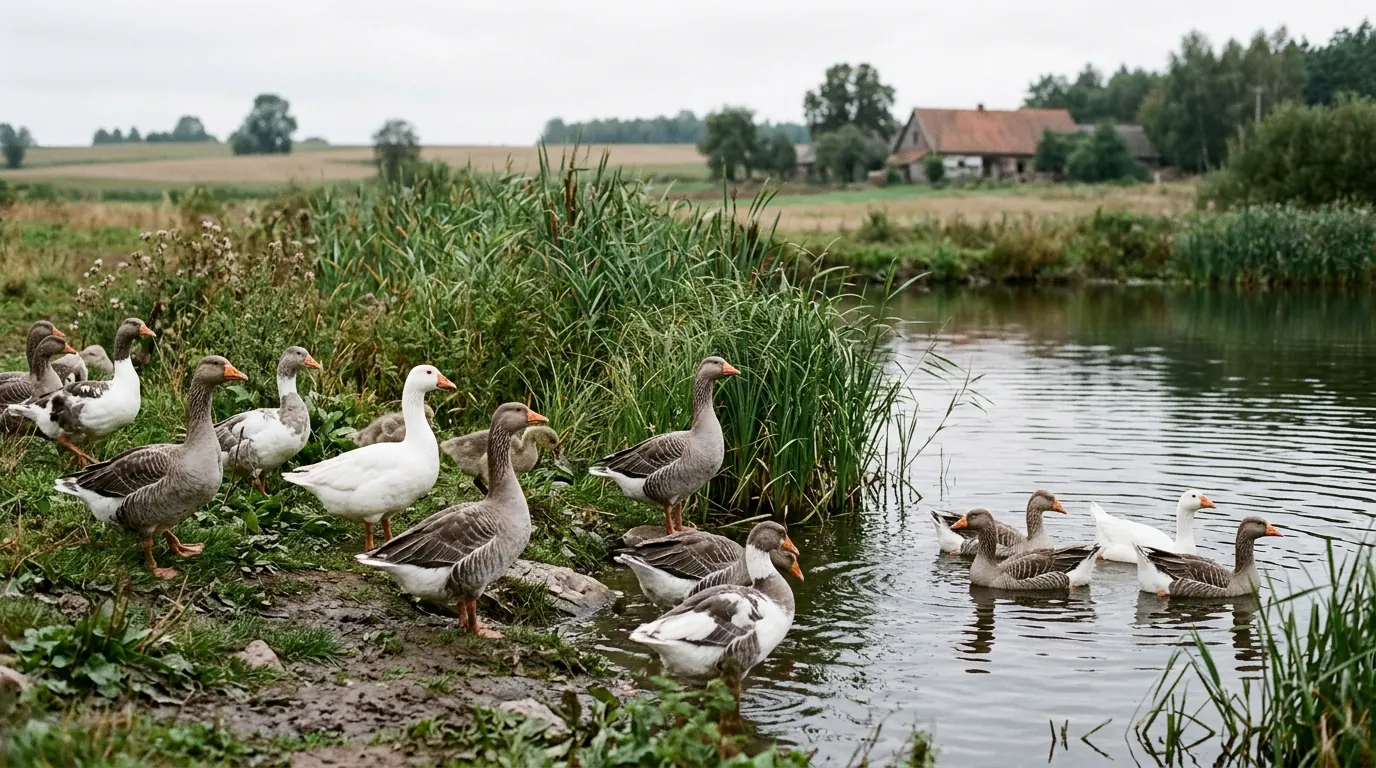
The Hungarian goose is a breed from Hungary, kept mainly for feathers, down and meat. Its plumage is white, so its feathers and down sell as a light-colored raw material. In Hungary, geese of this type are also linked with fatty liver production, but force-feeding is banned in Poland. Below we describe what you can do with this breed legally and profitably.
Who this breed suits
The Hungarian goose suits a keeper who wants to sell feathers, down and carcasses, and does not count on record egg numbers. You will meet it less often in Polish flocks than domestic breeds such as the Biłgoraj goose or the White Kołuda goose. Before you buy, compare it with breeds that are easier to get and that local buyers already know.
What we leave out
We give no specific body weights, laying rates or chick prices. They vary between breeding lines and from year to year. You can check the breed standard and flock assessment results at the Institute of Animal Science (Instytut Zootechniki PIB), and you set the price directly with the breeder you buy from.
Where the Hungarian goose comes from and what it looks like
Origin
The Hungarian goose was developed in Hungary, where goose keeping has a long tradition tied to feathers and liver. Like all domestic geese, it descends from the wild goose, as we describe in the article on the ancestor of the domestic goose. Hungarian lines were developed for large body size and good fattening ability. Today you will find different lines sold as "Hungarian goose", so always ask the seller which flock the goslings come from.
Appearance
The bird has white plumage, an orange bill and orange legs, which sets it apart from saddleback geese and the grey greylag-type breeds. The build is sturdy, with a broad, well-muscled body. White feathers are a real advantage: they do not discolor down and feathers, so it is easier to sell them as light-colored material. The standard describes bill and leg color exactly, but judge these traits on live birds, not only in photos.
Liver: what is allowed in Poland
The ban on force-feeding
In Poland the Animal Protection Act bans force-feeding of geese and ducks (gavage) to obtain a fatty liver. This also applies to Hungarian geese. Check the exact provision and its current wording in ISAP, Poland's online database of legal acts, because the legal text changes with amendments. If in doubt, ask the district veterinary officer (powiatowy lekarz weterynarii) before you introduce any fattening method.
What the science says
The European Food Safety Authority (EFSA) has issued a scientific opinion on the welfare of ducks and geese kept for fatty liver. Goose liver is produced in some European countries and banned in others. So there is no basis in Poland for selling a Hungarian goose as a bird "for liver". On the domestic market, use the breed for feathers, down and meat.
Feathers and down: the main income from the breed
Feathers and down
White feathers and down from the Hungarian goose have an edge over grey ones, because they need no dyeing or sorting by color. We describe harvesting and plucking rules in the guide to plucking geese and plucking machines. The price of the raw material depends on down quality, cleanliness, moisture and batch, so check current rates with buyers, not in tables that are months old.
Meat
The Hungarian goose gives meat that in Poland sells mostly by season, around St. Martin's Day and Christmas. You can sell the carcass directly or slaughter on your own farm if you meet the hygiene requirements. Always confirm the rules for slaughter and direct sales with the district veterinary inspectorate. For a large, late-maturing breed, also work out feed cost up to slaughter day, because it decides your profit.
Laying and hatching
Laying
As with most geese, laying is seasonal and depends on the line, the age of the females and conditions. We have gathered indicative figures for different breeds in the article on goose egg laying. We give no single value for the Hungarian goose, because results differ between flocks. Ask the breeder about laying in the last season and ask for the flock records.
Incubation
You can leave the eggs to a goose or to an incubator. How many days incubation takes and how to prepare the nest is covered in the article on a goose sitting on eggs. At hatching, watch egg moisture, cleanliness and regular turning. Do not buy goslings from a random seller: birds from an unknown flock risk disease and poor performance.
Pairing and sex
When you build a flock you need to tell the sexes apart, and in geese this is not obvious. We describe the methods in the guide on how to tell a goose from a gander. The right ratio of males to females depends on the breed and the housing system, so ask the seller or an adviser at an agricultural advisory center.
Feeding and housing
Feed and pasture
A goose makes good use of grass and green forage, so in the growing season you can cover part of the feed from pasture. We describe mixes for goslings, young birds and adults in the article on feeding geese and ducks. Always provide clean water, deep enough to dip the bill, and grit. Without water a goose cannot swallow dry feed.
House and run
A goose does not need a heated house, but it needs a dry, bedded, wind-sheltered area for the night. In the run, provide shade in summer and access to grass. Fence the area to protect birds from predators. Biosecurity rules also apply to geese, including limiting contact with wild waterfowl. Check current recommendations with the Chief Veterinary Inspectorate (Główny Inspektorat Weterynarii).
The Hungarian goose compared with other breeds
Polish native breeds
Native breeds are adapted to our climate and covered by genetic resource protection programs, which may bring subsidies. Compare the Hungarian goose with the Pomeranian and Kartuzy geese, the Biłgoraj goose and the greylag goose. Check subsidy conditions for conservation breeds with ARiMR (Poland's Agency for Restructuring and Modernisation of Agriculture), because the rules and the list of breeds change from year to year.
Foreign breeds
Among foreign breeds, the Hungarian goose competes with the Chinese goose, known for high laying, and the African goose with its typical knob. Choose the breed for your goal: feathers, meat or eggs. If you sell mainly locally, a breed customers know will sell faster than an exotic one.
Frequently asked questions
Is the Hungarian goose suitable for keeping in Poland?add
Yes, it is a hardy bird that copes well with cold and makes good use of pasture. It is less common in Poland than native breeds, so first find where you can buy goslings from a proven breeder and who will buy your feathers and carcasses.
Can you fatten geese for liver in Poland?add
No. The Animal Protection Act bans force-feeding of geese and ducks to obtain a fatty liver. You can find the current text of the provision in ISAP, and the district veterinary officer can settle any doubts.
What are Hungarian geese kept for?add
Mainly for feathers, down and meat. White plumage makes it easier to sell a light-colored raw material. It is a large-bodied breed, not a prolific layer, so do not count on many eggs.
How much does a Hungarian goose cost?add
The price depends on the breeding line, the age of the bird, its origin, and whether you buy a gosling or a breeding bird. Agree the amount directly with the breeder, because it changes with the season and demand.
What do you feed Hungarian geese?add
Green forage from pasture, a goose mix matched to the birds' age, and clean water. We describe feeding rules in the guide on feeding geese and ducks. Discuss the feed composition for your flock with a nutrition adviser.
Where can you check the Hungarian goose breed standard?add
At the Institute of Animal Science (Instytut Zootechniki PIB) and in poultry breeders' associations. The standard describes bill and leg color, body weight and build. Before you buy, compare the description with the flock you are looking at.
Sources & resources
- linkInstitute of Animal Science PIB (Instytut Zootechniki) — izoo.krakow.pl
- linkEFSA — efsa.europa.eu
- linkOnline System of Legal Acts (ISAP) — isap.sejm.gov.pl
- linkChief Veterinary Inspectorate — gov.pl/web/wetgiw
- linkARiMR — gov.pl/web/arimr
Prepared by: DlaFerm Team based on data from the sources listed · Publisher: INSTA-TECH sp. z o.o.
Manage your goose flock in farm management software
In the DlaFerm.pl farm management module you record bird batches, feed use and flock results in one place. Create a free DlaFerm farm account or get in touch, and we will show you how it works in practice.
Phone
+48 796 258 151