Domestic goose ancestor: where geese come from
The ancestor of the domestic goose is the greylag goose (Anser anser), a wild waterbird living across Europe and Asia. Chinese geese descend from the swan goose instead. Here is where geese come from, how they were domesticated and what that means for you as a keeper.
verifiedFrom the team that has organised work on poultry farms for years.
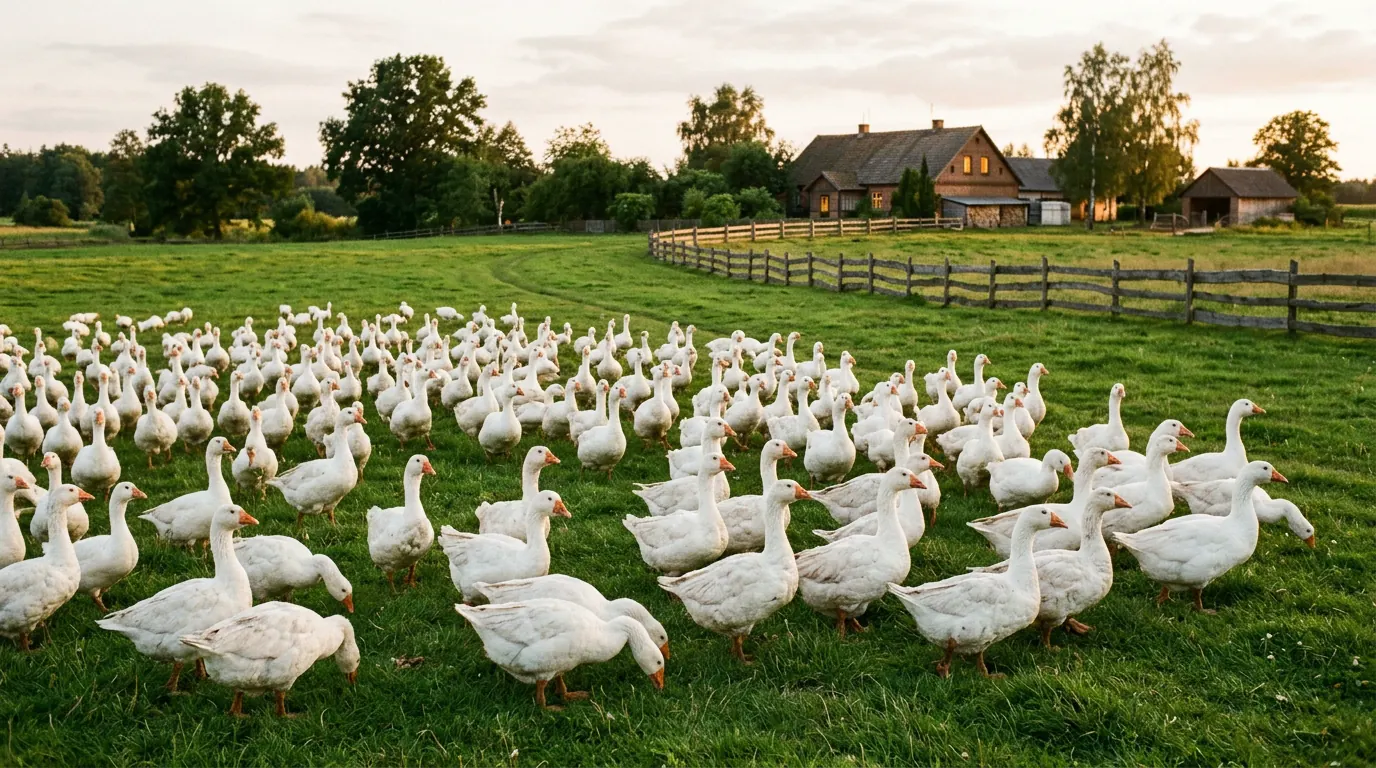
The ancestor of the domestic goose is the greylag goose (Anser anser), a wild bird that lives near water across much of Europe and Asia. The domestic goose is not a separate species built from scratch by people. It is a domesticated form of that same bird. The two differ a lot in body shape, weight and behavior, but the source is one. Chickens have a similar story: their wild ancestor is the red junglefowl (kur bankiwa).
Why knowing the ancestor helps on the farm
Knowing the ancestor tells you what the bird needs. The greylag grazes on grass, lives near water and travels long distances in season. Farm geese still need access to fresh grass, water for swimming or at least bathing, and a dry place to rest. These needs come straight from the ancestor's biology, not from a fashion for organic farming. We describe building requirements in housing requirements for geese. The general rule is simple: the closer to natural conditions, the fewer health problems in the flock.
The greylag goose: main ancestor of the domestic goose
Appearance and habitat
The greylag is one of the largest wild geese in Europe. It has gray-brown plumage, a pale underside, and an orange-pink bill and legs. It nests in wet areas: by lakes, in river floodplains and on peat bogs. Outside the breeding season it feeds in open country, on meadows, pastures and cereal fields, eating mainly grasses and parts of green plants. This feeding habit explains why domestic geese make such good use of pasture on a farm.
Migration and flock life
Greylags form family groups and larger flocks. In spring and autumn they fly between breeding grounds and wintering areas in the typical V formation. This urge to travel is deeply rooted and is the biggest difference between the wild form and the domestic goose. A flock of adults usually stays together, and the young learn the route from their parents. On a farm the same instinct shows when geese walk together, graze together and react to changes around them as a group.
How a wild bird became a farm animal
When and where
Geese were domesticated thousands of years ago. Researchers point out that the process was gradual. Birds were first used for meat, down and feathers, and later bred for other traits too. There is no single date or place that can be called the start. The details depend on findings by archaeologists and geneticists, so you will see different accounts in the literature. For a keeper the key point is that the domestic goose has been domesticated for a very long time, and its behavior and needs still echo the wild bird.
Selection for human use
People chose larger, calmer and more fertile birds for breeding. Over time, breeds appeared that differ in body weight, shape and plumage color. Today goose breeds differ so much that a layperson might take them for different species. This variety is the result of many generations of selection, not of changes in a single generation. For an example of a native Polish breed, see our text on the White Kołuda goose (gęś biała kołudzka).
The price of domestication
Domestication changed the bird in many ways. Domestic geese often lose the ability to fly far, and some heavy breeds fly poorly or not at all. The breeding rhythm and body weight changed as well. Wild birds live with limited food, while domestic geese usually have more. That has a consequence: a domestic bird is easier to overfeed if the ration does not match its age and purpose. Keepers see this difference every day, especially when choosing birds for breeding.
Chinese goose, bean goose and other lines
Swan goose: ancestor of the Chinese goose
Chinese geese descend from the swan goose (Anser cygnoides), a wild species from East Asia. It differs from the greylag by a clear knob at the base of the bill and a slimmer body. Geese of this type have a different build and behavior than European breeds. So when you buy birds, it helps to know which line stands behind a breed. That tells you how the bird may cope in your conditions and what growth rate to expect.
Bean goose: a wild relative
The bean goose (Anser fabalis) is another wild species of the same genus. It is not an ancestor of the domestic goose, although people sometimes mistake it for the greylag. The two species differ in bill color, size and plumage. The practical lesson for a keeper: the look of a wild bird is not enough to tell which line a domestic goose comes from. Read more in our article on the bean goose (gęś owsiana).
What goose origins mean for your farm
Pasture and water
The greylag feeds mainly on plants, so domestic geese use pasture well. Grass adds to the diet but does not replace a balanced concentrate feed. We describe feeding rules in feeding geese and ducks. Water is just as important. Waterbirds need water where they can dip the head and bill, not only to drink. Keep the drinker and the bathing spot clean, because dirty water quickly becomes a source of infection. Change the water regularly, especially in hot weather.
Cold, damp and litter
The goose's ancestor lives outdoors all year, so domestic geese tolerate cold well, provided they have dry bedding and shelter from wind. Damp inside the building is a serious problem. Wet litter encourages skin and foot disease and dirty eggs. Check the litter daily, especially after rain and when snow melts. Soggy ground near the drinker often causes trouble in a flock, so harden the area around drinkers or move them away from the resting zone.
Stocking density and space
In the wild the greylag moves across large areas. You cannot fully recreate that on a farm, but too many birds on a small run destroy the grass, create mud and stress the birds. How many birds fit per square meter depends on age, breed and housing system. When planning a run, expect the pasture to wear out, and give birds room to move and rest away from the water.
Rules and flock health
Where the rules come from
Requirements for keeping geese and for their welfare come from national and EU law. You can find current legal texts in ISAP (Internetowy System Aktów Prawnych, Poland's online database of legal acts), and animal keeping is supervised by the Chief Veterinary Inspectorate (Główny Inspektorat Weterynarii). The legal status described here is as of 22.11.2026 and may change, so check the current text before you invest. During an inspection the inspectorate usually asks about records and the condition of the birds, so keep your records up to date.
Health and the vet's decisions
Geese are prone to digestive diseases and parasites, especially when stocked densely on pasture. If you see any worrying sign, such as lower appetite, diarrhea or weakness, call a vet. The vet chooses the medicine and dose, not the keeper based on a forum post. Remember the withdrawal period: after a medicine is given, the birds cannot go to slaughter and products from them cannot be sold before the withdrawal period ends. Record every treatment, because without that it is hard to show you kept the withdrawal period.
Frequently asked questions
What bird is the domestic goose descended from?add
The domestic goose descends from the greylag goose (Anser anser), a wild bird living near water in Europe and Asia. Chinese geese descend from the swan goose (Anser cygnoides). Both species were domesticated by people a very long time ago.
Can domestic geese fly?add
Most domestic geese can lift off for a short distance, but many heavy breeds fly poorly or not at all. Wild greylags travel long distances. To limit escapes, check the fence height around the run and give the birds a steady place to graze.
Can a wild greylag breed with a domestic goose?add
Yes. The greylag and the domestic goose belong to the same species, so they can breed together. Breeders still protect breed purity, because crossing changes the production traits of the birds. Talk to an adviser or a breeders' club before you choose pairs.
Why do geese need water?add
Geese are waterbirds, so access to water matters for more than drinking. It helps them keep plumage in good shape and protects eyes and nostrils from dirt. Provide a drinker and a bathing spot, and change the water regularly.
Do any laws regulate keeping geese?add
Yes. Goose keeping falls under rules on farm animal welfare and animal health. You can find current texts in ISAP, Poland's online database of legal acts, and the Chief Veterinary Inspectorate supervises. The legal status is as of 22.11.2026.
Can you keep geese with chickens?add
You can, but a shared run needs care. Geese take up a lot of space around water and feed, and chickens may get pushed away from the drinker. Separate feeding areas make it easier to keep order and to check the health of both species.
Sources & resources
- linkNational Research Institute of Animal Production — izoo.krakow.pl
- linkChief Veterinary Inspectorate — gov.pl/web/wetgiw
- linkOnline database of Polish legal acts (ISAP) — isap.sejm.gov.pl
- linkMinistry of Agriculture and Rural Development — gov.pl/web/rolnictwo
Prepared by: DlaFerm Team based on data from the sources listed · Publisher: INSTA-TECH sp. z o.o.
Do you keep geese alongside other species?
The DlaFerm farm management program helps you keep records for poultry flocks, geese included, in one place. Create a free farm account on DlaFerm.pl and see how it works in practice, or get in touch with us.
Phone
+48 796 258 151