Red junglefowl: the ancestor of the domestic chicken
The red junglefowl (Gallus gallus, known in Polish as kur bankiwa) is a wild bird of the forests and scrub of Southeast Asia and the main ancestor of the domestic chicken. Its looks and behavior help explain why today's hens need perches, quiet corners and room to move. We explain what the wild relative passed on to modern flocks.
verifiedFrom the team that has organised work on poultry farms for years.
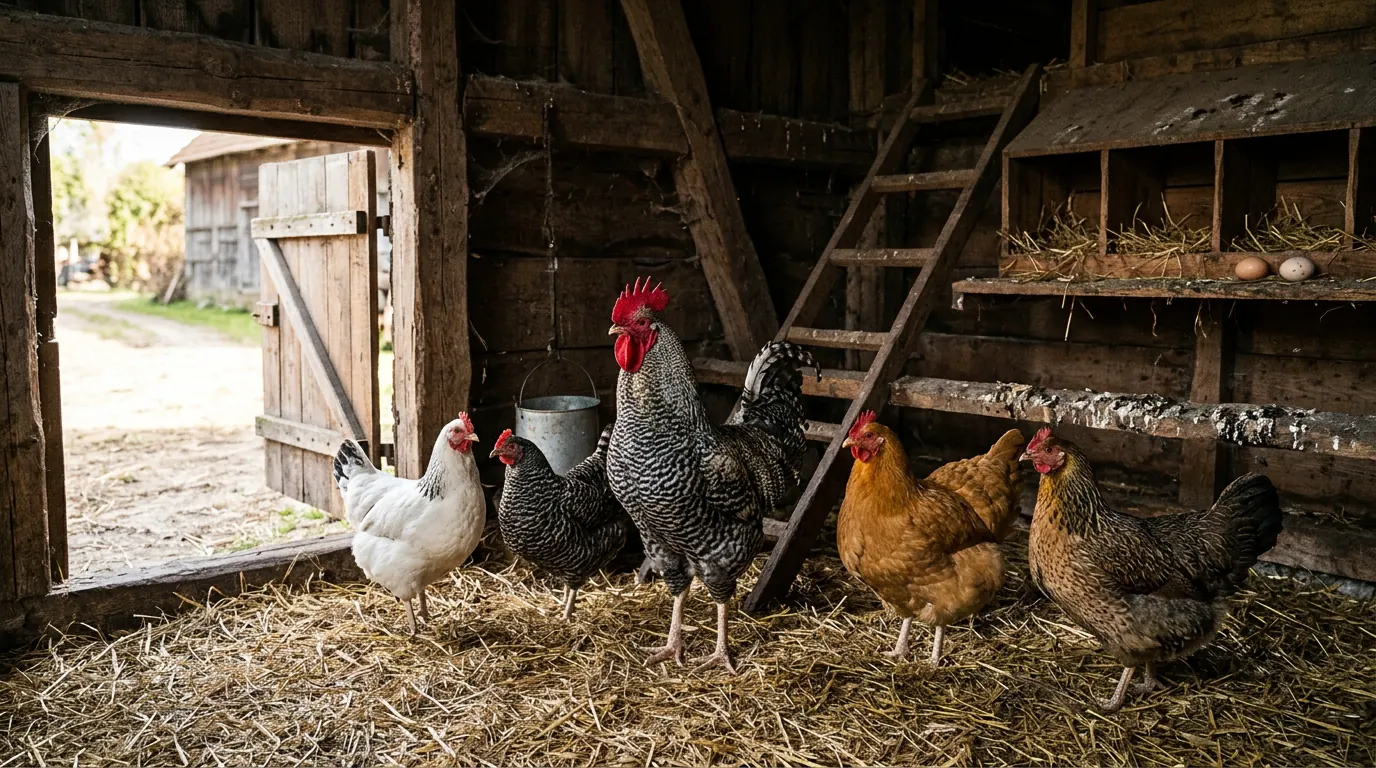
The red junglefowl (Gallus gallus) is a wild bird from Southeast Asia, regarded as the main ancestor of the domestic chicken. Today's hens, from laying breeds to ornamental ones, descend from it, although thousands of years of breeding have changed them a great deal. Below we describe what the junglefowl looks like, where it comes from and which of its behaviors survived in coops. For a keeper this is more than a curiosity, because many needs of modern hens are easier to understand when you look at their wild relative.
The key facts in short: the junglefowl lives in forests and scrub, the rooster has bright plumage and a large comb, the hen is more modestly colored, and the birds roost in trees. The species is the closest relative of the domestic chicken and can interbreed with it, which confirms their shared origin.
What a red junglefowl looks like
The rooster
The junglefowl rooster has full, bright plumage. The neck and back show golden and reddish feathers, the breast is darker, and the tail has glossy, black-green feathers. He has a large red comb and wattles under the beak. In the wild these ornaments signal condition and rank in the group, so you can spot the male from far away. The legs are gray, and an adult rooster has clear spurs.
The hen
The junglefowl hen is much more modestly colored. Her plumage is usually brown, buff and grayish-brown with darker flecks that hide her in leaf litter and undergrowth. Her comb and wattles are smaller. This camouflage matters, because the hen sits on the nest and raises chicks on the ground, out of sight of predators. Domestic hens kept a good deal of this variety of colors, although breeders selected them for looks, laying and usefulness.
Where the domestic chicken comes from
Natural range
The natural range of the junglefowl covers forests, scrub and farmland in Southeast Asia, from northeastern India through southern China and the Malay Peninsula to Java and neighboring islands. The bird is not a typical resident of open fields. It does best where shrubs and tall grass give cover, and at night it looks for shelter among trees. This preference explains why today's hens react badly to a lack of cover and quiet, even in large houses.
Domestication
Domestication of the chicken took thousands of years and began in the region where the junglefowl lives naturally. The chicken was valued above all as a source of eggs and meat. Over time one species gave rise to many breeds of different size, build and color. That is why the genetics of domestic chickens are so varied, and why the wild ancestors still share some behaviors with them.
How the red junglefowl lives in the wild
Group and pecking order
Junglefowl live in small groups, usually one rooster with a few hens. The rooster guards the flock, warns of danger with a loud call and defends territory against other roosters. A clear hierarchy operates in the group, and rank decides access to food and the best resting place. You see the same mechanism in a coop when too little space on one perch or at one drinker has to serve all the birds.
Roosting and movement
Wild birds roost high, on tree branches, away from the ground. Their flight is short and explosive. It lets them escape a predator but does not carry them over long distances. Domestic hens have the same instinct. If the coop has no perches, or they are too low or too crowded, birds sleep on the floor, which raises the risk of injuries and dirty eggs.
Nest and brood
The junglefowl hen builds a simple nest on the ground in a sheltered spot and lays eggs in the breeding season. She incubates alone, and after hatching the chicks quickly learn to look for food under her care. The domestic hen keeps the urge to nest, although in modern laying lines this trait is strongly reduced. That is why keepers provide nests in a quiet part of the coop.
What today's hens inherited from the wild ancestor
Laying
The junglefowl hen lays in season, in small numbers, because her aim is to raise offspring. Domestic hens, especially laying breeds, were selected to lay for most of the year. That is a huge change, but it demands a steady diet and access to calcium and water from the keeper. We cover feeding details in our guide to feeding laying hens. Differences between laying breeds are in our overview of laying hen breeds.
Flock behavior
Domestic hens still form a pecking order. Newly introduced birds are sometimes attacked, and weaker ones lose access to feed. Too few feeding points and drinkers make conflicts worse. When planning a run, keep space and the placement of equipment in mind, as we explain in the guide to the chicken run.
Perches and quiet
The instinct to roost high turns into concrete coop requirements: perches at a suitable height, enough perch length per bird, and nesting places in a secluded corner. We describe coop requirements in the article on coop requirements for laying hens.
Using what you know about the junglefowl in practice
Welfare
A bird that can keep its natural behaviors, such as scratching in litter, dust bathing and roosting on a perch, usually feels better and fights less in the flock. On a farm this means litter that can be scratched through, quiet spots, cover and a run with vegetation. Solutions depend on the housing system, so discuss any changes with your vet first.
Health and prevention
Hens kept at high density pass on diseases more easily, and good hygiene is the basis. Keep drinkers and feeders clean and check the birds regularly. If you have problems with bacteria from this group, see our description of Salmonella in laying hens. Treatment is always chosen by a vet who knows your flock and the withdrawal period rules.
Ornamental and native breeds
Among ornamental and native breeds, many keep a look close to the wild ancestor, for example in plumage color or comb shape. You will find an overview in the articles on ornamental chicken breeds and on Polish native chicken breeds.
Frequently asked questions
Are chickens descended from the red junglefowl?add
Yes, the red junglefowl is regarded as the main ancestor of the domestic chicken. Today's hens descend from wild birds of Southeast Asia, and thousands of years of breeding produced many breeds from them. Some of the behavior traits remain to this day.
Is the red junglefowl the same species as the chicken?add
The domestic chicken is counted as the same species, Gallus gallus, as the junglefowl. The two birds can interbreed, which confirms how closely related they are. The differences come mainly from domestication and long selection by people.
Where does the red junglefowl live in the wild?add
The wild red junglefowl lives in the forests and scrub of Southeast Asia, from northeastern India to Java and neighboring islands. It does best where shrubs and tall grass give cover. At night it looks for shelter in trees.
Can chickens fly like junglefowl?add
Chickens have the same short, explosive flight, but in many breeds it is weaker, and heavy birds hardly use it at all. Even so, the instinct to fly up to a perch is still clear. That is why a coop should have perches at a suitable height.
Does the red junglefowl lay eggs like a chicken?add
No, the junglefowl lays in the breeding season and in small numbers, because her aim is to raise chicks. Domestic hens, especially laying breeds, were selected to lay for most of the year. Their laying depends on breed, line and housing conditions.
Can you keep red junglefowl in Poland?add
Before buying or keeping birds from a wild population, check the current requirements with the Chief Veterinary Inspectorate (Główny Inspektorat Weterynarii) and your county vet. Pure breeds of similar appearance, available from breeders, are also a good starting point. Make any health decisions with your vet.
How can I give hens conditions close to natural ones?add
Provide litter for scratching, a quiet place to nest, perches and cover in the run. Keep enough space at feeders and drinkers to limit fights. Plan changes together with your vet, because they depend on the housing system.
Sources & resources
- linkInstitute of Animal Science (Instytut Zootechniki PIB) — izoo.krakow.pl
- linkEFSA — efsa.europa.eu
- linkChief Veterinary Inspectorate (Główny Inspektorat Weterynarii) — gov.pl/web/wetgiw
Prepared by: DlaFerm Team based on data from the sources listed · Publisher: INSTA-TECH sp. z o.o.
Keeping a flock and want everything in one place?
The coop records module in DlaFerm.pl helps you manage the coop, bird groups and flock events in one place. Create a free farm account and see how it works for your own coop.
Phone
+48 796 258 151