How long does a goose sit on eggs, and how to care for her
A goose usually sits on her eggs for 28–30 days, longer than a hen. She stays on the nest and leaves only to eat and drink. Here is how to prepare the nest, what to check and how to keep hatch records.
verifiedFrom the team that has organised work on poultry farms for years.
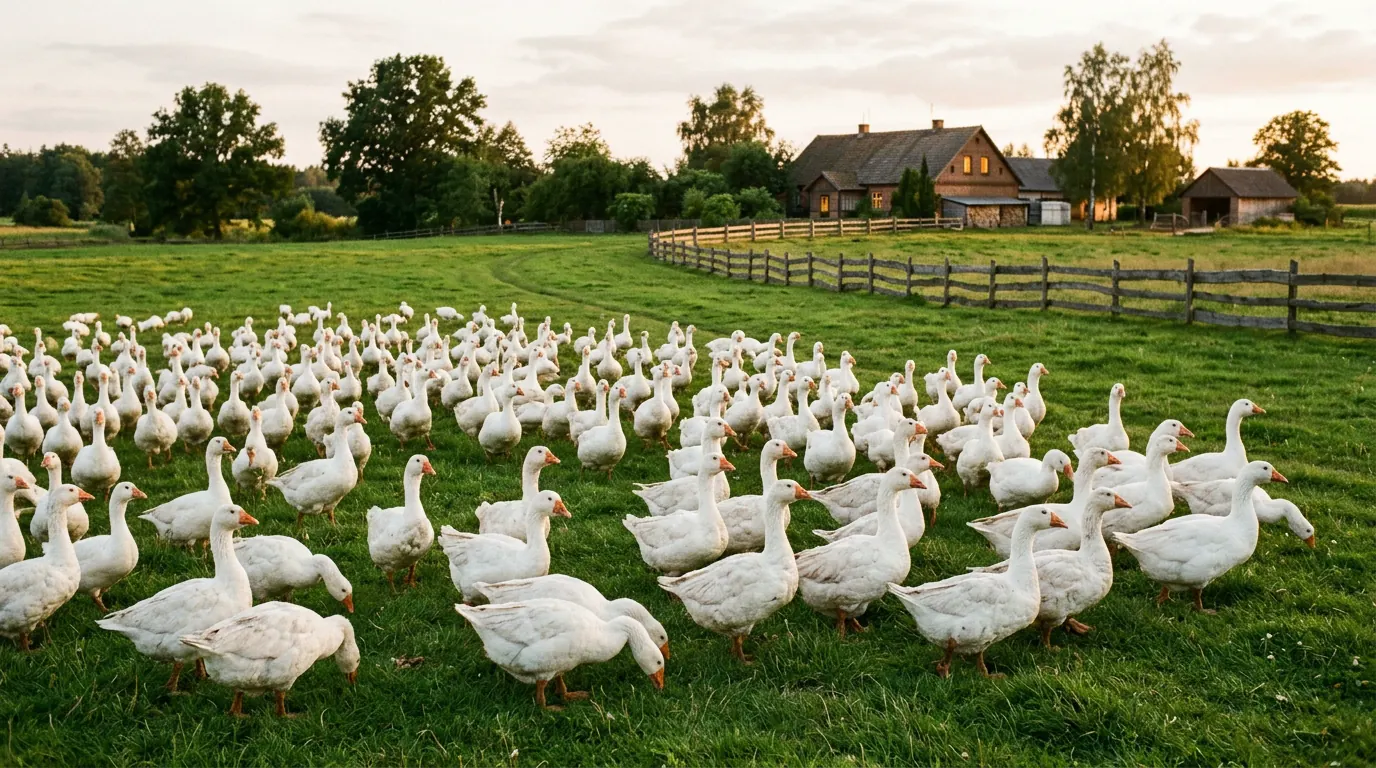
A goose sits on her eggs for about 28–30 days. That is how long goose eggs take to incubate under a natural broody goose, which builds her own nest and stays on the eggs almost without a break. This is clearly longer than a hen, which usually sits for 21 days, so plan for it from the start. Your job is to give her quiet, a dry nest, water and feed, and to keep an eye on her condition. You don't do the broody's work for her. You just don't get in her way.
Why a goose sits longer
Goose eggs are larger and heavier than hen eggs, and the embryo develops more slowly in them. That is why the sitting time is longer. You can't shorten it by changing the feed or by lifting the goose off the nest often. That disturbs the embryo and raises the risk that she abandons the eggs. If you plan a goose hatch, mark the date on the calendar and expect the bird to be at work the whole time. For a comparison with hens, see our guide on how long a hen sits on eggs.
When to start counting the days
Start counting from the day the goose begins sitting on a full clutch, not from the first egg laid. A goose lays over several days and only then starts to sit. If you set eggs laid on different days, the oldest will be further along and hatch earlier. So collect eggs from one period, write down the date you set them and store them briefly in a cool, dry place, usually for a few days.
The nest and the place for the goose
Location and nest
A goose needs a quiet, dark, dry place, sheltered from drafts and from other birds moving about. Make the nest from clean straw on a dry base so the eggs don't roll to the sides. The nest must be big enough for her to turn around freely and settle on the eggs. Keep her apart from the rest of the flock and away from dogs and cats. Moving the nest during sitting often ends with her abandoning it, so choose the spot once and don't move it without need.
How many eggs to set
Match the number of eggs to the size of the goose. She has to cover the eggs with her body, and eggs sticking out from under her are usually cooler and develop worse. It is better to set fewer eggs that fit under her than to overload the nest. Fertilization also depends on the male in the flock. Mating rules and male-to-female ratios are covered in our guide on how a rooster fertilizes a hen, and for geese check the details with an experienced breeder or a veterinarian.
Feeding, watering and the goose's condition
Feed and water within reach
While sitting, a goose eats and drinks less than when she is out on the range, but she still needs feed and clean water. Put the feeder and drinker close to the nest so she doesn't have to go far. Water should be fresh and available all day, because after leaving the nest the bird drinks and eats in a short time. Feed should be dry and good quality. Don't change the feed mix suddenly. A steady, proven diet lowers the risk of problems while the bird hardly moves.
How to check her condition
Watch the goose every day, ideally at the same times. A good sign is calm sitting, clean feathers around the vent and regular trips off the nest to eat. If she stays on for a long time, is listless, has ruffled feathers, has discharge from the eyes or beak, or refuses food, call a veterinarian. Don't give the bird any medicine on your own, because only a veterinarian chooses the drug and the dose. Write your observations in your records, since they help you catch a problem early.
Checking eggs and limiting losses
Don't disturb her without need
The goose turns the eggs herself and keeps them warm. Don't lift her off the nest more often than necessary. Every time she is taken off, the embryos chill and she gets distracted. If you want to check the eggs, do it quickly, in one go and calmly. Candling, which means checking eggs with a light, lets you spot infertile eggs or eggs with a dead embryo. Do it carefully and only when you don't risk wrecking the nest.
Cracked and dirty eggs
Remove cracked eggs at once, because moisture and bacteria can spread to the others. Dirty eggs shouldn't go under the goose. If you must clean them, do it dry or very gently without soaking, because water getting through the shell raises the risk of infection. Record your losses, as they show whether the problem is the nest, the feed or the condition of the goose. If losses are high, check where the eggs came from and how they were stored. For a list of hatcheries and how to order chicks, see poultry hatcheries in Poland.
What happens after hatching
Hatching doesn't happen all at once
Goslings don't hatch at the same time. Some come out sooner, others need more time. Don't pull goslings out by force and don't open the shells, because stepping in too early usually kills the embryo. If a gosling is stuck in the shell and the time has passed, consult an experienced breeder or a veterinarian. Don't disturb the goose during the first hours. Move the dried goslings to a warm, dry place only later, and then out to the range.
The goose with her goslings
After hatching, the goose leads the young and usually stops sitting on the nest. Give her and the goslings a dry bed, shelter from cold, and access to starter feed and water. For safety, separate the family from the rest of the flock, because adult birds may chase or hurt the young. Record the hatch date and the number of goslings. This is the starting point for your further flock records.
Records, planning and regulations
What to record for every sitting
Note the date you set the eggs, how many there are, the goose's number or mark, the planned hatch date and the results of your checks. This lets you compare successive sittings and know when to expect goslings. You can keep the placement plan and production cycle in placement and cycle planning, and the flock and housing details in the poultry house register.
Regulations and registration
Flock registration and poultry identification come from the law, and their scope depends on the size and purpose of the flock, so we don't rely on remembered figures here. Check current legal acts in Poland's Internetowy System Aktów Prawnych (online legal database), and guidance from the Główny Inspektorat Weterynarii (Chief Veterinary Inspectorate) and from ARiMR (Agency for Restructuring and Modernisation of Agriculture). This description of the legal state is current as of 22.11.2026. Before the hatch, also ask your veterinarian about biosecurity rules, because every contact with a foreign bird raises the risk.
Medicines and withdrawal periods
If a goose gets any medicine, record it with the date given and the withdrawal period. A veterinarian sets the withdrawal period and also decides on the drug and the dose. You keep the full treatment history in the treatment and withdrawal period records, so before sale or slaughter you can check that all the dates have passed.
Frequently asked questions
How many days does a goose sit on eggs?add
Usually 28–30 days from the time she starts on a full clutch. Confirm the number of days with a breeder or a veterinarian, because it depends on breed and conditions. Write down the date you set the eggs so you know when to expect the hatch.
Does a goose turn her own eggs?add
Yes, she shifts the eggs under her when she gets up and sits down. Don't take the eggs out or turn them by hand, because it upsets the nest and its temperature. If the goose stays off the eggs for a long time, consult a veterinarian.
What should I do if a goose leaves her nest?add
Check that the nest is dry, quiet and safe and that nothing is scaring her. Put water and feed near the nest. If she keeps abandoning the eggs, contact a breeder or a veterinarian.
Can a goose sit on eggs of another species?add
In theory yes, but different kinds of poultry have different incubation times, so a mixed hatch is hard to control. Ask an experienced breeder before you set them. Don't mix eggs from different days and species in one nest.
How can I tell an infertile egg?add
The simplest way is to candle the egg with a light in a dark room a few days after setting. An infertile egg shows no sign of an embryo developing. Do the check carefully so you don't chill the goose or wreck the nest.
Do I need to watch a broody goose every day?add
Yes, a short daily check is enough to catch a problem. Look at how she leaves for meals, the state of her feathers and her behavior. Write your observations in your records so you have a history of every sitting.
Sources & resources
- linkChief Veterinary Inspectorate (Główny Inspektorat Weterynarii) — gov.pl/web/wetgiw
- linkARiMR — gov.pl/web/arimr
- linkNational Research Institute of Animal Production (Instytut Zootechniki PIB) — izoo.krakow.pl
- linkInternetowy System Aktów Prawnych (Polish legal acts database) — isap.sejm.gov.pl
Prepared by: DlaFerm Team based on data from the sources listed · Publisher: INSTA-TECH sp. z o.o.
Planning a goose hatch in your flock?
The placement and cycle planning module helps you plan setting and hatch dates, and the poultry house register keeps your flock in order. Create a free farm account in DlaFerm.pl and enter your first hatch.
Phone
+48 796 258 151