Laying ducks: breeds and how many eggs they lay
The best laying ducks are the Khaki Campbell and the Indian Runner. Dual-purpose breeds, like the Polish Staropolska, lay fewer eggs but also give meat. We explain what drives egg numbers and how to match a breed to your flock.
verifiedFrom the team that has organised work on poultry farms for years.
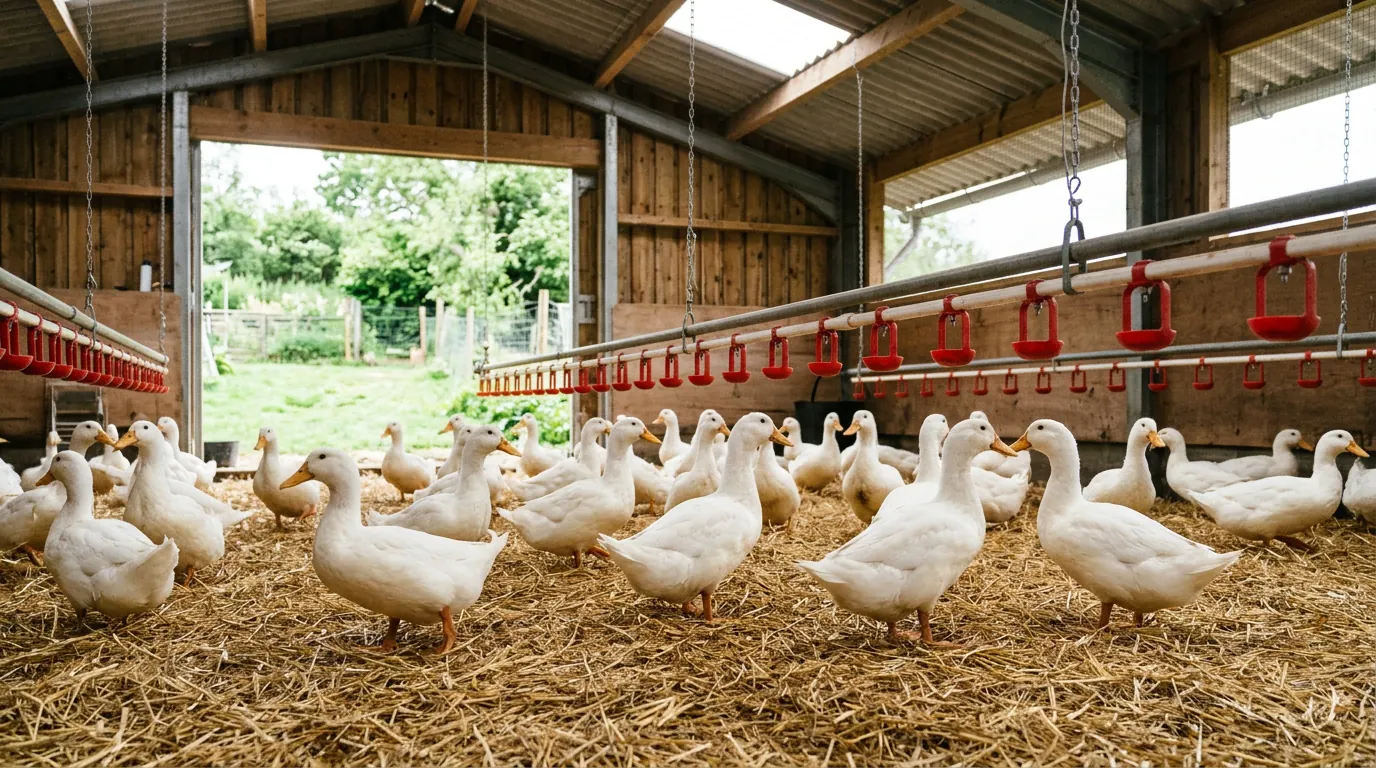
The most eggs among ducks come from breeds kept purely for laying: the Khaki Campbell and the Indian Runner. In good lines with good care they match or beat laying hens, and breed descriptions most often quote around 200–300 eggs a year. Meat breeds and dual-purpose breeds lay clearly fewer. Egg numbers depend on the line, age, light and feed, so treat every figure in a breed description as a rough guide.
Duck eggs are larger than hen eggs and have a stronger shell. Ducks rarely get the typical hen-house diseases, and they lay mostly in the early morning, which makes collecting easy. This overview helps you choose a breed for your own flock. For the other breeds, see our overview of duck breeds, and if you plan to sell eggs, read about the market in our article on duck eggs.
Which duck breeds are laying breeds
Three use groups
Ducks fall into three groups. Laying breeds (Khaki Campbell, Indian Runner) are light, active and lay the most eggs. Meat breeds, for example the Pekin, grow fast and have a heavy carcass, but lay less. Dual-purpose breeds, including the Staropolska duck, combine moderate laying with good meat. The Muscovy is a separate species, kept mainly for meat, and is not a laying breed. If eggs are your goal, look for light breeds with an upright build or lean, agile types.
What laying duck breeds have in common
Good layers have a lighter body, mature earlier and are less inclined to sit on a nest. This matters: a duck that often goes broody stops laying. In laying breeds the broody instinct has largely been bred out, so hatching is usually done in an incubator. If you want natural hatching, plan on broody ducks from heavier breeds and check how long a duck sits on her eggs.
Khaki Campbell and Indian Runner
Khaki Campbell
The Khaki Campbell is considered the best laying duck. Ducks of this breed are medium-sized, have the typical khaki plumage and lay for many months of the year. In good lines with good care, output can approach the upper end of the quoted 250–300 eggs a year, but on farms with poorer feeding or no extra light it will be lower. You will find the full breed description in our article on the Khaki Campbell duck.
Indian Runner
The Indian Runner stands out for its upright, bottle-like shape. The bird is light and lively and does well on range, where it finds part of its own food. Keepers' descriptions put the Runner's laying close to the Khaki Campbell, though results depend on the line: birds from show lines are sometimes weaker layers than working lines. When buying, ask which line the parent flock comes from and whether laying records are kept. Runners are skittish, so they need a calm setting and solid fencing.
Staropolska duck, Pekin and other breeds
Staropolska duck
The Staropolska duck is a Polish dual-purpose breed. It is hardy, does well on pasture and lays fewer eggs than the Khaki Campbell, but in return gives a decent carcass and keeps its broody instinct. It is a good choice for a farm that wants eggs for its own use and meat. We describe it in detail in our article on the Staropolska duck. Poland's Institute of Animal Science (Instytut Zootechniki PIB), among others, runs animal genetic resources conservation programs, so you can check there which breeds are protected.
Pekin and other meat breeds
The Pekin grows fast and uses feed well, but its laying is much lower than in light breeds. Eggs are large, and the ducks readily go broody. If meat is your main product, the Pekin will serve you better than the Khaki Campbell. If you are after eggs, do not pick heavy breeds: lower laying will not make up for higher feed use. For birds from meat lines, the quoted laying is usually a fraction of Khaki Campbell results.
Rare breeds
Interest in rare breeds is growing, but information on their laying comes mainly from breeders and can vary. We describe the Magpie, Welsh Harlequin and Abacot Ranger in our article on rare duck breeds. Before buying, ask the breeder for data from their own flock, not just the figures from the breed description.
What affects duck egg laying
Light and season
Ducks lay in spring and summer because they respond to day length. In autumn and winter laying drops or stops. Egg-focused flocks use extra lighting to keep a long day, but intensity and hours depend on the breed and conditions, so we give no fixed values here. Sudden changes in the light schedule do harm: lengthen the day gradually. Before winter, ducks molt and do not lay then either.
Feed and water
A laying duck needs feed with enough protein, calcium and phosphorus. Too little calcium means a thin shell and lower laying. Ducks drink a lot and must have constant access to water deep enough to dip their bills. We describe feeding standards and feed mixes in our article on feeding geese and ducks. Layer feed for hens is a generally good base, but ducks have different needs for some vitamins, so check the formula with a feed adviser.
Age, stress and conditions
Ducks lay the most in their first laying year, then results fall gradually. A calm setting, dry bedding and no predators are conditions without which even the best breed will not reach the figures in its description. Stress, noise, night-time threats and overcrowding cut laying faster than small feed mistakes. For comparison, see the laying of geese over a season.
When ducks start laying and for how long
Start of laying
Laying breeds start laying earlier than heavy breeds. In practice a light duck begins laying after about six months, and the exact age depends on breed, line, hatch time and lighting. Hens respond to age and light in a similar way, as we describe in our article on when hens start laying eggs. Ducklings hatched in late summer often start laying only the following spring.
How many years to keep a flock
Ducks lay the most in their first and second laying years. In later years laying falls, but the birds can still serve as broody ducks or for meat. Many keepers add young ducks every year or two to keep production up. We cover duck lifespan in our article on how long ducks, geese, turkeys and guinea fowl live.
How to choose a breed and run the flock
Match the breed to your goal
Start by asking why you want ducks. If you want to sell eggs, choose a Khaki Campbell or an Indian Runner from a working line. If you want both eggs and meat, consider the Staropolska or crosses. If you have a small yard and want pet-like birds, look at the breed's temperament and noise. Buy ducklings from reliable hatcheries; for prices, purchase age and places, see where to buy geese, ducks and guinea fowl.
Keep laying records
Without records you do not know whether the flock lays as much as it should. Note the daily egg count, the number of birds, feed use and losses. A drop in laying lasting several days in a row is a signal to check light, feed, water and flock health. In DlaFerm you can keep a hen house register for ducks too: you enter eggs, birds and events, and the system shows trends. Flock data and treatment records also make inspections by Poland's Veterinary Inspection (Inspekcja Weterynaryjna) easier.
Frequently asked questions
Which duck lays the most eggs?add
The Khaki Campbell and the Indian Runner from working lines lay the most. Breed descriptions quote around 200–300 eggs a year, but the result depends on the line, feeding and light. Meat breeds lay clearly fewer.
How many eggs does a duck lay in a year?add
It depends on the breed. Laying breeds can lay from about 200 to 300 eggs, dual-purpose breeds fewer, and heavy meat breeds the fewest. You only learn the exact number from your own flock, so record daily laying.
Do ducks lay eggs in winter?add
Usually not. Ducks respond to day length, so in autumn and winter laying drops or stops. Extra light, lengthened gradually, can partly keep it going, but the right hours depend on the breed and conditions.
Does a duck need a drake to lay eggs?add
No. A duck lays eggs without a drake, but those eggs cannot be hatched. You need a drake only if you want ducklings.
Is the Staropolska duck a good layer?add
It is an average layer, better than meat breeds but weaker than the Khaki Campbell. It is a dual-purpose breed: a moderate number of eggs and good meat, and it copes well with farm conditions.
What affects how many eggs ducks lay?add
Breed and line, the birds' age, day length, feed composition, access to water and calm in the flock. The most common causes of a drop are lack of calcium, stress and a shorter day.
Sources & resources
- linkInstitute of Animal Science PIB (Instytut Zootechniki PIB) — izoo.krakow.pl
- linkMinistry of Agriculture and Rural Development — gov.pl/web/rolnictwo
- linkChief Veterinary Inspectorate — gov.pl/web/wetgiw
Prepared by: DlaFerm Team based on data from the sources listed · Publisher: INSTA-TECH sp. z o.o.
Keep your laying records in DlaFerm
The hen house register module lets you record the daily egg count, flock numbers and feed use in one place, for ducks too. Create a free farm account or get in touch with us.
Phone
+48 796 258 151