When do hens start laying eggs? Age at first egg and peak lay
Hens start laying after they reach maturity, and laying flocks are planned by weeks of age. Breeders' offers usually give a start around week 16, 18 or 20. The exact timing depends on breed, line and rearing, so there is no single date for every flock. We explain what to expect, what peak lay looks like and how to check it on your own farm.
verifiedFrom the team that has organised work on poultry farms for years.
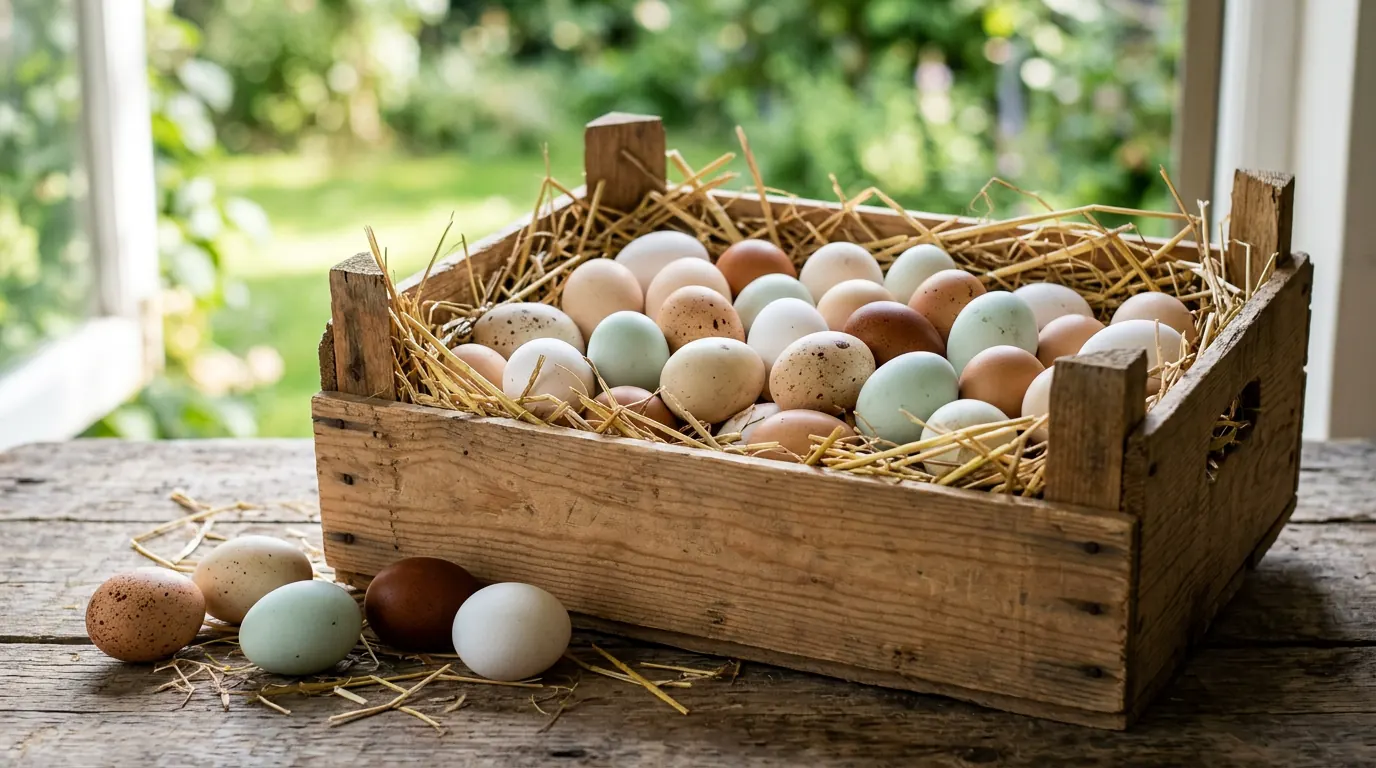
Hens start laying once they reach sexual maturity, and in laying flocks this is counted in weeks of age. Offers from laying-hen breeders give start ranges at 16, 18 and 20 weeks, but the moment of the first egg depends on breed, line and rearing conditions. There is no single date for every flock, so you should know your birds' age in weeks and check it in the hatchery or supplier documents. When you buy, ask about the planned age of transfer to laying and about the results of earlier flocks of the same line. You will find more on buying in our guide to where to buy laying hens.
Why age is only a rough guide
Age in weeks is the simplest reference point, but the start of lay is also affected by body weight during rearing and by how even the flock is. The 2023 Aviagen parent stock handbook lists body weights, uniformity (CV%) and weighing age among the data recorded on the farm, separately for males and females. This shows that the numbers from the whole rearing period decide when laying starts, not the calendar alone. These records let you compare your flock with the breeder's recommendations and spot deviations early.
The first egg and the start of lay
What happens before the first egg
Before laying starts, a hen goes through maturation, in which the reproductive system develops. This process needs a suitable body weight, not just a certain age. That is why underfed or overly fat young hens often start laying later or irregularly. The switch to layer feed should follow the breeder's plan, not a random date. If birds do not start laying when expected, begin by checking body weight on a sample of the flock and discuss the causes with a vet.
Why flocks start at different times
One house can hold birds from several hatches and different lines. Each group starts at its own time, so averaging the date of the first egg for the whole building usually tells you nothing. Record the placement date and age of each batch separately. Placement and cycle planning and register entries help here, showing which group is ahead and which is behind.
Peak lay and the decline through the cycle
What the laying curve looks like
After the start, laying rises over several weeks to a peak and then slowly declines. The shape of the curve depends on breed, feeding and flock health. The Aviagen handbook lists eggs per day, per week and cumulative per bird among the data recorded in parent stock. This record is the best tool for judging the peak, because it shows the gap between plan and reality. When the curve departs from the breeder's standard, check feeding and light first, and only then suspect the breed.
Floor eggs and egg weight
Eggs laid outside the nests lower your result and often point to a problem in the house, such as too few nests or birds being spooked. It is worth recording them separately. The same handbook lists average egg weight, counted daily and weekly, and egg mass as an indicator. A drop in egg weight with a stable number of eggs is a signal to review feeding. Collect the data from both indicators in one place, for example in a poultry farm management program.
Which breed lays the most eggs
Why there is no single record-holder breed
The question of which breed lays the most eggs comes up most often. It cannot be answered in one sentence, because results depend on line, age, body weight, feeding and the house. Ornamental and utility breeds were developed for different goals. A comparison only makes sense when both groups are kept in similar conditions and measured the same way. Without such data, quoting a number for a specific breed would be guesswork.
Where to look for laying data
Start with the descriptions of laying breeds in our overview of laying hen breeds and compare them with records from your own farm. Also check descriptions of laying hybrids, remembering that their data come from the line producer and need careful interpretation. For utility breeds, compare results only when keeping conditions are similar. Only then does a difference in egg numbers say something about the breed rather than the house, the feed or the age of the flock.
Feeding and vitamins around the start of lay
Feed matched to weight and laying
The 2021 Aviagen nutrition handbook for parent stock states that its recommendations are based on a common energy density of 2800 kcal/kg and must be adapted to local conditions and the quality of raw materials. The amount of feed should follow body weight, muscle scoring and egg production, not just the calendar. Nutrient values must be recalculated proportionally when the energy of the feed changes. You will find detailed feeding rules in our guide to feeding laying hens.
Vitamins and supplements
Use supplements for chicks and layers only when they follow from a feeding plan or a vet's advice. We give no doses here, because they depend on age, body weight and feed composition, and the vet always chooses the medicine and dose. Check every product given to laying birds for a withdrawal period, especially when the eggs are sold. Record the products you give, with the date, so you can later compare them with laying results.
House conditions and data records
Space, light and calm
Hens lay best in a house without stress, with nests available to the whole flock and a steady daily routine. Changes in light, noise and overcrowding are common causes of drops. Check that the size and fittings suit the number of birds before you increase stocking. Record conditions at every change, because a drop in laying often shows up days or weeks after a change in the house, not right away.
Records as a tool
Recording daily egg counts, floor eggs and losses in one place lets you see a problem early. The house register module helps keep this data in order. When the flock behaves differently than usual, a record covering a few weeks is enough to decide whether you need to talk to a vet and review conditions.
Frequently asked questions
When do hens start laying eggs?add
Hens start laying after sexual maturity, and in laying flocks the start is planned in weeks of age. Breeders' offers give ranges of 16, 18 and 20 weeks, but the exact timing depends on breed and line. Always check your birds' age in the supplier's documents.
When is peak lay in hens?add
The peak comes a few weeks after the start, and then laying slowly declines. The exact moment depends on the line and how the flock is managed. You will learn it best from your own laying curve, compared with the breeder's recommendations.
Which hen breed lays the most eggs?add
There is no single answer, because results depend on line, feeding and keeping conditions. Compare breeds only in similar conditions and on the same indicators. When choosing, ask the breeder for results of earlier flocks.
Do hens lay eggs all year round?add
Laying does not stay at a constant level through the whole productive life. After the peak it slowly declines, and egg weight usually drops with age too. A change in light or stress can lower the result for a time.
Why are my hens not laying eggs?add
A lack of laying can have many causes: body weight, feeding, stress, day length or disease. Record the conditions and the data from recent weeks, then discuss them with a vet. Do not choose products on your own.
Where can I check laying data?add
First in the breeder's or hatchery's documentation, then in records from your own farm. Publications of the Institute of Animal Science (Instytut Zootechniki PIB) can help if they cover the relevant group of animals. We list the main sources below.
Sources & resources
- linkRoss Parent Stock Management Handbook 2023 (Interactive)
- linkRoss 308 Parent Stock Nutrition Specifications 2021
- linkChief Veterinary Inspectorate (Główny Inspektorat Weterynarii) — gov.pl/web/wetgiw
- linkInstitute of Animal Science PIB (Instytut Zootechniki PIB) — izoo.krakow.pl
Prepared by: DlaFerm Team based on data from the sources listed · Publisher: INSTA-TECH sp. z o.o.
Want to track your flock's laying in one place?
The house register module and the poultry farm management program help you record flock data from placement onward. Create a free farm account in DlaFerm.pl or get in touch, and we will show you how it works in practice.
Phone
+48 796 258 151