Rare duck breeds: Magpie, Welsh Harlequin, Abacot Ranger
Magpie, Welsh Harlequin and Abacot Ranger are three British duck breeds that combine attractive plumage with good laying. In Poland they are rare, so you usually buy them from hobby breeders, not large hatcheries. We explain how they differ and what to provide in the duck house.
verifiedFrom the team that has organised work on poultry farms for years.
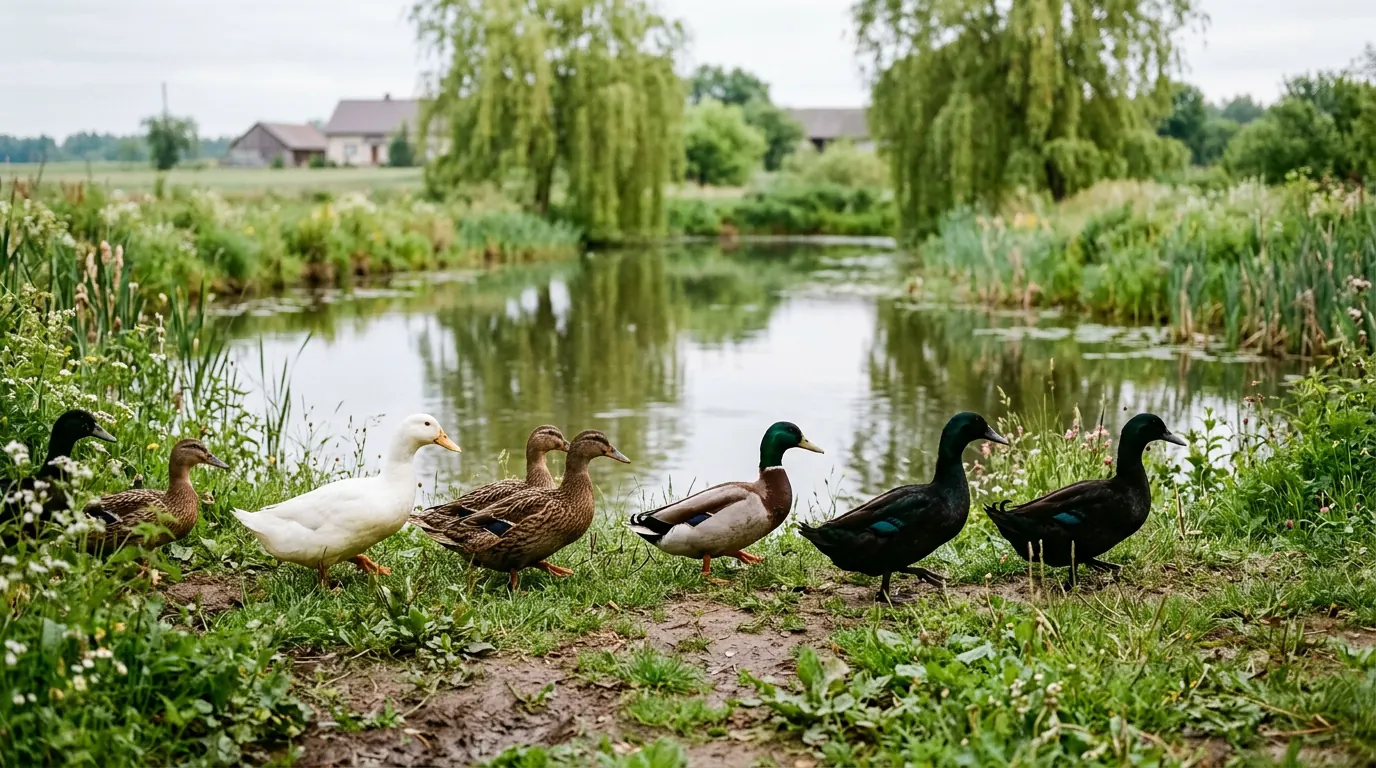
Rare duck breeds are mostly light laying breeds developed in Britain in the 20th century. Three of them come up most often: the Magpie, the Welsh Harlequin and the Abacot Ranger. All of them lay well, are lively and like to forage on range. They are not suited to intensive meat fattening, because their carcasses are lighter than those of meat breeds. For a basic overview of popular breeds, see the table of duck breeds.
Why they are worth knowing
Keepers choose these breeds for three reasons. First, they make good use of feed from the range and do not need expensive feeding. Second, you can sell their eggs directly to customers who want something different from standard hen eggs. Third, their rarity means selling purebred ducklings to other keepers can bring extra income. Keep in mind that a rare breed means a small choice of ducklings, so plan your purchase well ahead.
Magpie duck
Origin and appearance
The Magpie is a British breed developed in Wales in the early 20th century. The name comes from the magpie bird, because the duck has contrasting black and white plumage. The typical pattern is a dark cap on the head, a dark back and tail, and a white body. It also comes in blue and chocolate varieties, but black and white is the most common. The bird has a light, slim build and an upright, lively walk. Ducklings hatch with dark or light down, and the correct plumage pattern shows only after the first molt.
Performance and temperament
Magpie ducks are regarded as good layers, and they also give a compact, tasty carcass. Laying depends on the line, age and feeding, so we do not promise specific numbers. Ask the breeder for the results of their own flock. The birds are active, alert and happy to forage in a meadow. Ducks tolerate cold well, but they dislike mud and damp bedding in the house. If eggs are your main goal, compare them with other laying ducks.
Welsh Harlequin
Where it comes from
The Welsh Harlequin originated in Wales in the 1940s. A breeder noticed ducklings with a lighter, different coloring in a flock of Khaki Campbell ducks and began breeding them as a new variety. That is why the breed is closely related to the Khaki Campbell, considered one of the best laying ducks. In the Harlequin, the drake usually has a darker head and neck with a greenish sheen, while the duck is light, creamy brown, with delicate feather markings.
Laying and temperament
The breed has a reputation as a very good layer, which is no surprise given the Khaki Campbell link. The ducks are calm and tame easily, so they work well on small farms with children and for direct egg sales. They have a medium body weight, so they are lighter than typical meat ducks. Females usually do not like to sit on eggs, so an incubator is often used for breeding. When buying, check that the birds show true breed traits, because with loose selection the coloring easily fades.
Abacot Ranger
Origin and features
The Abacot Ranger is a British breed developed in the first half of the 20th century by crossing laying ducks. It has an upright stance, but less extreme than the Indian Runner. The variety you will meet most often has creamy-brown plumage with a darker head. The birds are lively and very active on range, find food well and readily cover long distances. For the keeper this means solid fencing and plenty of outdoor space.
Who this breed suits
The Abacot Ranger fits a flock where eggs and low feed costs matter, because in season a large part of the food comes from the range. It is less known than the Pekin or the Muscovy, so buying ducklings takes more searching. The birds have a lively temperament and spook more easily than Harlequins. We describe the feeding rules for adult ducks in the guide to feeding geese and ducks.
Magpie, Harlequin or Abacot: which to choose
All three breeds are light and good layers, so they differ mainly in looks and temperament. Choose the Magpie if you want striking, contrasting plumage. The Welsh Harlequin suits you if you want calm, easy-to-handle birds. We recommend the Abacot Ranger for flocks on a large range, where activity and foraging count. Before buying, decide whether you want eggs, ducklings to resell, or show birds, because that determines the breeding line you pick.
Rare breeds versus meat breeds
If you plan to sell meat, rare laying breeds are a weak choice, because growth and carcass weight are lower than in meat breeds. For meat production, meat lines work better; we cover them in the overview of meat breeds. On a mixed farm, though, you can keep laying ducks next to hens and use the same records.
How to start keeping a rare breed
Buying and quarantine
Buy ducklings and hatching eggs from a reliable breeder, ideally with documented origin. A rare breed does not exempt you from biosecurity: keep new birds separate for a quarantine period set by your vet. We gathered buying tips in the guide on where to buy goslings, ducklings and guinea fowl chicks. Flock health is also protected by testing for Salmonella and by worming, described in the article on worms in ducks.
House and range
Ducks need dry bedding, a ventilated shelter that you can close at night, and a drinker where they can dip their bills without spilling water all over the house. Wet bedding encourages disease, so replace it regularly. We describe space and equipment in the article on duck house requirements. With a small flock, keep notes on laying and health; with a larger one, use the flock records in DlaFerm.pl.
Frequently asked questions
What is the difference between a Magpie duck and a Welsh Harlequin?add
The Magpie has contrasting black and white plumage, while the Welsh Harlequin is lighter, creamy brown with a greenish sheen on the drake. Both are light laying breeds from Britain. The Harlequin descends from the Khaki Campbell and is usually calmer.
Do rare duck breeds lay well?add
Yes, the Magpie, Welsh Harlequin and Abacot Ranger count as laying breeds. The exact number of eggs depends on the line, age and feeding, so ask the breeder for their flock's results. You will find a breed comparison in our article on laying ducks.
Where can I buy Abacot Ranger or Magpie ducks?add
Most often from private breeders and clubs for ornamental poultry, not from large hatcheries. Ask about the birds' origin and the conditions they were kept in. You agree the price directly with the seller, because it depends on line and age.
Are these ducks good for meat?add
You can slaughter them, but their carcasses are lighter than those of meat breeds, so meat production pays less. It is better to treat them as laying and breeding birds. For fattening, choose meat lines.
What conditions do rare duck breeds need?add
They need dry bedding, shelter at night, access to range and clean water. Solid fencing and a house that closes protect them from predators. Flock health also depends on biosecurity and tests, so ask your vet.
Do I have to register a duck flock in Poland?add
Registration duties depend on the number and kind of birds you keep. In practice, check them with ARiMR (Poland's Agency for Restructuring and Modernisation of Agriculture) and with your county vet before buying ducklings.
Sources & resources
- linkInstytut Zootechniki PIB (National Research Institute of Animal Production) — izoo.krakow.pl
- linkGłówny Inspektorat Weterynarii (Chief Veterinary Inspectorate) — gov.pl/web/wetgiw
- linkARiMR — gov.pl/web/arimr
- linkMinistry of Agriculture and Rural Development — gov.pl/web/rolnictwo
Prepared by: DlaFerm Team based on data from the sources listed · Publisher: INSTA-TECH sp. z o.o.
Keeping several breeds in one house?
Flock records in DlaFerm.pl let you log flock numbers, laying and events for each group of birds separately. Create a free farm account or get in touch.
Phone
+48 796 258 151