Khaki Campbell duck: the best laying duck
The Khaki Campbell is a light duck breed kept for eggs, not meat. We cover its origin, looks and laying, how to feed and house it, and what to watch for in flock health.
verifiedFrom the team that has organised work on poultry farms for years.
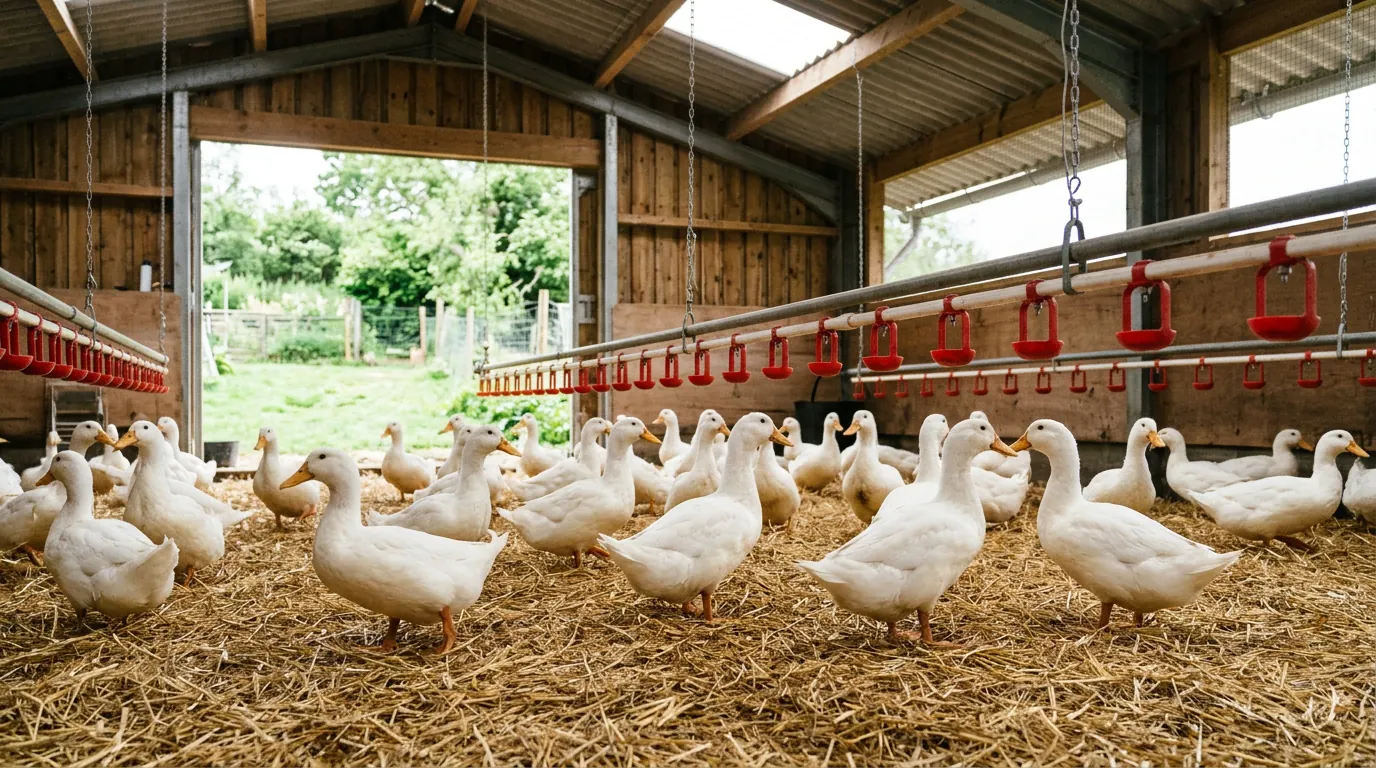
The Khaki Campbell is regarded as the best laying duck. The breed came out of breeding work in England in the late 19th century. Its creator, Adele Campbell, crossed Indian Runner ducks with Rouen ducks and the wild mallard. The goal was a bird that lays eggs through most of the year. Today the Khaki Campbell goes to small farms, backyard flocks and keepers who want duck eggs for direct sale.
Who this breed is for
Khaki Campbell ducks are light, active and good foragers. They are not suited to fattening for meat, because weight gain and body weight are clearly lower than in the Pekin. You choose them when eggs are what you want. For other breeds, their weights and uses, see duck breeds: Pekin, Muscovy, Indian Runner, Staropolska.
Origin and looks of the Khaki Campbell
Plumage color
The name comes from the color: the plumage is khaki, a sandy brown, with darker speckling on the back. On the drake, the head, neck and rump have a greenish, olive sheen. The duck is evenly colored, without a distinct sheen. The duck's bill is dark, the drake's greenish, and the legs are orange-brown. Differences between the sexes show well from about a few weeks of age. Hatchlings are dark, so telling the sexes apart exactly takes experience or help from the breeder you buy from.
Build and body weight
The Khaki Campbell is a light bird with a straight, slightly tilted body. Adult ducks usually weigh about 2 kg, drakes a little more. You can compare exact values for different poultry species in the table poultry body weight. Low weight has advantages: the ducks eat less feed than meat breeds, are nimble and do well on range. They tolerate cold less well and have a stronger urge to escape, so the fence should be higher than for heavy breeds.
Egg laying of Khaki Campbell ducks
How many eggs a Khaki Campbell lays
The breed stands out for laying among ducks. Keepers and breed descriptions say that in good lines ducks lay over 200 eggs a year, and the best layers more. The actual number depends on the line, age, feeding, lighting and conditions in the house, so when you buy, ask about the results of the parent flock. Data on native and bred poultry breeds is published by the National Research Institute of Animal Production (Instytut Zootechniki PIB). Duck eggs are larger than hen eggs and have a white or slightly greenish shell.
Start and decline of laying
Ducks start laying after a few months of life, and peak laying falls in the first year of use. In later years the number of eggs falls gradually. Hens behave the same way, as we describe in laying hen after one year: decline in laying and what next. If you plan to sell eggs, plan flock replacement so that a group of young ducks joins every year. For a comparison with hens, see laying hens: where to start and which breed is best.
Feeding and conditions for Khaki Campbells
Feed and water
Laying ducks need feed matched to the laying period, with enough protein and calcium for the shell. We describe exact norms for ducks in feeding geese and ducks. Do not feed ducks hen feed without checking the composition, because ducks' needs differ from hens'. A duck eats and drinks at the same time, so it always needs access to water deep enough to dip its bill. The container must be deep but placed so the birds do not splash water all over the house.
House, range and stocking density
Ducks do not need perches, but they need dry, clean litter and a shaded spot. We describe construction details in house requirements for ducks, and the placement of the shelter and drinkers in drinkers and equipment for ducks. You can set the number of birds per square meter using the rules in duck stocking density. Also follow the rules on keeping ducks, which we collected in legal standards for keeping ducks.
Eggs for sale
If you sell eggs, collect them daily, preferably in the morning, because ducks often lay at night or early in the morning. Eggs lying in damp litter get dirty and spoil faster. Check the rules for direct sales with Poland's Chief Veterinary Inspectorate (Główny Inspektorat Weterynarii) and the county veterinarian (powiatowy lekarz weterynarii).
Diseases and flock health
The most common threats
When keeping ducks, watch for three problems. The first is Salmonella bacteria, which we cover in Salmonella in ducks. The second is internal parasites, described in worms in ducks. The third is ptaszyniec, covered in ptaszyniec in ducks. Wild waterfowl and dirty water raise the risk of infection, so limit contact between your ducks and wild birds and change the water often.
Treatment and withdrawal period
Do not choose the drug and dose yourself. A vet chooses them after examining the flock. After every treatment a withdrawal period applies, during which eggs and meat may not be sold or eaten. The vet and the product leaflet give the length of the withdrawal period. Record the date the drug was given, the product name and the number of birds treated. That makes it easy to work out when the eggs can be sold again.
Where to buy and whether it pays
Buying ducklings
Buy Khaki Campbell ducklings from breeders who know the origin of the parent flock and can show its laying results. For general advice, including the age to buy, see where to buy geese, ducks and guinea fowl. The price depends on the line, age, number of birds and season. Check current prices directly with breeders, because they change during the year. If you want birds with more interesting colors, see rare duck breeds.
Profitability of duck eggs
Four things decide profit: feed cost, laying rate, the egg selling price and the labor involved. Duck eggs are usually sold directly, so the price depends on the local market and on whether you have regular buyers. You will find the full calculation in profitability of duck keeping. Before you buy a flock, work out daily feed use per bird and compare it with the number of eggs per month.
Frequently asked questions
How many eggs does a Khaki Campbell duck lay?add
In good lines keepers report over 200 eggs a year. The result depends on the line, age, feed and conditions in the house. When you buy, ask the breeder for data from the parent flock.
Is the Khaki Campbell good for meat?add
It is not a meat breed. The ducks weigh about 2 kg and grow more slowly than fattening breeds such as the Pekin. They are kept mainly for eggs.
Does a Khaki Campbell need a pond?add
Ducks can also do well without a pond, but they must have a deep drinker where they can dip their bill. A pond or paddling pool improves welfare, but it needs clean water and regular changes.
Do Khaki Campbell ducks sit on eggs?add
The breed is built for laying, and its broody instinct is weak. To raise ducklings, keepers most often use an incubator, or another duck or a hen as a broody.
Can you keep ducks with chickens?add
You can, but ducks wet the litter heavily and need more water than hens. It is better to give them a separate corner or pen. That also makes it easier to feed each species the right feed.
Sources & resources
- linkNational Research Institute of Animal Production (Instytut Zootechniki PIB) — izoo.krakow.pl
- linkChief Veterinary Inspectorate (Główny Inspektorat Weterynarii) — gov.pl/web/wetgiw
- linkMinistry of Agriculture and Rural Development — gov.pl/web/rolnictwo
- linkEFSA — efsa.europa.eu
Prepared by: DlaFerm Team based on data from the sources listed · Publisher: INSTA-TECH sp. z o.o.
Keep your duck records in the DlaFerm house register module
In the house register module you record eggs laid, losses and feed use for each group of birds. See how it works in the <a href="/program-do-ewidencji-kurnika">poultry house register</a>, then create a free farm account or get in touch with us.
Phone
+48 796 258 151