East Friesian sheep: a dairy breed
The East Friesian is one of the best-known dairy sheep in the world. It gives plenty of milk and often has more than one lamb, but it needs good feed and regular milking. We explain how to recognize it, where it fits on a Polish farm and what to provide in the sheep shed.
verifiedFrom the team that has organised work on poultry farms for years.
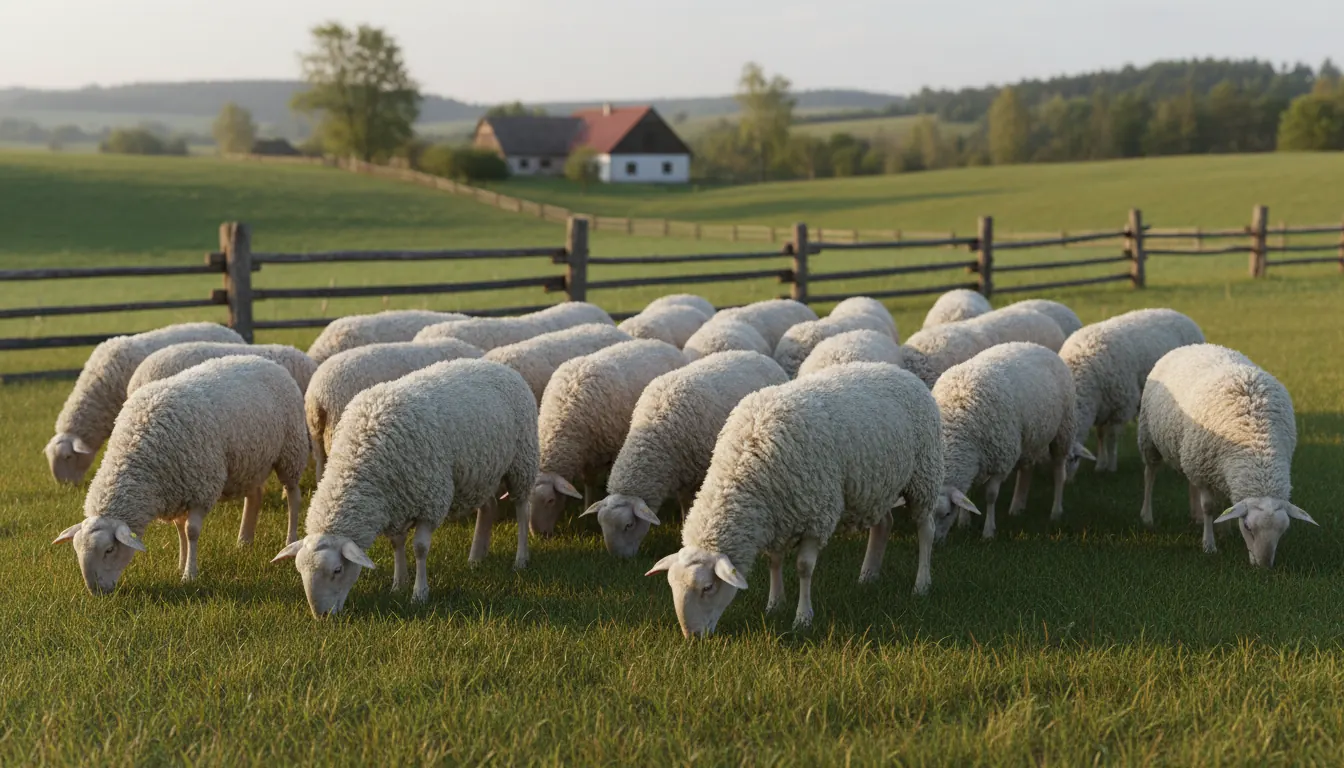
The East Friesian is a breed made for milk production. It comes from northern Germany and the Netherlands, and keepers value it because it gives clearly more milk than meat and wool breeds. The milk is sold or made into cheese, and surplus lambs go to fattening. It suits a farm that has time for regular milking and a good feed base. For an overview of other types, see our article on sheep breeds.
Who this breed is for
Dairy sheep make sense where you can put the milk to use: selling raw milk, running your own cheese dairy or selling direct. Without an outlet for milk, the East Friesian loses its edge over meat breeds, because its carcass is lighter and less muscled. Before you buy your first ewes, read how to start keeping sheep and how to work out the costs.
Origin and appearance
Where the East Friesian comes from
The breed was developed in East Friesland, on the border of Germany and the Netherlands. Milk yield and fertility have been improved in it for decades, so today it is the model dairy sheep, and its rams are used for crossing with other breeds. It is not a native breed in Poland. Keepers choose it for commercial milk production, not for conserving genetic resources, which is what conservation breeds are for.
How to recognize it
The East Friesian is a large sheep with a well-developed frame and a light, dry build. It is white, and the head and legs have no wool or only short, sparse hair. The tail is thin and thinly covered. The ewe's udder is large and well attached, which makes milking easier. Check exact dimensions and body weight in the breed standard from the breeders' association or with the seller, because they differ between lines.
Milk, prolificacy and meat
How much milk a dairy sheep gives
Milk yield depends on the line, the ewe's age, lactation number, feeding and how milking is organized. In these conditions the East Friesian is one of the higher-yielding breeds, but we do not give an exact figure because results differ widely between flocks. The only real data is from your own flock, so record the milk from each ewe. Polish studies cited in the IZ PIB monograph (the National Research Institute of Animal Production) compared the milk yield of the Polish Mountain Sheep and its F1 crosses with East Friesian rams.
Prolificacy and lambs
Ewes of this breed often have twins, sometimes triplets. That is an advantage, because you have more lambs to sell, but the workload grows too. With multiple births a ewe cannot always feed all her lambs, so you need to supplement. A colostrum reserve and milk replacer make this easier. How to prepare the shed and help at birth is covered in our guide to lambing.
Dairy sheep in a Polish flock
East Friesian rams in crossbreeding
A ram of this breed is used to improve milk yield in the daughters of native or meat-breed ewes. The IZ PIB literature lists studies on the milk yield of the Polish Mountain Sheep and its F1 crosses with East Friesian rams. Crossbreds may give more milk, but they lose some of the traits for which local breeds are valued, such as hardiness and easy keeping. Breeds that receive payments for genetic resource conservation lose that status when crossed, so check the program rules first.
Native breeds as an alternative
If you have no outlet for large volumes of milk, consider local breeds that cope better with poor pasture. One example is the Polish Mountain Sheep (polska owca górska) from the Podhale region, tied to the tradition of cheese making. Another is the Olkuska sheep (owca olkuska), known for high prolificacy. According to data from Wiadomości Zootechniczne (IZ PIB), lamb rearing rates in 2016 were 77.4% for the Olkuska and 93.1% for the coloured variety of the Polish Mountain Sheep.
What to feed dairy sheep
Feed for a lactating ewe
High milk yield means high nutritional needs. A lactating ewe eats more than a dry one, and an energy shortfall quickly cuts milk and weakens condition. The base is good hay or silage and fresh pasture grass, plus concentrate matched to the amount of milk. Set the ration with a feeding adviser or from a feed analysis. We cover the basics in our article on what sheep eat.
Grazing and water
Dairy sheep make good use of young grass, but graze them in paddocks to limit gut parasites. Milk is over 80% water, so a lactating ewe drinks a lot, and the drinker must always be clean and full. Paddock rotation rules are in our guide to grazing sheep. In winter, stock up on bulky feed early, because a shortage in the middle of lambing season costs the most.
Sheep shed, welfare and profitability
Floor space
The Poradnik Gospodarski from WODR Poznań (a regional agricultural advisory center), May 2024, gives space standards for sheep. A female over 12 months with a lamb needs at least 2.5 m², plus 0.7 m² for each additional suckling lamb. Under the higher welfare option (eco-scheme) the requirement is 3 m² and 0.84 m² for each further lamb. On top of this comes grazing or access to a run for at least 120 days in the growing season. With a prolific breed, plan room for twins, and size the run fencing of your sheep pen to the number of animals.
Are dairy sheep profitable
Profitability depends on the milk price, feed cost, your own labor at milking and the outlet for lambs. Milk and lamb prices change, so we give no figures. Check current rates with the dairy or buyers, and record results for each ewe separately. Remember the paperwork too: marking and reporting are covered in our guide to registering sheep with ARiMR (Poland's Agency for Restructuring and Modernisation of Agriculture). For milk meant for sale, observe withdrawal periods after medicines.
Frequently asked questions
Is the East Friesian a good sheep breed for milk?add
Yes, it is one of the most widely chosen dairy breeds in the world. It does well on milk volume and prolificacy. It needs good feed and regular milking, though, and without an outlet for milk it loses its edge over meat breeds.
How much milk does an East Friesian sheep give?add
Yield depends on the line, age, feeding and how milking is organized, so we give no exact figure. You get data for your own flock by measuring the milk from each ewe and recording it. Rough values come from the breeders' association or the breeder you buy from.
What dairy sheep breeds are there in Poland?add
Dairy sheep include the East Friesian and its crosses, and the Polish Mountain Sheep, long tied to milk and cheese production in Podhale. Native breeds are usually less demanding but give less milk than specialized foreign breeds.
Do you have to wait after treating a dairy sheep before using the milk?add
Yes. After a medicine there is a withdrawal period, the time when milk cannot be sold. A vet sets the medicine, the dose and the length of the withdrawal period. Record the treatment date and the end of withdrawal for each ewe.
Can East Friesian sheep be grazed on pasture?add
Yes, they use young grass well, but they need a clean drinker and paddock grazing to limit parasites. At high yields the ration from pasture must be topped up with concentrate.
Can native breeds be crossed with a dairy sheep?add
Yes, studies in Poland looked at crosses of the Polish Mountain Sheep with East Friesian rams. Before crossing, check the rules of genetic resource conservation programs, because crossbreds may not qualify for local breed payments.
Sources & resources
- linkIZ PIB — Livestock keeping and breeding over 70 years. Cattle Breeding Department, Sheep and Goat Breeding Department
- linkWODR Poznań — Poradnik Gospodarski, May 2024 (Welfare issues in sheep and goat keeping)
- linkIZ PIB (Wiadomości Zootechniczne) — Development of native sheep breeds in Poland, 2008–2016
- linkAHDB — Reducing lamb losses for Better Returns (Sheep Manual 14)
Prepared by: DlaFerm Team based on data from the sources listed · Publisher: INSTA-TECH sp. z o.o.
Milk after treatment: track withdrawal in the Treatment and withdrawal module
The Treatment and withdrawal module in DlaFerm lets you record treatments and withdrawal dates, which helps for any animal whose products go to sale. We have no separate module for sheep, but the general modules can be adapted for your records. Create a free farm account or get in touch.
Phone
+48 796 258 151