Polish Mountain sheep: the sheep of Podhale
The Polish Mountain sheep (polska owca górska) is a native breed tied to the Carpathians and the Podhale region. Its lambs give Podhale lamb (jagnięcina podhalańska), a regional product with a protected name. We show IZ PIB data on lamb weights and rearing, and the rules of summer grazing on the mountain pasture.
verifiedFrom the team that has organised work on poultry farms for years.
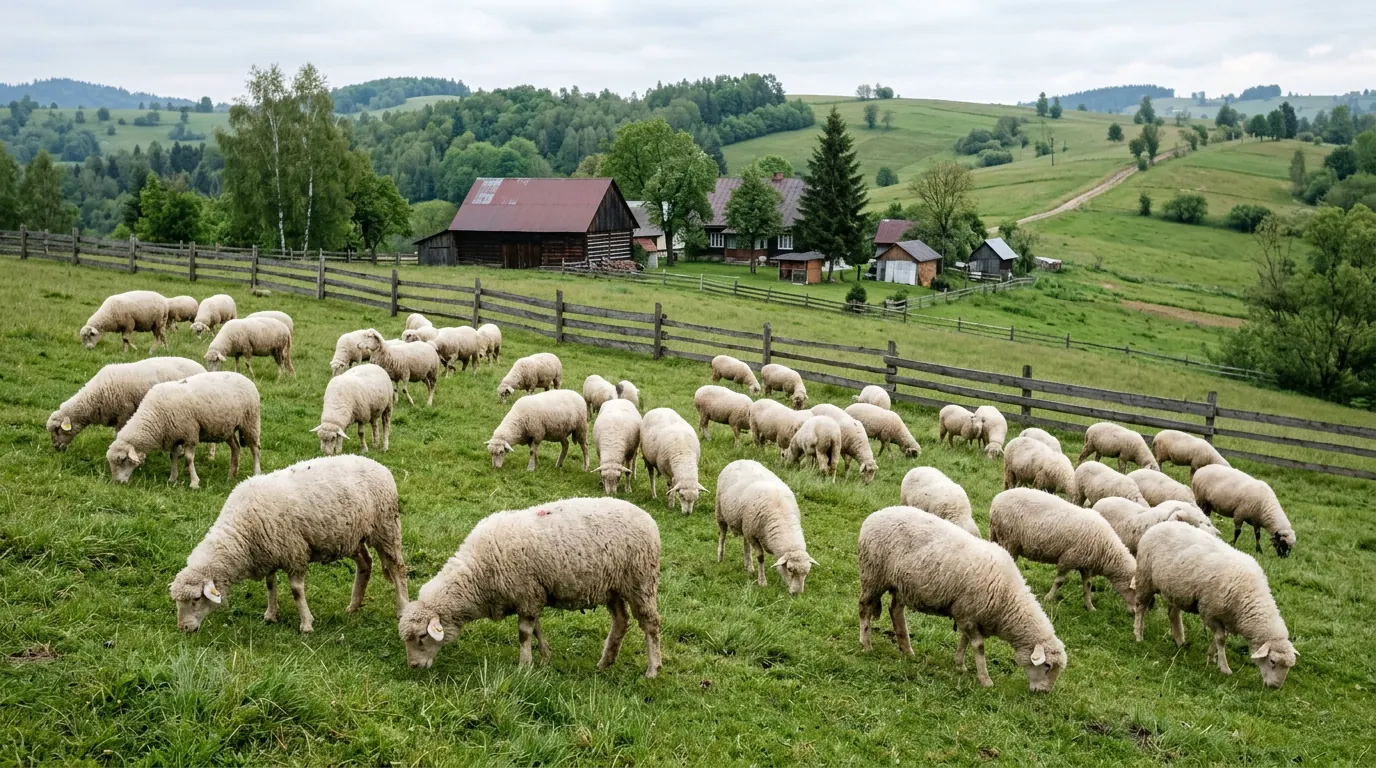
The Polish Mountain sheep is a native breed kept in the Carpathians. In the data of the Instytut Zootechniki PIB (IZ PIB, Poland's National Research Institute of Animal Production) it appears as the "Polish Mountain sheep, colored variety" (polska owca górska odmiany barwnej). Its lambs, together with lambs of the Podhale cakiel (cakiel podhalański), give Podhale lamb. The name of this meat is on the list of regional products and is protected across the European Union. The listing covers the way the meat is produced, so the value of the breed lies in the lambs, not the wool.
Who this breed is for
This is a breed for a keeper with mountain or foothill pasture who wants to sell lambs in season. It is not a heavy sheep like the Wielkopolska or the Coridale. In IZ PIB tables its lambs are clearly lighter than lambs of meat and wool breeds, but rearing stays at a high level. If you are only planning a flock, start with Sheep farming: where to start, what it costs and whether it pays.
What you will find below
We gathered figures from IZ PIB monographs and its journal Wiadomości Zootechniczne: lamb weights, rearing rates in 2008–2016 and the requirements of the regional product. We also describe mountain grazing in the Carpathian tradition. You can compare other breeds in Sheep breeds: meat, wool, dairy and Polish native. Prices of lambs and breeding animals change every season, so we give no amounts.
The Polish Mountain sheep among Polish native breeds
Colored variety and the Podhale cakiel
IZ PIB reports list the Polish Mountain sheep, colored variety, next to a dozen or so other breeds in performance assessments. The Podhale cakiel, a sheep from the same region, appears beside it. Both types go into the same tables and the same definition of Podhale lamb. Lambs of these two groups were assessed on day 30 of life, and other breeds on day 56. So when you compare results, use columns from the same time frame and do not set figures from different days side by side.
Other native breeds
The same IZ PIB tables include native breeds with a different profile. We describe them separately: the wrzosówka, the świniarka and the olkuska. The olkuska is known for prolificacy, but lamb rearing in the 2016 data was only 77.4%. The Polish Mountain sheep had 93.1% that year. The gap shows that the mountain breed copes well with rearing in harder conditions.
Lamb weights and rearing in IZ PIB data
Body weight on day 30
According to the IZ PIB monograph, lambs of the Polish Mountain sheep, colored variety, weighed on day 30 of life: in 2010 10.0 kg (ewe lambs) and 10.3 kg (ram lambs), in 2012 9.8 and 10.1 kg, in 2014 9.7 and 10.0 kg, in 2016 9.7 and 9.9 kg. The Podhale cakiel reached 10.0 kg for ewe lambs and 10.2 kg for ram lambs in 2016. Weight slipped slightly from year to year. If you weigh your own lambs, record the weight on the same day of life so the comparison with these figures makes sense.
Lamb rearing
In Wiadomości Zootechniczne 2018, rearing of lambs of the Polish Mountain sheep, colored variety, was: 94.2% in 2008, 96.9% in 2010, 93.9% in 2012, 93.0% in 2014 and 93.1% in 2016. The Podhale cakiel had 95.1%, 95.6%, 93.7%, 92.3% and 93.0% respectively. These results are higher than for many lowland breeds, for example the wrzosówka in 2016 (88.4%) or the olkuska (77.4%). The authors note, however, that in 2010–2016 the breeding performance of the Polish Mountain sheep, colored variety, showed an unfavorable trend.
What these numbers mean for you
High rearing means most lambs born live to weaning. Low lamb weight, though, limits income per animal. You can raise profit through more lambs per ewe and by selling as Podhale lamb, not by finishing to large carcasses. AHDB's "Better Returns" guides, including "Reducing lamb losses", cover lamb losses. They are worth using when you plan lambing.
Podhale lamb: what it is and how to qualify
Requirements according to IZ PIB
The IZ PIB monograph describes Podhale lamb as meat from lambs of the Polish Mountain sheep and Podhale cakiel breeds. The animal must be no older than 60 days and fed only on its mother's milk. Carcasses weigh 4 to 8 kg. Podhale lamb has been on the regional products list since 2012, and its name is protected and reserved across the European Union. Check the detailed registration and sales requirements on the sites of the Ministry of Agriculture and Rural Development and of ARiMR (Agency for Restructuring and Modernisation of Agriculture).
Being listed and selling
Breed traits alone do not give you the right to the name. You must meet the product conditions: age, feeding method and origin of the lambs. Before you label meat "podhalańska", ask ARiMR or the competent office which documents you need. The Veterinary Inspection (Inspekcja Weterynaryjna) handles information on slaughter and animal identification. Remember also to register the flock and report animals. Flock records help with this, as we describe in the article on sheep farming.
Mountain pasture, the season and Carpathian cooking
Grazing from St. Adalbert's day to St. Michael's day
IZ PIB describes an old transhumance custom in the Carpathians. Sheep began their stay on the mountain pasture (hala) on St. Adalbert's day (23 April) and ended on St. Michael the Archangel's day (29 September). Lambs younger than 6–8 months, born around the turn of March and April, went up with their mothers. Grazing in the mountains is not only tradition. It lowers the cost of bulky feed in the season and suits a breed that tolerates harsh conditions.
How lamb is prepared
According to the monograph, ordinary lamb has little white, odorless fat and light, tender meat. It is enough to marinate it ("rosolić") for a few hours in whey, kefir or red wine. For older lamb the marinade takes 24–48 hours, and for mutton 3–4 days or longer. This knowledge helps when you sell meat directly and answer customers' questions about preparation.
How to run a mountain sheep flock
Health and parasites
On pasture, sheep pick up gut parasites. Set the worming plan with a vet, who will choose the medicine and dose. Keep the withdrawal period before slaughter, because the meat goes on sale. The HCC/AHDB/QMS guide "Worm control in sheep" describes ways to limit parasites. The Veterinary Inspection also publishes a leaflet on bluetongue disease (BTV). Record every treatment and the date the withdrawal period ends. The Treatment and withdrawal period module helps with this.
Comparison with meat breeds
If you want heavier lambs, keepers often cross ewes with rams of meat breeds: Texel, Suffolk or Charollais. Such crossing changes the breed of the lambs, though. They will not meet the definition of Podhale lamb, which requires lambs of the Polish Mountain sheep or Podhale cakiel. Decide before you buy rams and write it into the flock plan.
Biosecurity and visits to the pasture
With direct sales you get more visitors, and with them a higher risk of bringing in disease. Keep a visitor log, set aside a place for protective clothing and control who enters the sheep shed. The QR entry and exit log and the Biosecurity plan generator help with these tasks.
Frequently asked questions
What is the Polish Mountain sheep?add
It is a native sheep breed from the Carpathians and Podhale. In IZ PIB data it appears as the Polish Mountain sheep, colored variety. Its lambs, together with lambs of the Podhale cakiel, give Podhale lamb.
How much do Polish Mountain sheep lambs weigh?add
According to IZ PIB, lambs of the Polish Mountain sheep, colored variety, weighed 9.7 kg (ewe lambs) and 9.9 kg (ram lambs) on day 30 of life in 2016. In 2010 it was 10.0 and 10.3 kg. The data refer to day 30, not day 56 as for many other breeds.
What is the lamb rearing rate of this breed?add
In 2016, rearing of lambs of the Polish Mountain sheep, colored variety, was 93.1%. The highest result in the years studied was 96.9% in 2010. The data come from IZ PIB's Wiadomości Zootechniczne.
What is Podhale lamb?add
It is meat from lambs of the Polish Mountain sheep and Podhale cakiel breeds, up to 60 days old and fed only on their mother's milk. Carcasses weigh 4 to 8 kg. The name has been on the regional products list since 2012 and is protected in the EU.
When do the sheep go up to the mountain pasture?add
In the Carpathian tradition described by IZ PIB, grazing on the pasture ran from 23 April to 29 September. Mothers went up with lambs born in March and April. Today the dates depend on weather and pasture.
How much does a Polish Mountain sheep cost?add
The price depends on age, origin, herd book registration and season. Ask breeders directly or a sheep breeders' association. We give no amounts because they change every season.
Sources & resources
- linkIZ PIB (monograph) — The potential of native sheep breeds in natural food production: tradition, regionality, quality
- linkIZ PIB (Wiadomości Zootechniczne) — Development trends in breeding of native sheep breeds in Poland, 2008–2016
- linkIZ PIB — Farming and breeding of livestock over 70 years. Cattle Breeding Department, Sheep and Goat Breeding Department
- linkAHDB — Reducing lamb losses for Better Returns (Sheep Manual 14)
- linkHCC / AHDB / QMS — Worm control in sheep – for better returns
Prepared by: DlaFerm Team based on data from the sources listed · Publisher: INSTA-TECH sp. z o.o.
Control visitors and treatments on your farm
DlaFerm.pl has no separate sheep module, but the QR entry log and the treatment and withdrawal records also work for a sheep flock. Create a free farm account or get in touch.
Phone
+48 796 258 151