Suffolk sheep: a meat breed for crossing
The Suffolk is a sire breed: you put a Suffolk ram with a flock of mother ewes, and his lambs go to slaughter or finishing. In Poland's breeding program it sits in one group with the Blackhead (czarnogłówka), Ile de France and Texel. We explain how to use it and what to watch for.
verifiedFrom the team that has organised work on poultry farms for years.
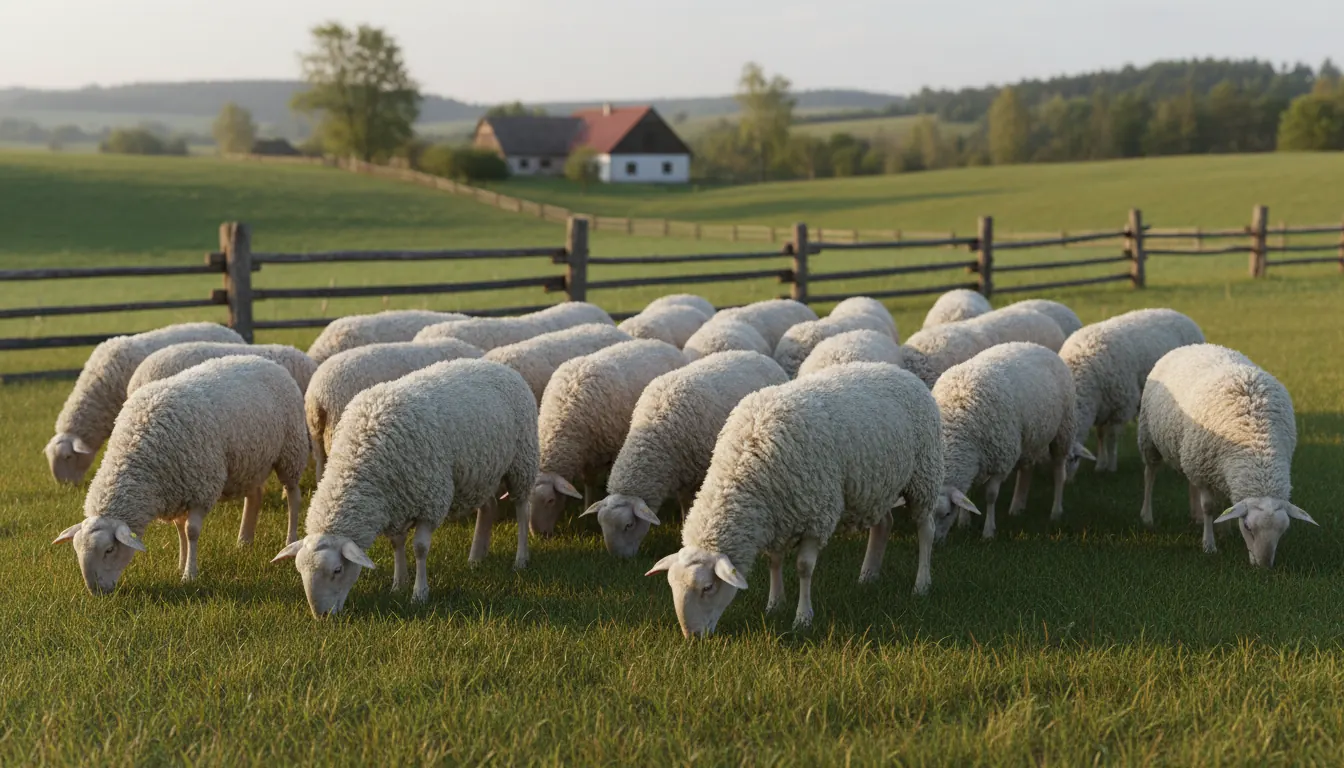
The Suffolk is a meat breed kept mainly so that its rams can be used for terminal crossing. In Poland's breeding program, sheep breeds are split into maternal and sire breeds. According to a monograph by IZ PIB (Poland's National Research Institute of Animal Production), the sire breeds include the Blackhead (czarnogłówka), Suffolk, Ile de France and Berrichonne, and among other meat breeds the Texel, Charolaise, Alpine White, Dorset Horn and Leine. So the Suffolk is not a breed for building a flock of mothers. It is a ram that improves the meat performance of lambs born to ewes of other breeds.
Where the Suffolk fits in your choice of breed
If you are still planning a flock, start with the general guide to sheep farming: where to start and whether it pays. You will find all production types compared in the overview of sheep breeds. A Suffolk makes sense when you already have a flock of ewes and want to sell meat lambs. If you keep sheep for wool, milk or landscape care, buying a Suffolk ram will not help you.
How to use a Suffolk ram
Ewes from maternal breeds
According to IZ PIB, the maternal breeds include Merino, Wielkopolska, Corriedale, Pomeranian, Kamieniecka and the Polish Mountain Sheep. The prolific breeds, treated as maternal, are the Romanov, Finnsheep and Friesian. A Suffolk ram covers ewes from these groups, and you finish and sell the lambs from the cross. Do not keep ewe lambs from this cross as flock replacements if you want to hold on to the mothers' traits. Choose replacements from lambs sired by a maternal-breed ram.
Suffolk, Texel or Charolaise
Teagasc (Ireland's agriculture and food development authority) says a crossbred ewe can be put to a Texel, Suffolk or Charolais ram to increase lamb growth rate. So the choice between sire breeds depends on your priorities, not on which is "best". We describe each breed separately: the Texel, the Charolaise and the Blackhead sheep. Compare them before you buy a ram, because you cannot undo the choice until next season.
Parasite resistance and early lambing
Gut parasites
According to Teagasc, the Texel has higher parasite resistance than the Suffolk. That gives the Texel an edge in organic systems, where worming is limited. The same edge has been described for the Belclare, which carries some Texel genes. The takeaway is simple: with a Suffolk ram, plan parasite control for the flock instead of counting on breed resistance. The guidance on worm control in sheep from HCC, AHDB and QMS recommends testing dung and matching the treatment to the result. A vet always chooses the product and dose.
Lambing early in the season
Teagasc points out one more trait: if you want ewes to lamb early, crossbred ewes with some Suffolk give an advantage. That is an argument for anyone who wants to sell lambs before the main peak in supply. Early lambing does need a dry shed, good feed for the ewes in the last weeks of pregnancy and close attention to lambs in their first days. AHDB covers these points step by step in its material on reducing lamb losses.
Housing needs and feeding
Space and bedding
Describing organic systems in Ireland, Teagasc gives this rule for sheep housed in a building: a solid, bedded floor and no more than 50% slatted area. The minimum space is 1.5 m² per ewe plus 0.35 m² for each lamb. For a flock of 40 ewes with two lambs per ewe, that comes to 88 m² in total (60 m² plus 28 m²). These are Irish organic rules, so in Poland check the current requirements with an ODR (agricultural advisory center) or your adviser. The calculation still lets you estimate how much room you need in the lambing season. Use plenty of straw so the ewe's bed stays dry.
Feed for ewes and lambs
Crossbred lambs grow faster, so they need good feed: a nursing ewe must have access to quality feed, and lambs must be able to pick at solid feed. We cover rations and the grazing season in what sheep eat: feeding on pasture and in the shed. Do not hold lambs destined for slaughter longer than needed: feed cost rises faster than carcass value.
Health, withdrawal periods and your own replacements
Raise your own replacements instead of buying
Teagasc recommends raising your own replacement animals. This lowers the risk of bringing in disease and helps build resistance to local pathogens on your farm. You still have to buy the sire-breed ram. Buy from the best-known source you can, and on arrival keep him apart from the flock for quarantine. Agree the length of quarantine with your vet. Record every entry to the farm and the shed, including visitors and people from service companies.
Treatment and withdrawal period
Any treatment of lambs meant for slaughter brings a withdrawal period: the time after giving a medicine during which the animal cannot go to slaughter. The product leaflet gives the length, and a vet chooses the medicine and dose. For Suffolk crosses you sell on a set date, record the treatment date, the product and the planned slaughter day. You will find information on animal diseases such as bluetongue in notices from the Veterinary Inspection (Inspekcja Weterynaryjna), and the rules from ARiMR (Poland's Agency for Restructuring and Modernisation of Agriculture) and the Chief Veterinary Inspectorate (Główny Inspektorat Weterynarii). See also treatment records and withdrawal periods.
Frequently asked questions
Is the Suffolk a meat sheep breed?add
Yes. According to IZ PIB, the Suffolk is one of the sire breeds in Poland's breeding program, along with the Blackhead, Ile de France and Berrichonne. It is used mainly for crossing with ewes of maternal breeds.
What ewes should you cross a Suffolk ram with?add
Ewes of maternal or prolific breeds, such as Merino, Wielkopolska, Corriedale, Romanov or Friesian. Teagasc also says a crossbred ewe can be put to a Texel, Suffolk or Charolais ram to increase lamb growth rate.
Are Suffolk sheep resistant to parasites?add
According to Teagasc, the Texel has higher parasite resistance than the Suffolk. With a Suffolk ram, plan regular parasite control in the flock. A vet chooses the product and dose.
Are Suffolk crosses good for early lambing?add
Teagasc notes that if you want early lambing, crossbred ewes with some Suffolk give an advantage. They need a dry shed and good feeding at the end of pregnancy.
How much shed space does a ewe with lambs need?add
For organic systems in Ireland, Teagasc gives at least 1.5 m² per ewe plus 0.35 m² per lamb, on a bedded floor. In Poland, check the current requirements with an ODR or your adviser, especially on an organic farm.
Should you keep ewe lambs from Suffolk crosses as replacements?add
Usually not, if you want to keep the mothers' traits. Send the sire-breed crosses to slaughter and build replacements from lambs sired by a maternal-breed ram. Raising your own replacements also lowers the risk of bringing in disease.
Sources & resources
- linkIZ PIB — Livestock farming and breeding over 70 years. Cattle Breeding Department, Sheep and Goat Breeding Department
- linkTeagasc — Teagasc Sheep Open Day 2022
- linkHCC / AHDB / QMS — Worm control in sheep – for better returns
- linkAHDB — Reducing lamb losses for Better Returns (Sheep Manual 14)
Prepared by: DlaFerm Team based on data from the sources listed · Publisher: INSTA-TECH sp. z o.o.
Keep treatments and withdrawal periods in one place
The <a href="/ewidencja-leczenia-i-karencja-lekow">Treatment and withdrawal period</a> module in DlaFerm helps you keep treatment records and track withdrawal dates before you sell animals. Create a free farm account or get in touch.
Phone
+48 796 258 151