Charollais sheep: a French meat breed
The Charollais (also spelled Charolaise) is a French meat breed. In Poland it counts as a sire breed. Farmers mainly use its rams to cross with ewes of maternal breeds, not as the base of a flock. We explain what it is for, what to compare it with and how to keep it.
verifiedFrom the team that has organised work on poultry farms for years.
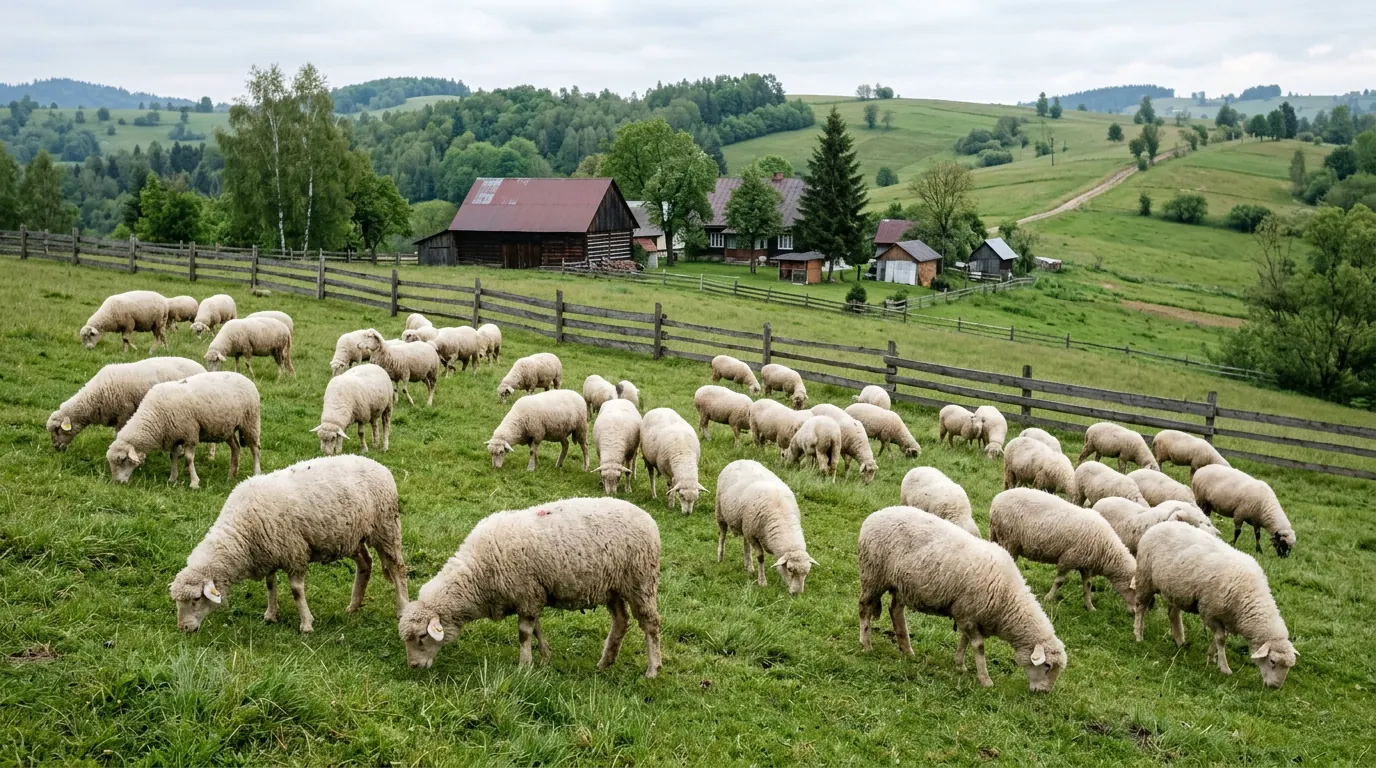
The Charollais (called "charolaise" in Polish sources, and also spelled "charollais") is a meat breed developed in France. In Poland's breeding program, the Institute of Animal Science (Instytut Zootechniki PIB, IZ PIB) lists it among the sire breeds, together with Texel, Suffolk, Blackhead (czarnogłówka) and Ile de France. That means you keep it mainly so that its rams improve muscling in lambs sold for slaughter. If you are still planning a flock, start with our overview of sheep farming and the list of sheep breeds.
Charollais among the sire breeds
The IZ PIB monograph splits the breeds in the Polish breeding program into maternal and sire breeds. The sire breeds include Ile de France, Blackhead, Suffolk and Berrichonne, plus other meat breeds: Texel, Charolaise, White Alpine, Dorset Horn and Leine. Maternal breeds include, for example, Merino, the Wielkopolska sheep, the Pomeranian sheep and the Polish Mountain Sheep. This split sets how each is used: the ewes produce the lambs, and the sire rams give those lambs their meat traits.
Do not confuse it with Charolais cattle
The name "Charolaise" also belongs to a well-known beef cattle breed. Cattle figures in Polish publications do not describe sheep. According to IZ PIB, Charolaise bulls standardized to 210 days weighed 280.2 kg on average, with gains of 1115 g a day. Those values are for cattle. For beef cattle, read our article on the suckler cow system.
What the Charollais sheep is used for
A sire ram for terminal crossing
The main use of the breed is terminal crossing. You put a Charollais ram to maternal-breed ewes and send the lambs to slaughter. You do not keep these lambs for breeding. The sire breed improves meat traits, while the ewe supplies fertility and milk. So the choice of ewes decides the result as much as the choice of ram. When you pick animals, rely on performance assessment and the selection indexes run under the breeding program.
How widely it is used abroad
Teagasc, Ireland's agriculture and food development authority, reports that in Ireland 73% of lowland ewes are sired by one of three main sire breeds: Suffolk, Texel and Charollais. The same material notes that two of these breeds are naturally low in prolificacy. The lesson is practical: a sire ram improves the meat but does not raise the number of lambs per ewe. If lamb numbers matter to you, that depends on the ewe breed, for example a prolific one.
Charollais compared with Texel, Suffolk and Blackhead
Same group, different lines
All these breeds play the same role: they give meaty lambs after crossing. We describe their traits separately: the Texel is known for muscling, the Suffolk is used for crossing, and the Blackhead (czarnogłówka) is a meat breed from Poland. The choice depends on which rams are available near you, on the breed of your ewes and on who buys your lambs. Before you buy, compare the performance results of the individual animals, not just the breed name.
How to choose a ram
Ask the breeder about the ram's origin, the performance results of his parents and the health of the flock. The ram must be healthy, sound on his feet and able to breed through the whole season. Check legs, hooves and teeth. Ask for pedigree papers and a flock health certificate. Agree the price with the breeder, because ram prices change with the line and with demand.
Housing and feeding
Feed for rams and ewes
Before the breeding season, rams and ewes need good condition, not fat. Fit the ration to the animals and the stage of the cycle. In the grazing season the base is good pasture; in winter it is hay or silage with supplementary feed. We cover feeding rules in what sheep eat. Without scales and body condition checks it is easy to overfeed or underfeed.
Conditions in the sheep house
The sheep house should be dry, free of drafts and have room for group lambing pens. Keep rams apart from ewes outside the breeding season so that no accidental matings happen. Change the bedding regularly and clean the drinkers. Record mating and lambing dates, because this makes it easier to plan care around lambing.
Health, lambs and treatment
Rearing lambs
Lamb losses depend on the ewe breed, on feeding before lambing and on conditions in the sheep house. IZ PIB gives lamb rearing rates for native Polish breeds for 2008–2016, and values for individual breeds ranged from several dozen to over 90%. For example, the Wielkopolska sheep reached 94.2% in 2016 and the Olkuska 77.4%. These are data for native breeds, not Charollais, but they show how the ewe breed affects the result.
Parasites and medicines
Agree deworming and prevention with your vet. The vet chooses the medicine and the dose and states the withdrawal period, which is the time after treatment when the animal cannot go to slaughter. Do not sell lambs for slaughter before the withdrawal period ends. Record every treatment as it happens, with the date and the animal's number.
Is a meat ram worth it?
Cost of the ewe and number of lambs
Teagasc reports that the average ewe replacement rate on lowland farms is 22%, and that rearing a ewe to first mating (about 19 months) costs around 25% of the value of her lamb carcasses over her whole life. The ewe carries most of the production cost, not the lamb. The more lambs she rears in her lifetime, the lower the cost per lamb. A meat ram alone will not change that, but it raises the value of each lamb.
Lamb prices
We do not give lamb prices, because they change weekly and depend on season, weight, abattoir and region. Check offers from local buyers, the price reports published by agricultural advisory centers and the IZ PIB studies. Before you buy a ram, work out how much the lamb price would have to rise to cover the extra cost.
Frequently asked questions
Is the Charollais a meat sheep breed?add
Yes, it is a French meat breed. In the breeding program of Poland's Institute of Animal Science (IZ PIB) it is classed as a sire breed, together with Texel and Suffolk.
What are Charollais sheep used for?add
Mainly for terminal crossing: a Charollais ram is put to maternal-breed ewes and the lambs go to slaughter. Crossbred lambs are not kept for breeding.
Is the Charollais a prolific breed?add
Do not assume so. Teagasc notes that two of the three main sire breeds in Ireland (Suffolk, Texel and Charollais) have low prolificacy. Get prolificacy from the ewe breed.
How much does a Charollais sheep or ram cost?add
The price depends on origin, age, performance results and demand, so agree the price with the breeder. Check several offers and compare pedigree papers.
How are Charollais sheep different from Charolais cattle?add
They are two different species that share a breed name. Weight and gain figures in publications on Charolaise usually refer to beef cattle, not sheep.
Who treats sheep and sets the withdrawal period?add
The vet sets the medicine, the dose and the withdrawal period. Before lambs go to slaughter, make sure the withdrawal period has passed, and record all treatments.
Sources & resources
- linkIZ PIB — Livestock keeping and breeding over 70 years. Cattle Breeding Department, Sheep and Goat Breeding Department
- linkTeagasc — Teagasc Sheep Open Day 2022
- linkIZ PIB (Wiadomości Zootechniczne) — Development of native sheep breeds in Poland in 2008–2016
- linkIZ PIB — WZ — Current state and prospects of beef cattle farming in Poland (H. Grodzki et al.), WZ LIII(2015)2:77–87
Prepared by: DlaFerm Team based on data from the sources listed · Publisher: INSTA-TECH sp. z o.o.
Record treatment and withdrawal periods in one place
The Treatment and Withdrawal module in DlaFerm.pl helps you track treatment dates and withdrawal periods before you sell animals. Create a free farm account or get in touch.
Phone
+48 796 258 151