Świniarka sheep: a Polish heritage breed
The świniarka is a native Polish sheep breed protected as a genetic resource. Lambs are small: at 56 days old they weigh about 9–10 kg. The meat carries more fat than that of most other native breeds. Here is what research from IZ PIB says about this breed.
verifiedFrom the team that has organised work on poultry farms for years.
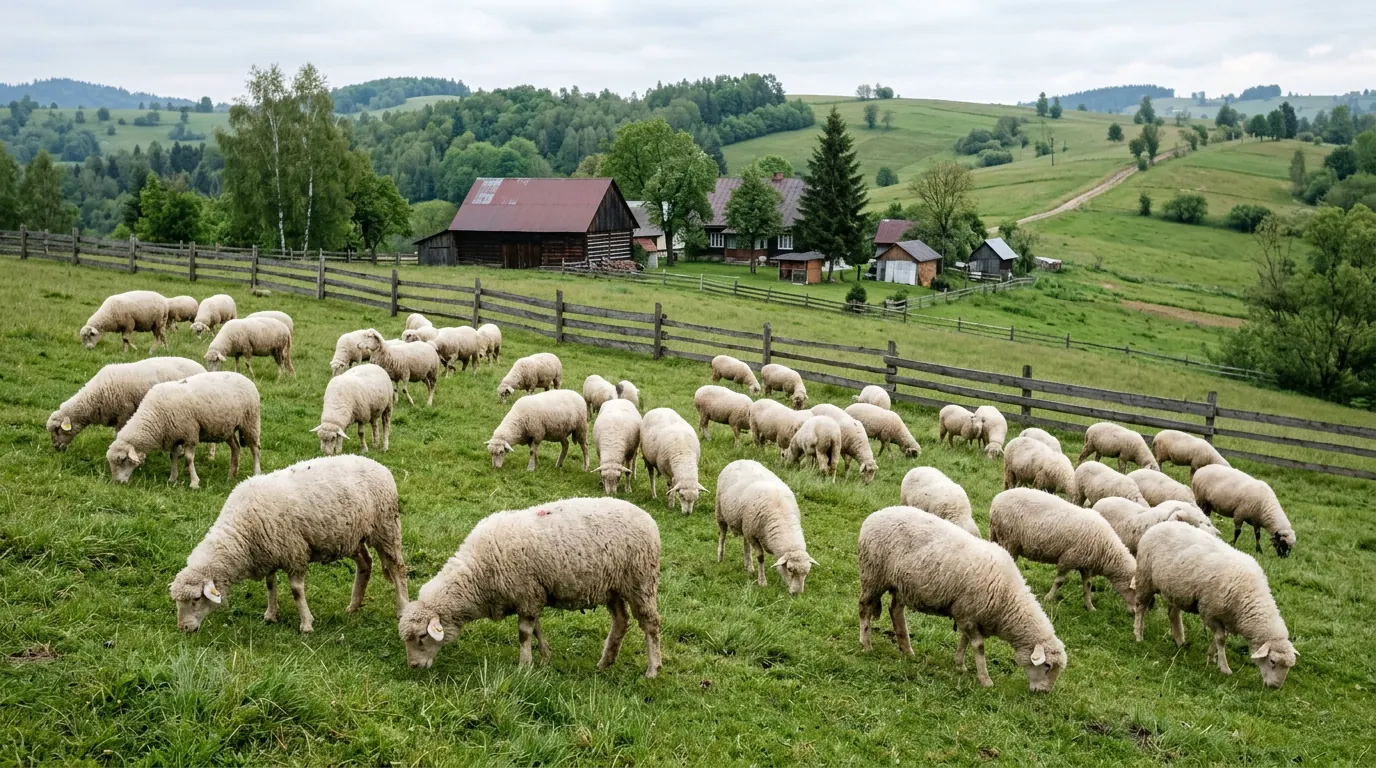
The świniarka is one of Poland's native sheep breeds. It is kept under a genetic resources conservation program because the breed is small in number. The animal is small, and the lambs grow more slowly than those of commercial breeds. So farmers keep świniarka to preserve the breed, for regional meat and for grazing, not for fast weight gain. We describe other native Polish breeds in our catalog of sheep breeds.
Where the data comes from
The figures here come from publications of the Institute of Animal Science, National Research Institute (IZ PIB): a monograph on native breeds and Wiadomości Zootechniczne, a Polish animal science journal (data from 2010–2016). We leave out prices of animals, subsidies and purchase prices, because they change every year. Check current rates with Poland's ARiMR (Agency for Restructuring and Modernisation of Agriculture) and with breeders. The information is current as of 23.11.2026.
Świniarka lamb weights
Data from 2010–2016
According to IZ PIB, świniarka lambs weighed at 56 days old: in 2010, 8.5 kg for ewe lambs and 8.9 kg for ram lambs. In 2012 it was 9.7 and 9.9 kg, in 2014 8.9 and 9.6 kg, and in 2016 9.5 and 10.0 kg. The difference between the sexes is small, usually under 1 kg. Differences between years come partly from how the ewes were fed and from the weather in the grazing season.
Comparison with other breeds
The same tables show how small the świniarka is next to commercial breeds. In 2016, Wielkopolska sheep lambs weighed 19.4 kg (ewe lambs) and 21.7 kg (ram lambs), and Koridale lambs about 20.1 kg. The Olkuska reached 15.6/16.1 kg. Close to the świniarka are the wrzosówka (9.1/9.4 kg in 2016) and the colored variety of the Polish mountain sheep (9.7/9.9 kg). Meat breeds such as the Texel or Suffolk grow faster, but they need better feeding.
Świniarka lamb meat
Chemical composition of the meat
The IZ PIB monograph on native breeds gives the composition of meat from lambs slaughtered at 30–35 kg (świniarka and wrzosówka) or 35–40 kg (other breeds). For świniarka fed on pasture with supplementary feed (marked "KW" in the table), the meat contained 20.48% protein and 5.46% fat. With feeding based on concentrate mix in creep feeders (marked "GM"), it was 19.27% protein and 4.60% fat. In the same comparison, wrzosówka had about 2.10% and 1.74% fat.
Fat compared with other breeds
Świniarka meat has more fat than most native breeds in this comparison: Uhruska 1.96–2.23%, Pomorska 1.27–1.82%, Czarnogłówka 1.76–2.22%. Higher values were found in the old-type Polish Merino (4.62–5.01%) and Wielkopolska sheep (7.47–9.14%). So świniarka meat is juicy, but fattier than that of the czarnogłówka. Deviations in the table can be large, so treat these as approximate values.
How to keep them
What the świniarka is good for
Because the lambs are light, the świniarka is not a breed for fast finishing. It makes sense on farms that combine sheep keeping with landscape care, grazing on poorer land and selling regional meat. If you want to compare breeds for profitability, start with our article on sheep farming. The profitability of sheep keeping is described, among others, by CDR (Agricultural Advisory Center) in Horyzont CDR 2/2026.
Health and biosecurity
Native sheep are fairly hardy, but gut parasites and infectious diseases affect every breed. Set up a worming program with your vet. The vet chooses the medicine and dose, and you keep to the withdrawal period. The Veterinary Inspection (Inspekcja Weterynaryjna) reports on bluetongue, and current notices are on the GIW (Chief Veterinary Inspectorate) website. You can prepare a plan to protect your flock in the biosecurity plan generator.
A heritage breed and its conservation program
Native sheep breeds are kept in genetic resources conservation programs. This means animals are entered in herd books and performance is assessed by authorized organizations. Check the rules, applications and deadlines with ARiMR and the Ministry of Agriculture, because they change each season. IZ PIB publishes data on how native breed numbers developed in 2008–2016. We have gathered breeder documents and animal duties in our regulations section.
Frequently asked questions
What is a świniarka sheep?add
It is a native Polish sheep breed protected under genetic resources conservation. It is small, and lambs at 56 days old weigh about 9–10 kg.
How much does a świniarka lamb weigh?add
According to IZ PIB, in 2016 lambs at 56 days old weighed 9.5 kg (ewe lambs) and 10.0 kg (ram lambs). In 2010 it was 8.5 and 8.9 kg.
Is świniarka meat fatty?add
Yes, it is fattier than that of most native breeds. IZ PIB research found 4.60–5.46% fat at a slaughter weight of 30–35 kg, depending on the feeding system.
How is the świniarka different from the wrzosówka?add
Lamb weights are similar (about 9 kg at 56 days), but świniarka meat has more fat. In the study wrzosówka had about 2% fat and świniarka 4.6–5.5%. We describe the wrzosówka separately.
Is the świniarka good for finishing lambs?add
Not for intensive finishing, because it grows slowly and is small. It works better in extensive systems and for regional meat production.
Where can I check the rules for protecting native breeds?add
With ARiMR, the Ministry of Agriculture and the Institute of Animal Science (IZ PIB). Rules and deadlines change, so always check the current call for applications.
Sources & resources
- linkIZ PIB (Wiadomości Zootechniczne) — Development of native sheep breed farming in Poland in 2008–2016
- linkIZ PIB (monograph) — The potential of native sheep breeds in natural food production: tradition, regionality, quality
- linkIZ PIB (Wiadomości Zootechniczne) — Characteristics of the świniarka sheep population
- linkInstitute of Animal Science, National Research Institute — izoo.krakow.pl
- linkARiMR — gov.pl/web/arimr
Prepared by: DlaFerm Team based on data from the sources listed · Publisher: INSTA-TECH sp. z o.o.
A biosecurity plan for your sheep flock
The biosecurity plan generator in DlaFerm helps you set clear rules for entry, cleaning and quarantine on your farm. Create a free farm account or get in touch with us.
Phone
+48 796 258 151