Wrzosówka Sheep: A Polish Native Breed
The wrzosówka is a small, hardy native sheep, kept mostly on poor pasture, heathland and protected areas. A lamb weighs about 9 kg at 56 days, and prolificacy is around 127%. We show the numbers from IZ PIB research and explain who this breed suits.
verifiedFrom the team that has organised work on poultry farms for years.
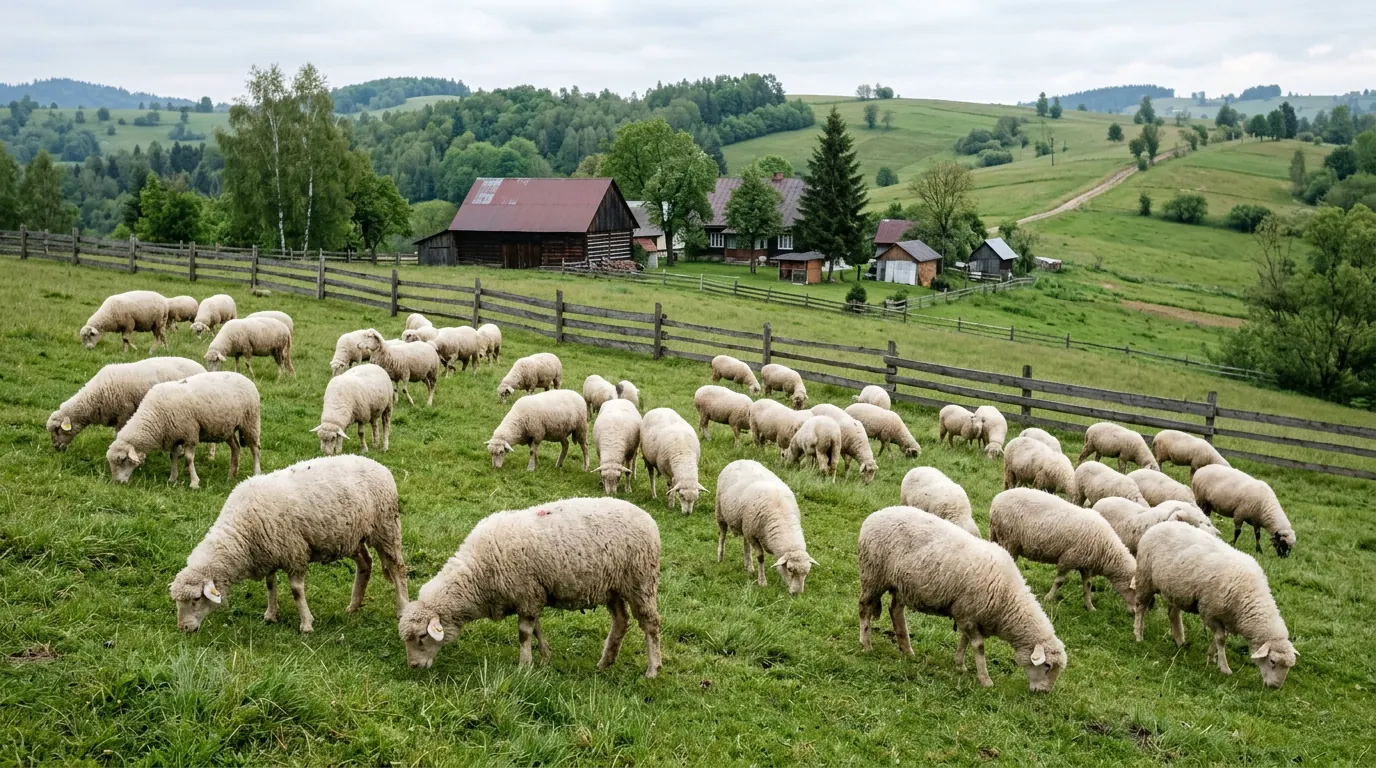
The wrzosówka is a Polish native sheep breed. It is kept as an undemanding, hardy animal that makes good use of poor feed. It cannot match meat breeds for body weight. Its strengths are hardiness, fairly good prolificacy and lamb meat quality. Below are figures from performance recordings run by the Institute of Animal Science, National Research Institute (Instytut Zootechniki PIB, IZ PIB) in 2008–2016.
Who the wrzosówka suits
The breed fits a keeper with a small flock on poorer land, who uses payments for protecting genetic resources, or who sells lamb as a regional product. Do not choose it if you want fast growth and large carcasses. For a general overview of breeds, see sheep breeds. For the basics of starting a flock, see sheep farming: where to start.
Wrzosówka lamb weights
Weight at 56 days
According to IZ PIB (Wiadomości Zootechniczne, recordings from 2010–2016), wrzosówka ewe lambs weighed 9.1 to 9.3 kg at 56 days, and ram lambs 9.4 to 9.7 kg. In 2016 it was 9.1 kg for ewe lambs and 9.4 kg for ram lambs. The result is steady from year to year, with no clear upward trend. This is a small breed, so expect different growth from typical commercial sheep.
Comparison with other native breeds
The same tables show that larger breeds reach much more. In 2016 the owca wielkopolska weighed 19.4 kg (ewe lambs) and 21.7 kg (ram lambs), and the olkuska 15.6 and 16.1 kg. Among breeds of similar small size the wrzosówka is on par: in 2016 the świniarka had 9.5 and 10.0 kg, and the cakiel podhalański 10.0 and 10.2 kg. Read more about related breeds in the articles on the świniarka sheep and the olkuska sheep.
Prolificacy and lamb rearing
Prolificacy
The IZ PIB monograph on 70 years of livestock breeding gives wrzosówka prolificacy for each recording year: 135.9% in 2008, 132.9% in 2010, 125.0% in 2012, 124.0% in 2014 and 127.4% in 2016. That means about 1.27 lambs per ewe after lambing in the last year of the study. For comparison, the świniarka had 121.3% in 2016 and the olkuska as much as 194.6%. So the wrzosówka has average prolificacy among native breeds, clearly lower than the most prolific one.
Lamb rearing
Rearing rate is the share of lambs that survived to weaning. For the wrzosówka it was 88.0% in 2008 and 2010, 84.7% in 2012, 86.1% in 2014 and 88.4% in 2016. In 2016 the świniarka reached 86.0% and the olkuska only 77.4%. Losses of around 12% of lambs are typical for native sheep on pasture. You can reduce them with good care around lambing: a dry, clean lambing place, colostrum given quickly, and watching the ewes in the first days. The UK's AHDB guide Reducing lamb losses gives advice on lamb losses.
Wrzosówka lamb meat
Chemical composition of the meat
An IZ PIB monograph on the potential of native sheep breeds in natural food production analyzes meat from lambs slaughtered at 30–35 kg. Under the KW feeding system, wrzosówka meat contained 21.78% protein and 2.10% fat, and under the GM system 19.12% protein and 1.74% fat. For comparison, świniarka meat had 5.46% fat under KW, and the owca wielkopolska 7.47%. So wrzosówka meat is clearly lean. KW and GM are feeding systems described in the monograph; check the monograph for details.
Selling and profitability
With such small carcasses, profitability depends on selling at a higher price than for a standard lamb, for example direct or as a traditional product. We do not give current prices because they change from season to season. Check them with buyers and in local listings. Economic analyses of sheep farming are in IZ PIB publications on the economics of sheep farming in Poland and on improving the profitability of sheep production in Poland.
How to run a wrzosówka flock
Pasture and feeding
The wrzosówka copes well with grazing poor pasture, so it suits habitat conservation. That does not mean feed does not matter. Before lambing and during lactation, ewes need better feed, because milk and lamb survival depend on it. Work out the ration and composition with a feeding adviser or an agricultural advisory center.
Flock health
Test dung regularly for gut parasites and worm only when the result calls for it. The HCC/AHDB/QMS guide Worm control in sheep sets out the rules for worm control. A vet always chooses the medicine and dose. After treatment, observe the withdrawal period for meat and milk. Follow notices from Poland's Veterinary Inspection (Inspekcja Weterynaryjna), for example on bluetongue disease.
Records and biosecurity
Every animal must be identified and reported to the register. Keep an accurate log of people and vehicles entering, and a biosecurity plan. DlaFerm.pl has general tools that help keep this in order: a QR visitor log, treatment and withdrawal records and a biosecurity plan generator.
Wrzosówka or another breed
If lamb weight matters to you, consider meat breeds such as the Texel or the Suffolk, often used for commercial crossing. If high prolificacy matters, look at the olkuska sheep. If you want a native mountain breed, read about the Polish mountain sheep (polska owca górska) or the czarnogłówka. The wrzosówka is for keepers who value hardiness, protecting genetic resources and lean meat, not maximum carcass output.
Frequently asked questions
How much does a wrzosówka lamb weigh?add
According to IZ PIB, a wrzosówka lamb weighs about 9 kg at 56 days. In 2016 ewe lambs averaged 9.1 kg and ram lambs 9.4 kg.
What is the prolificacy of the wrzosówka sheep?add
In 2016 wrzosówka prolificacy was 127.4%. In 2008 it was 135.9%. That means on average about 1.27 lambs per ewe after lambing.
What is the lamb rearing rate for wrzosówka sheep?add
In 2016 the rearing rate was 88.4%, and in 2012 it was 84.7%. You can reduce losses with good care at lambing and by giving colostrum quickly.
Is wrzosówka meat fatty?add
No. In IZ PIB studies, wrzosówka lamb meat contained about 1.7–2.1% fat and 19–22% protein, depending on the feeding system. Meat from the owca wielkopolska had several times more fat.
Is the wrzosówka a commercial meat breed?add
Not really. It is a small native breed, kept mainly to protect genetic resources and for regional products. For intensive meat production, meat breeds are better.
How much does a wrzosówka sheep cost?add
Prices depend on region, the animal's age and whether it comes from a recorded breeding flock. Look for offers from breeders in sheep breeders' associations and ask for breeding documents.
Sources & resources
- linkIZ PIB (Wiadomości Zootechniczne) — Development of native sheep breed breeding in Poland in 2008–2016
- linkIZ PIB — Livestock farming and breeding over 70 years. Department of Cattle Breeding, Department of Sheep and Goat Breeding
- linkIZ PIB (monograph) — The potential of native sheep breeds in natural food production: tradition, regionality, quality
- linkAHDB — Reducing lamb losses for Better Returns (Sheep Manual 14)
- linkHCC / AHDB / QMS — Worm control in sheep – for better returns
Prepared by: DlaFerm Team based on data from the sources listed · Publisher: INSTA-TECH sp. z o.o.
Keep your sheep farm in order with DlaFerm
The QR visitor log and treatment and withdrawal records help organize the paperwork of any flock, sheep included. DlaFerm.pl has no separate sheep module, but you can try these general tools on your own data. Create a free farm account or get in touch.
Phone
+48 796 258 151