Olkuska sheep: Poland's most prolific breed
The Olkuska is a Polish conservation breed known for multiple births: ewes often have twins and triplets. The price is higher lamb losses and lighter lambs. We give the numbers from IZ PIB data (Poland's National Research Institute of Animal Production) and explain how to run a flock like this.
verifiedFrom the team that has organised work on poultry farms for years.
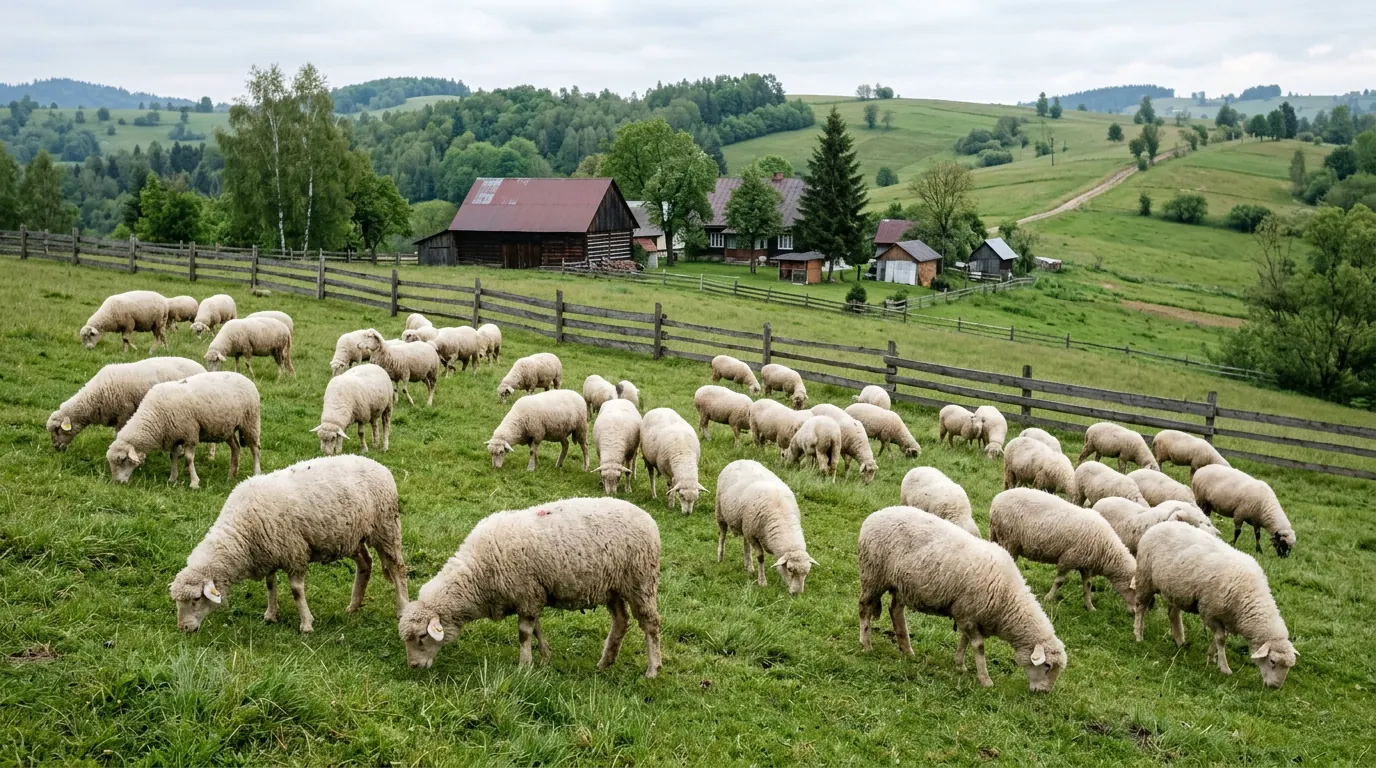
The Olkuska is famous for litter size: ewes often give birth to several lambs at once, which sets it apart from other native Polish breeds. On a farm in south-eastern Poland described in an IZ PIB monograph, the multiple births came mainly from Olkuska ewes, and the lambs from those litters were topped up with goat's milk. You keep this breed for the number of lambs, not their size. For a general overview of breeds, see Sheep breeds: meat, wool, dairy and native Polish.
Where the large number of lambs comes from
The authors of an IZ PIB study on native sheep breeds for 2008–2016 note that big differences in breeding performance between breeds may come from how well some native breeds, the Olkuska among them, are adapted to local conditions, and from their greater resistance to disease. Litter size has a price, though, and the data on lamb survival and weight show it. Both are covered below.
Lamb survival and weight in Olkuska lambs
Litter size
The IZ PIB tables for native breeds in the performance recording scheme give Olkuska litter size (lambs born per 100 ewes lambing) of 220.4% in 2008, 214.0% in 2010, 201.0% in 2012, 199.3% in 2014 and 194.6% in 2016. That is the highest of all the breeds in the table. The next highest in 2016 was 145.9% for the Polish Colored Merino (Merynos polski barwny), and Heath sheep (wrzosówka) had 127.4%.
Lamb survival
According to IZ PIB data (Wiadomości Zootechniczne), the share of Olkuska lambs reared was 72.7% in 2008, 76.8% in 2010, 73.6% in 2012, 74.2% in 2014 and 77.4% in 2016. These are the lowest values among the native Polish breeds compared. For comparison, the Heath sheep had 88.4% in 2016 and the colored Polish Mountain sheep 93.1%. The breed needs more attention at lambing than less prolific breeds. We cover the basics of running a flock in Sheep farming: where to start, what it costs and whether it pays.
Lamb weight
The IZ PIB monograph gives Olkuska lamb weights at day 56. In 2010 they were 15.5 kg for ewe lambs and 16.1 kg for ram lambs; in 2016, 15.6 kg and 16.1 kg. The values are stable from year to year. Olkuska lambs are lighter than Wielkopolska lambs (19.4 kg for ewe lambs and 21.7 kg for ram lambs in 2016) but heavier than Heath sheep lambs (9.1 kg and 9.4 kg in 2016). Compared with the native breed described in Heath sheep (wrzosówka): a native Polish breed, the Olkuska is a medium-sized breed.
What this means for you
A lighter lamb does not rule out profit: what counts is the total weight of lambs reared per ewe per year. When a litter has several lambs, each gets less milk and grows more slowly. With a breed this prolific, supplementary feeding of lambs, checking the ewes' milk and spotting weak lambs quickly in the first days of life all matter.
Lambing and rearing multiple litters
Topping up lambs
The farm in the IZ PIB monograph kept a flock of 22 Olkuska ewes and 2 rams. Lambs from multiple births were topped up with goat's milk from the farm's dozen or so goats. With a big litter, a ewe cannot always feed every lamb. Keep lamb milk replacer ready, clean bottles or feeders, and a separate spot where weaker lambs get an extra feed.
Lamb losses
The British AHDB publication "Reducing lamb losses" says losses are best cut in the first days of life: feed the ewe well before lambing, give colostrum quickly and keep the lambing area clean. These rules apply to every breed, but they matter even more in an Olkuska flock, where survival is naturally lower. Record how many lambs were born and how many lived to weaning. Only those figures show where you lose animals.
Feeding ewes
A ewe carrying several lambs needs more energy in late pregnancy, and more feed after lambing to produce milk. Set the ration to the condition of the flock and the quality of your forage. We cover the basics in What sheep eat: feeding sheep on pasture and in the shed. In prolific breeds, a feed shortage late in pregnancy ends in weak lambs and little milk.
Payments and profitability of a conservation breed
Payments for local breeds
In 2009 the farm in the IZ PIB monograph began keeping conservation-breed sheep covered by funding under the genetic resources protection program, to improve the economics of production. It chose Olkuska sheep first, then Uhruska. Program terms and rates change, so check current rules with ARiMR (Poland's Agency for Restructuring and Modernisation of Agriculture) and with an agricultural adviser. The ARiMR and Instytut Zootechniki PIB websites are useful.
How much income support provides
The IZ PIB analysis "The economics of sheep farming in Poland at the start of the 21st century" shows that Common Agricultural Policy (CAP) support made up 66.98% to 84.82% of flock income, depending on the payment variant. The variant with a per-sheep payment, an agri-environment payment for local breeds and a payment for extensive grassland gave an income of 1,478.01 PLN per breeding ewe. That data is years old and rates are different today. It still shows the principle: in a small conservation-breed flock, support often decides the result.
Meat and sales
The breed is less muscled than meat breeds, so Olkuska lambs will not match the carcass yield of a Texel or a Suffolk. Lamb prices change through the year and depend on weight, timing and buyer. Agree a specific price with a local buyer or direct customer. Many keepers of conservation breeds look to direct and regional sales.
The Olkuska next to other Polish breeds
Native breeds
Among native breeds, lamb weight at day 56 in 2016 was: Heath sheep 9.1 kg/9.4 kg, colored Polish Mountain sheep 9.7 kg/9.9 kg, Olkuska 15.6 kg/16.1 kg and Uhruska 19.7 kg/20.6 kg (ewe lambs/ram lambs). We describe some of them here: Świniarka sheep, Polish Mountain sheep and the Czarnogłówka (Blackhead) sheep.
Which breed to choose
If you want a large number of lambs and have time to look after ewes at lambing, the Olkuska is a good choice. If you want less work and higher lamb survival, look at breeds with a calmer rate of reproduction. Keeping a conservation breed also means keeping flock records. Check the current requirements of the protection programs with ARiMR and the animal science institute.
Health, resistance and flock biosecurity
Disease resistance
The IZ PIB authors say that breeds such as the Olkuska may be more resistant to disease thanks to their adaptation to local conditions. That is their assessment from the studies, and it does not mean your flock is free of parasites. Control of gut worms and pasture rotation are needed in every flock, and you should set a worming program with your vet.
Treatment and withdrawal
A vet always chooses the medicine and dose. After a medicine is given, a withdrawal period applies: until it ends, lambs and milk must not go to the food chain. Record the date, the product name and the animal's number. For animal diseases, including bluetongue, current notices are published by the Main Veterinary Inspectorate (Główny Inspektorat Weterynarii).
Frequently asked questions
What is an Olkuska sheep?add
It is a native Polish sheep breed covered by a genetic resources protection program. It stands out for high litter size, meaning many lambs per birth. The lambs are smaller than those of meat breeds.
Is the Olkuska the most prolific sheep breed in Poland?add
Among the native breeds in the IZ PIB table it has the highest litter size: 220.4% in 2008, falling to 194.6% in 2016. Exact values depend on the flock and the year, so check your own performance recording results.
How much does an Olkuska lamb weigh?add
According to IZ PIB, at day 56 Olkuska lambs weighed about 15.6 kg (ewe lambs) and 16.1 kg (ram lambs) in 2016. Results in 2010–2016 were similar.
What is the lamb survival rate in Olkuska sheep?add
IZ PIB data show 72.7% in 2008 and 77.4% in 2016. That is lower than in many other native breeds. Cut losses with good ewe feeding, quick colostrum and topping up weaker lambs.
Are there payments for keeping Olkuska sheep?add
The Olkuska is one of the breeds covered by the genetic resources protection program, and the farm in the IZ PIB monograph used that funding. Rates and terms change, so check current rules with ARiMR.
Where can I find more about sheep farming?add
Start with our guide to sheep farming and our overview of sheep breeds on DlaFerm.pl. IZ PIB publishes data on native breeds in Wiadomości Zootechniczne and in monographs.
Sources & resources
- linkIZ PIB (Wiadomości Zootechniczne) — Development of native sheep breed farming in Poland in 2008–2016
- linkIZ PIB — Farming and breeding of livestock over 70 years. Department of Cattle Breeding, Department of Sheep and Goat Breeding
- linkIZ PIB (monograph) — The potential of native sheep breeds in natural food production: tradition, regionality, quality
- linkIZ PIB (Wiadomości Zootechniczne) — The economics of sheep farming in Poland at the start of the 21st century
- linkAHDB — Reducing lamb losses for Better Returns (Sheep Manual 14)
Prepared by: DlaFerm Team based on data from the sources listed · Publisher: INSTA-TECH sp. z o.o.
Keep lamb treatments and withdrawal periods in one place
The Treatment and Withdrawal module in DlaFerm lets you log the medicines you give and track withdrawal dates, even when the flock has many lambs from multiple births. Create a free farm account or get in touch.
Phone
+48 796 258 151