Brown Swiss cattle: milk for cheese
In Poland the Brown Swiss averages 7076 kg of milk per cow, with 4.30% fat and 3.54% protein. We show the numbers next to other breeds and explain when this milk pays off.
verifiedFrom the team that has organised work on poultry farms for years.
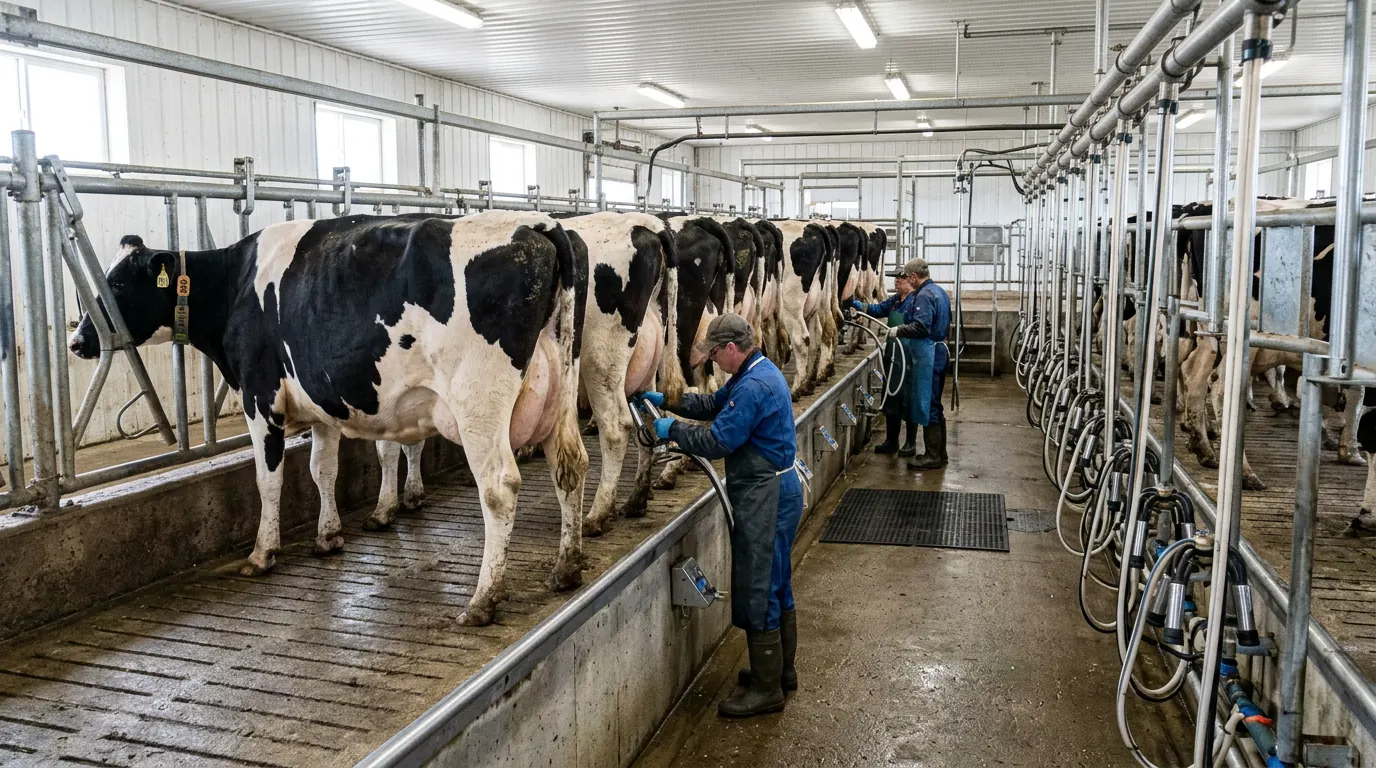
The Brown Swiss (in Polish: rasa szwajcarska brunatna) is a dairy breed valued for milk with high fat and protein. According to a summary discussed by IZ PIB (the National Research Institute of Animal Production) in "Wiadomości Zootechniczne" (2015), 258 cows of this breed in Poland averaged 7076 kg of milk, 4.30% fat and 3.54% protein. The national average in the same summary was 7582 kg of milk, 4.08% fat and 3.36% protein. So the Brown Swiss gives a little less milk than average, but thicker milk. Below we cover the numbers, the breed's place in Poland and the cases where it makes sense to choose it.
Brown Swiss and Brown Swiss cow: one breed
"Brown Swiss" and "Brown Swiss cow" mean the same breed, which Poles call szwajcarska brunatna. In Poland's milk recording it appears next to Holstein-Friesians, Jersey, Montbeliarde and native breeds. It is a small breed in Poland, so you must expect a limited choice of animals and semen. Before you choose it, compare its results with breeds in our catalog, for example Montbeliarde and Jersey. Both compete with the Brown Swiss for the same place in a barn aimed at milk with good composition.
Brown Swiss milk yield in Poland
Milk, fat and protein
The summary by the Polish Federation of Cattle Breeders and Dairy Farmers, described by IZ PIB, gives three figures for the Brown Swiss average cow: 7076 kg of milk, 4.30% fat and 3.54% protein. That is less milk than the Polish average of 7582 kg, but clearly more protein (3.54% against 3.36%) and more fat (4.30% against 4.08%). The result is averaged over 258 cows, so a single herd can look different. It depends on feeding, the stage of lactation and the breeding line. Treat these numbers as a reference point, not a promise for your own barn.
Comparison with other breeds
In the same summary the black-and-white Holstein-Friesian gave 7742 kg of milk, 4.07% fat and 3.35% protein, and Montbeliarde 7203 kg, 3.97% and 3.49%. Jersey had 6009 kg of milk but 5.10% fat and 3.84% protein. The Polish Red gave 3588 kg of milk, 4.31% fat and 3.38% protein. So the Brown Swiss sits in the middle: its yield is close to Montbeliarde, and its milk composition is close to breeds with more solids. We describe Jersey separately in the catalog, and you can read about the Polish Red in its own article.
Why Brown Swiss milk suits cheese
Protein and fat decide the cheese
Cheese is made from milk protein, and the amount depends on protein and fat content, not on liters alone. Milk with 3.54% protein and 4.30% fat holds more solids than milk at the national average (3.36% protein and 4.08% fat). From the same amount of milk a cheesemaker can get more cheese, although the exact yield depends on the technology and the type of cheese. Describing the Simmental, IZ PIB points out that high protein, especially casein, matters for making fine cheeses. The same rule explains the interest in breeds with thick milk.
When less milk pays off
If you sell milk to a dairy by volume, the highest-yielding breed usually wins. If you make cheese on the farm, what counts is how much cheese you get from a day's milking. Then a cow giving fewer liters but with higher protein and fat can come out ahead. Work it out with your own data: record yield, fat and protein from milk recording, then compare cheese yield per liter. Milk and cheese prices change often, so check current rates with your dairy or on the local market instead of relying on old calculations.
Brown Swiss in the Polish herd
The 2015 summary covers 733,241 cows assessed in Poland, of which only 258 are Brown Swiss. That is a tiny fraction, so the breed is a rarity in the country. For a farmer this has several practical effects. Heifers of this breed are harder to buy, the choice of bulls and semen is smaller, and comparing your results with other herds is harder because the sample is small. Before you buy animals, ask the breeders' association about the availability of breeding material and about pedigrees. You will also find information on performance recording in publications of the Institute of Animal Science (Instytut Zootechniki PIB).
Breeds of a similar type
If you want cattle with good milk composition and the Brown Swiss is hard to get, consider other breeds in the catalog. The Pinzgauer is a dual-purpose mountain breed, and the Shorthorn also combines milk and beef use. In the Polish summary Montbeliarde had 2612 cows and a yield of 7203 kg of milk, so it is far more numerous than the Brown Swiss. Each of these breeds has different needs and a different market for calves, so start your choice from what you want to sell: milk, cheese or young animals.
Calves and crossing with beef breeds
Colostrum in the first hours
Whatever the breed, a calf must get colostrum as soon as possible after birth. Teagasc states that the calf should suckle the cow to satisfaction, and when that is not possible, it should get colostrum at 5% of birth weight, about 2 liters for a 40 kg calf. This should happen within about an hour of birth, and the next feeding of colostrum or suckling the dam should follow after 6–8 hours. According to Teagasc, the earlier the calf suckles, the better the absorption of antibodies. The rule applies to Brown Swiss calves and their crosses too.
Dairy cows in crossbreeding
Teagasc notes that beef-dairy crossbred cows give more milk than purebred beef cows, and calves suckling such dams grow faster. Likewise, dairy cows are sometimes used to produce calves for fattening after crossing with beef bulls. In the catalog we describe breeds used for such crossing, for example Charolaise and Limousine. Agree on the choice of bull with a breeding adviser, because calving and calf growth depend on the traits of the particular sire. Check prices of slaughter and fattening calves at buying points and markets as they change.
How to judge whether Brown Swiss fits your farm
Start with your goal. The Brown Swiss makes sense when you turn milk into cheese or sell it to a plant that pays for protein and fat. If you are paid by liters only, the highest-yielding breeds win. Also check whether you can buy animals and semen locally, because limited availability in Poland raises the cost of entering the breed. Before buying, ask for performance results of dams and sires and for animal identification documents. To keep the herd in order, record yield, milk composition and treatment in one place.
Herd records
In a small herd of a specialist breed every cow counts, so good records pay back quickly. Note yield, fat and protein from each recording, calving dates, treatments and medicines given with their withdrawal periods. The DlaFerm system helps you keep such records and links them with registration duties through the IRZplus integration module (IRZplus is ARiMR's online animal register in Poland). A vet always chooses the medicine and dose, and you keep to the withdrawal period before milk goes to sale or into cheese.
Frequently asked questions
How much milk does a Brown Swiss cow give?add
In the summary discussed by IZ PIB (2015), Brown Swiss cows in Poland averaged 7076 kg of milk. The average for all assessed cows was 7582 kg. The result in your herd depends on feeding, lactation and breeding line.
How much fat and protein is in Brown Swiss milk?add
According to the same data, Brown Swiss milk contained 4.30% fat and 3.54% protein. The national average is 4.08% fat and 3.36% protein. This higher composition is why the breed is linked with milk for cheese.
Is the Brown Swiss popular in Poland?add
No. The 2015 summary counted 258 cows of this breed out of 733,241 assessed cows. Animals and semen are harder to buy than for Holstein-Friesians or Montbeliarde.
Brown Swiss or Montbeliarde: which should I choose?add
Montbeliarde gave 7203 kg of milk, 3.97% fat and 3.49% protein, Brown Swiss 7076 kg, 4.30% and 3.54%. So the Brown Swiss has thicker milk, while Montbeliarde is more numerous and easier to get. The choice depends on whether you care more about milk composition or about availability of animals.
How much does a Brown Swiss cow cost?add
The price depends on age, origin, the dam's yield and whether you buy a heifer or a cow in lactation. We give no figure because prices change often. Ask breeders and the cattle breeders' association for current offers.
How should I feed a calf after birth?add
The calf should get colostrum as soon as possible. Teagasc advises that when the calf cannot suckle the cow, it gets colostrum at 5% of birth weight, about 2 liters for a 40 kg calf, within about an hour. The second feeding or suckling the dam should follow after 6–8 hours.
Sources & resources
- linkIZ PIB — Wiadomości Zootechniczne — Current state and prospects of dairy cattle breeding in Poland (T. Piechowska, PFHBiPM), WZ LIII(2015)2:36–45
- linkIZ PIB — Farm animal keeping and breeding over 70 years. Cattle Breeding Department, Sheep and Goat Breeding Department
- linkTeagasc — Teagasc Beef Manual — Section 7: Animal Health
- linkTeagasc — Teagasc Beef Manual — Section 6: Nutrition
Prepared by: DlaFerm Team based on data from the sources listed · Publisher: INSTA-TECH sp. z o.o.
Keep herd records together with IRZplus
The DlaFerm IRZplus integration module helps you keep data on animals and herd events in order. Create a free farm account or get in touch, and we will show you how it works.
Phone
+48 796 258 151