Blue Swedish duck: breed and color inheritance
The Swedish duck is a medium-heavy, dual-purpose breed with blue-gray plumage and a white bib on the chest. The blue color does not breed true: two blue parents produce ducklings in three colors. We describe the breed and show how to plan your pairings.
verifiedFrom the team that has organised work on poultry farms for years.
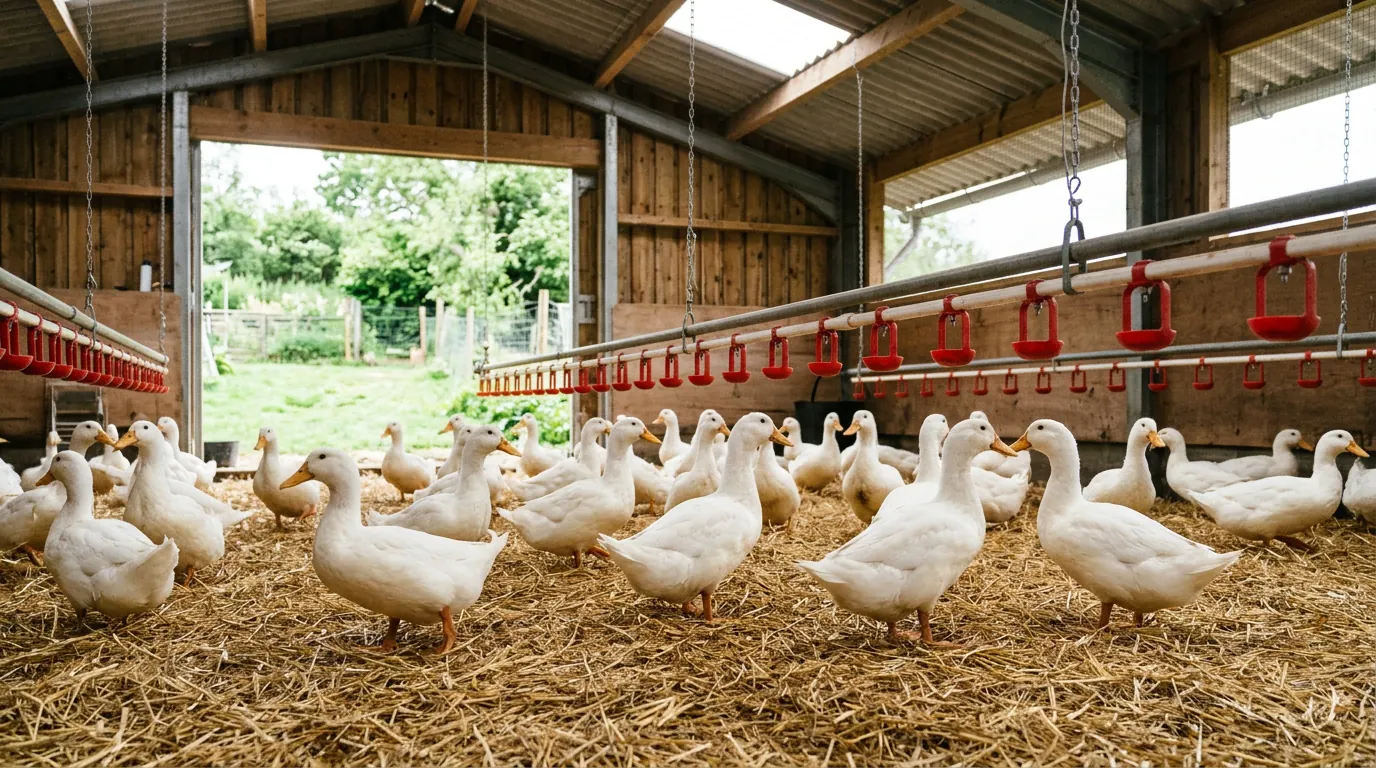
The blue Swedish duck is a medium-heavy, dual-purpose duck: kept for meat, eggs and looks. It has blue-gray plumage, a dark bill and a white bib on the chest. The blue color is inherited incompletely, so two blue parents will not give you all blue ducklings. That is the most useful thing to know about this breed, and we cover it in the most detail.
The Swedish duck and its blue color
If you search for "Swedish duck", you will usually find blue birds, because that color is typical of the breed. The standard also recognizes a black variety with a white bib, and pale birds with dark patches turn up in flocks. We cover them in the section on inheritance. Check exact body weights and egg numbers in the breed standard or with a breeders' association, because they depend on the line.
Who this breed suits
The Swedish duck suits a small farm where ducks have access to water and a run. It gives meat and eggs and looks striking. If you are building a flock from several breeds, compare it with the Pomeranian duck (kaczka pomorska) and the Saxony duck (kaczka saksońska).
Looks and performance of the Swedish duck
How to recognize a Swedish duck
The bird has a sturdy, horizontally carried body and a broad chest. The plumage is blue-gray, from light ash to deep slate. A white patch on the front of the chest, the bib, is a breed feature in the standard. The drake's head and neck are darker, and the bill is dark, bluish or blackish. Drakes and ducks differ in voice and slightly in head color, so judge sex once the ducklings have grown out. Always check specific body weights and measurements in the standard.
Meat and eggs
The Swedish duck is a dual-purpose breed, so it gives both a carcass and eggs. Laying is moderate, typical of medium-heavy ducks rather than laying breeds. If you keep ducks mainly for eggs, compare it with other breeds, for example the Old Polish duck (kaczka staropolska). For meat, growth rate matters, and in traditional breeds it is slower than in commercial ducks. Real results depend on the line, feed and run, so keep your own notes on weights and egg counts.
How the blue color is inherited
Why blue does not breed true
The blue color comes from a gene that dilutes black plumage. A blue bird has one copy of this gene and one copy of black. When you pair two blue birds, each parent passes on one of its two copies at random. This causes splitting: about half the ducklings are blue, about a quarter black, and about a quarter "splash", a pale, almost white color with bluish patches. This is a general rule, not a guarantee for every clutch: in small hatches the proportions can differ a lot.
The same mechanism in chickens
Blue chickens inherit color in a similar way. We describe it in detail for the Andalusian hen (kura andaluzyjska), where two blue birds also give you three colors. Understanding one species helps you plan pairings in the other. With ducks, remember that you usually get fewer ducklings from one hatch and a shorter season, so results come out less evenly.
Which pairings give which color
Pairing chart
The rules are simple. Blue × blue gives about half blue, a quarter black and a quarter splash. Blue × black gives about half blue and half black. Blue × splash gives about half blue and half splash. Black × splash gives, in theory, all blue. Splash × splash gives all splash. Of these, the most convenient pairing for a keeper who wants as many blue birds as possible is black × splash. The proportions given are averages over a large number of ducklings.
What to do with ducklings of an unwanted color
Black and splash ducklings are not a fault: you need them for further breeding. Use black and splash birds for the pairing that gives all blue. If you do not keep those varieties, you can raise them for meat or sell them. Before you plan many pairings, work out how much space you have for each group. For notes on parents and hatches, a plain flock record is enough, for example the DlaFerm poultry house register, where you can record the origin and color of each batch.
Housing and rearing in practice
Run, water and litter
Ducks need a dry, airy shelter for the night and a run with access to water deep enough to dip their bill and eyes. Swimming is not essential, but the drinker must be deep enough for them to rinse in. Litter gets wet quickly, so change it more often than for chickens. In frost the water freezes, so check it in the morning. Keep one drake with several ducks; set the exact ratio from the standard or the advice of an experienced breeder.
Ducklings and buying a flock
Ducklings are sensitive to cold and damp in the first weeks, so they need a heated, dry place and constant access to water. Feed them a feed made for ducks, not a medicated one, as dosing of medicines is decided by a vet. If you buy starter stock, check where the birds come from and ask about the parents' color. We describe where to look for ducklings in where to buy geese, ducks and guinea fowl. For a flock of several breeds, also consider the Cayuga duck or the Rouen duck.
Flock notes and future seasons
What to record
Record the number or mark of the parents, the date eggs were set, the number of ducklings hatched and their colors. After a few seasons you will see which pairs give more blue birds and whose offspring grow faster. Mark ducks with leg rings or tags, and note ducklings by color after hatching. Notes also help you avoid inbreeding, which weakens a flock over time.
Growing the flock
When the flock grows, start keeping records in one place. This lets you compare batch results, watch withdrawal periods after treatment and plan the next placements. We describe the tools in the farm management software module. Start with simple notes and add more indicators later.
Frequently asked questions
Is the Swedish duck always blue?add
No. The breed comes in blue and in black with a white bib. Clutches from blue parents also include pale ducklings with patches.
What do you get from crossing two blue ducks?add
On average about half the ducklings will be blue, about a quarter black and about a quarter pale splash. In small hatches the proportions can drift.
How do you get all blue ducklings?add
Pair a black bird with a splash bird. In theory all the offspring will be blue. Both parents must be of the pure variety.
What is the Swedish duck good for?add
It is a dual-purpose breed, so it gives meat and eggs and looks good on a farm. It is neither a high-laying nor a fattening breed. Specific results depend on the line and conditions.
Where can you buy Swedish duck ducklings?add
Best from a breeder with documented flock origin or through a breeders' association. Prices change with season and color, so ask the seller for the current price.
Sources & resources
- linkInstitute of Animal Science (Instytut Zootechniki PIB) — izoo.krakow.pl
- linkMinistry of Agriculture and Rural Development (Ministerstwo Rolnictwa i Rozwoju Wsi) — gov.pl/web/rolnictwo
- linkChief Veterinary Inspectorate (Główny Inspektorat Weterynarii) — gov.pl/web/wetgiw
Prepared by: DlaFerm Team based on data from the sources listed · Publisher: INSTA-TECH sp. z o.o.
Keeping several color varieties in one flock?
The DlaFerm poultry house register lets you record origin, hatches and duckling colors in one place. Create a free farm account or get in touch.
Phone
+48 796 258 151