Polish Merino: a wool and meat sheep
The Polish Merino is a dual-purpose wool and meat sheep, kept mainly in maternal flocks. In the 2019 BLUP evaluation, 2079 offspring of this breed were assessed, plus 805 head of the old-type Merino. We describe the varieties, prolificacy, lamb carcass quality and the breed's place in commercial crossing.
verifiedFrom the team that has organised work on poultry farms for years.
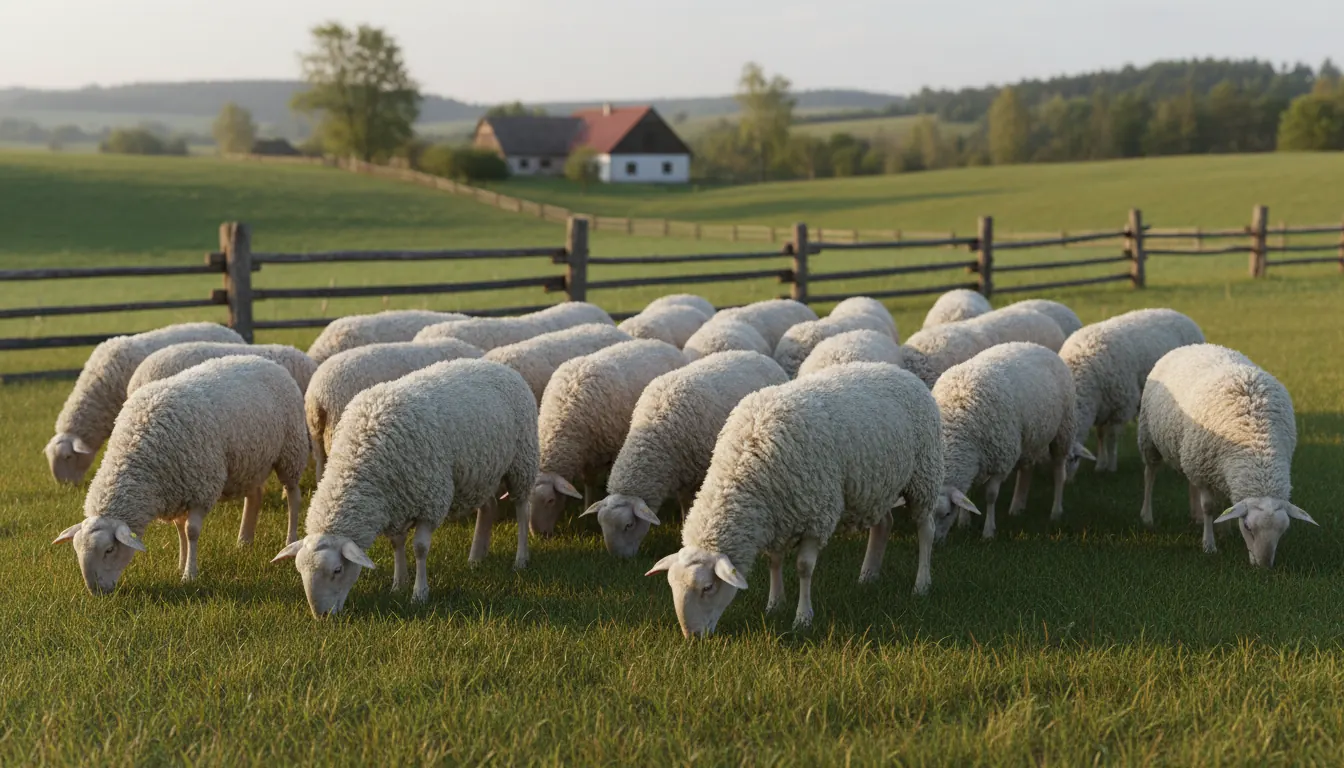
The Polish Merino is a sheep breed with wool and meat use. In breeding value programs it goes into maternal flocks, meaning flocks that supply ewes for further rearing and crossing. Sire flocks are made up of meat breeds, for example the Blackheaded sheep (czarnogłówka) or the Suffolk. According to IZ PIB (Poland's National Research Institute of Animal Production), 10,689 sheep were evaluated with the BLUP method in 2019, and the Polish Merino was among the most numerous maternal breeds assessed.
Polish Merino, old-type Merino and colored Merino
Institute of Animal Science materials use three names: the Polish Merino, the old-type Polish Merino and the colored Polish Merino. Each was evaluated separately. In 2019 the Polish Merino had 96 rams, 1038 ewe lambs and 1041 ram lambs, 2079 offspring in total. The old-type Merino had 32 rams, 420 ewe lambs and 385 ram lambs, 805 offspring in total. The colored variety belongs to the breeds covered by the genetic resources conservation program, so separate studies describe its results.
Who the breed suits
Keepers choose the Merino when they want sheep that give wool and lambs for fattening at the same time. The breed works as mothers for commercial lambs sired by a meat ram. If you are only starting out, read first about how to start sheep farming and compare several breeds in our overview of sheep breeds.
Wool and meat in one sheep
Wool
The name Merino brings to mind fine, soft wool, and rightly so. Wool is the main trait of the breed, so the sheep are shorn regularly, usually once a year, before the grazing season or before spring lambing. The price of wool changes from year to year and depends on quality, the lot and buyer demand. That is why we give no amounts: check current rates with a wool buyer or a breeders' association. Keep the bedding clean and dry, because wool contaminated with hay and litter loses value.
Meat and lamb carcass
IZ PIB compared the carcass composition of lambs from several sheep breeds. According to that table, carcasses of old-type Polish Merino lambs on standard feeding had about 4% fat, while the Świniarka had about 11% and the Blackheaded sheep about 11%. Dry matter in the Merino was about 38%. The practical conclusion: Merino meat is leaner than that of many native breeds. The results apply to lambs assessed in the study, not to every flock, and composition also depends on feeding and slaughter age.
Merino litter weight compared with other breeds
Wiadomości Zootechniczne (a Polish animal science journal) reports litter weight at day 56 for breeds in the genetic resources conservation program. For the colored Polish Merino it was 24.7 kg in 2010, 24.4 kg in 2012, 22.6 kg in 2014 and 25.2 kg in 2016. For comparison, the Olkuska sheep had 27.3 kg in 2016, the Wielkopolska 21.7 kg and the Wrzosówka 10.9 kg. The colored Merino was therefore among the top of the 13 breeds evaluated. We describe the most prolific Polish breed in our article on the Olkuska sheep.
What affects litter weight
Litter weight is the total weight of all lambs of one ewe. It depends on the number of lambs in the litter, the ewe's milk yield, feeding in late pregnancy and during suckling, and the ewe's condition before mating. So record the number of lambs born and reared and their weight at a fixed age. Without such records you cannot judge which ewes to keep in the flock. For weighing at day 56, have a scale ready and enter the result in your records straight away.
The Merino as mother of commercial lambs
Meat breed rams
The most common use of the Merino is maternal ewes mated to a meat breed ram. Crossbred lambs have better muscling than a pure Merino, while the mother supplies milk and wool. Sire flocks evaluated by IZ PIB in 2019 included Ile de France, Blackheaded sheep, Suffolk, Berrichonne and Charollais. Our pages also cover the Texel sheep as a strongly muscled breed. Choose the sire breed to suit the size of your ewes, to avoid difficult lambing.
BLUP evaluation and choosing a ram
The BLUP method estimates an animal's breeding value from the results of its family, not just from its own appearance. In 2019 it was used to evaluate 4179 ram lambs and 4142 ewe lambs in maternal flocks. When buying a Merino ram, ask the breeder for performance evaluation results and pedigree. A ram with a pedigree and evaluation lets you improve the flock over generations, not just hold its current level.
Feeding and health of a Merino flock
Minerals and condition
Teagasc, Ireland's agriculture and food development authority, describes how cobalt deficiency in sheep causes loss of condition, poor fleece quality, lack of appetite, watery eyes and more parasites. Selenium deficiency is linked to slower lamb growth and white muscle disease. Sheep do not store cobalt, so they need it throughout the grazing season. In wool sheep, poor wool is often the first sign of a deficiency. If you see such signs, ask a vet to examine the flock and choose mineral supplements.
Parasites and treatment
Plan worming with your vet, based on a fecal test rather than a calendar. The vet chooses the medicine and dose. Record the name of the medicine, the date given and the withdrawal period before a lamb or milk is sold. You can keep these records in the treatment and withdrawal period module. Also prepare a separate biosecurity plan for the whole farm, for example with the biosecurity plan generator.
How the Merino differs from native breeds
Native breeds such as the Świniarka, the Wrzosówka or the Polish Mountain Sheep are less prolific than the Merino. Litter weight of the Wrzosówka and Świniarka in 2016 was about 10.9 kg, against 25.2 kg for the colored Merino. In return, native breeds give meat with more fat and cope well on poor pastures. The Merino needs better feed but gives more lambs and wool. If you keep sheep under the genetic resources conservation program, check current payment conditions with ARiMR (Agency for Restructuring and Modernisation of Agriculture) and your agricultural advisory center.
Frequently asked questions
What is the Polish Merino sheep used for?add
The Polish Merino is a wool and meat sheep. It gives wool and lambs for fattening, and on commercial farms it is most often the mother of lambs sired by a meat breed ram. According to IZ PIB it goes into maternal flocks.
How many Merinos were evaluated in the BLUP program?add
In 2019 IZ PIB evaluated 2079 offspring of the Polish Merino and 805 of the old-type Polish Merino. In total, 10,689 sheep were evaluated with BLUP that year.
What is the colored Polish Merino?add
It is a variety of the Polish Merino covered by the genetic resources conservation program. In 2016 its litter weight at day 56 was 25.2 kg, according to Wiadomości Zootechniczne.
Is Merino meat fatty?add
According to IZ PIB studies, carcasses of old-type Merino lambs had about 4% fat, while carcasses of the Świniarka and Blackheaded sheep had about 11%. The result depends on feeding and slaughter age.
How much does a Merino sheep cost?add
Prices vary with origin, breeding value evaluation, age and sex of the animal. You can get a specific price from a breeder or a sheep breeders' association.
Sources & resources
- linkIZ PIB — Livestock keeping and breeding over 70 years. Cattle Breeding Department, Sheep and Goat Breeding Department
- linkIZ PIB (Wiadomości Zootechniczne) — Development of native sheep breed breeding in Poland in 2008–2016
- linkIZ PIB (monograph) — Potential of native sheep breeds in natural food production: tradition, regionality, quality
- linkTeagasc — Teagasc Sheep Open Day 2022
Prepared by: DlaFerm Team based on data from the sources listed · Publisher: INSTA-TECH sp. z o.o.
Plan biosecurity for your sheep flock
Try the biosecurity plan generator in DlaFerm.pl. It sets out the rules for entering the farm and handling visitors. Create a free farm account or get in touch.
Phone
+48 796 258 151