Mastitis in Cows: Symptoms, Somatic Cell Count and Prevention
Mastitis is inflammation of the mammary gland. It lowers milk quality, cuts yield and raises treatment costs. According to KPODR Minikowo (a Polish agricultural advisory center), 75% of the total cost of mastitis comes from subclinical cases, which you cannot see in the milk or on the udder. We cover symptoms, the role of somatic cell count, dry-off and prevention.
verifiedFrom the team that has organised work on poultry farms for years.
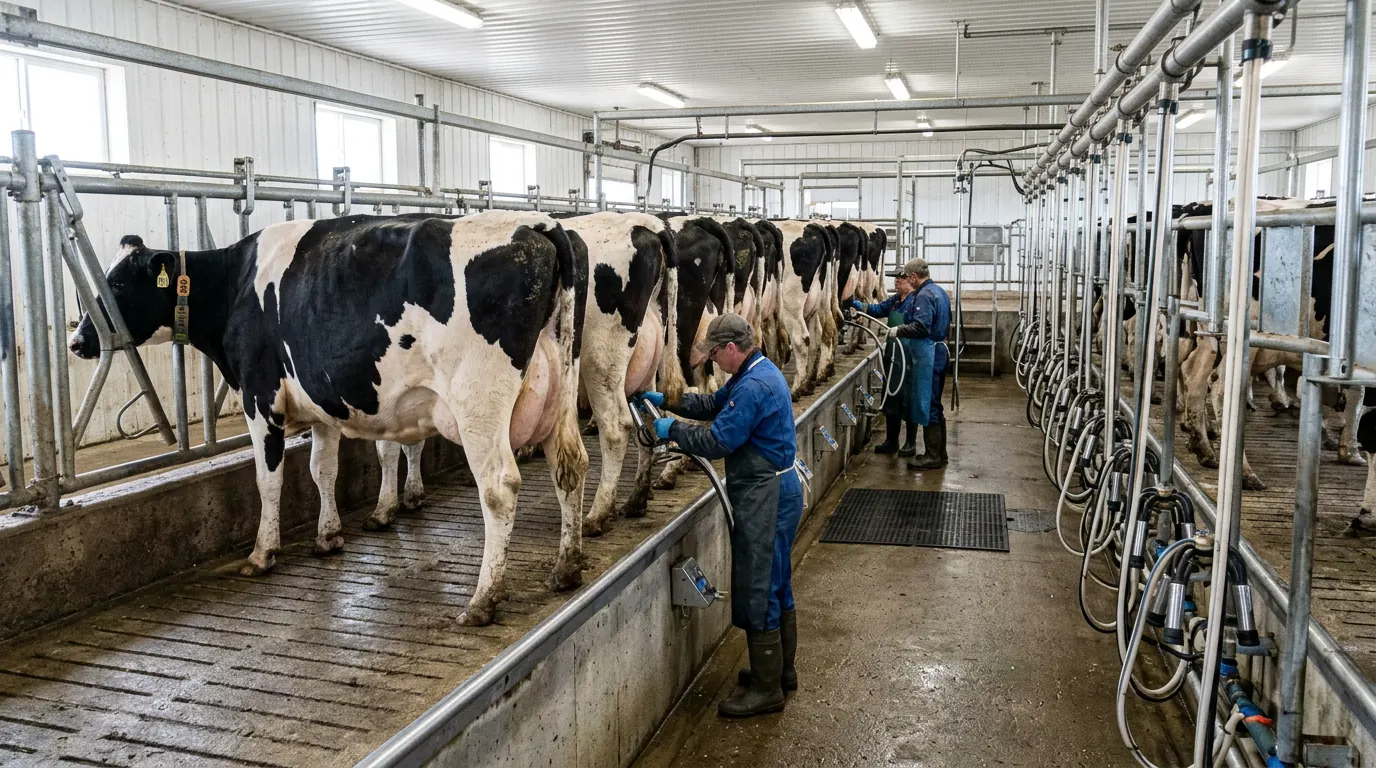
Mastitis is inflammation of a cow's mammary gland. It lowers milk quality, causes a large drop in yield, calls for antibiotic treatment and raises costs. In the worst cases you have to cull the cow. Dairy economists cited by KPODR Minikowo rank udder inflammation, along with fertility problems, among the costliest problems in dairy farming.
Mastitis in cows: what you need to know first
The disease takes two forms. Clinical mastitis shows on the udder or in the milk. Subclinical mastitis shows only as a raised somatic cell count in the milk. The second form costs you more because you do not see it. Below we explain how to detect it, how to lower the risk in the barn and why dry-off matters for udder health. For the anatomy of the udder and teats, see Cow anatomy: stomach, udder, teeth, digestive system.
Mastitis symptoms and how to tell clinical from subclinical
Clinical form
In the clinical form you see changes on the udder or in the milk. The quarter may be swollen, hot and painful to the touch, and the milk changes: clots appear and it turns watery. The cow may eat less and give clearly less milk. Strip the first milk from each quarter into a separate cup before attaching the cluster, and check it at every milking. Final diagnosis and choice of treatment belong to the vet.
Subclinical form
According to KPODR Minikowo, 75% of the total cost of mastitis comes from subclinical cases. They cause no visible changes in the milk or on the udder. You find them by a raised somatic cell count in the milk. The cow looks healthy, yet the herd loses milk quality and yield. Looking at udders is not enough; you need regular milk test results.
When udder signs mean something else
Skin lumps and swelling on the udder, lower milk yield and listlessness do not always mean mastitis. A leaflet from PODR Szepietowo (a Polish agricultural advisory center) on lumpy skin disease (LSD) lists among the signs a high fever above 40°C, skin lumps on the head, neck and udder, and a drop in milk yield. The incubation period of this disease is 1 to 5 weeks. If you see these signs, call the District Veterinary Officer (Powiatowy Lekarz Weterynarii) at once, do not move animals and do not bring new ones into the herd.
Somatic cell count: why you should track it
What the cell count tells you
Somatic cells are the cow's own body cells found in milk. Their number rises when the udder is inflamed. KPODR Minikowo points out that a raised somatic cell count is how you recognize subclinical mastitis. Milk with a high somatic cell count or poor microbiological quality does not meet purchase standards. Your dairy sets the exact limits and payment rules, so check them in your milk supply contract.
Performance recording as a tool
According to KPODR Minikowo, the best way to detect udder inflammation and stop it spreading in the herd is to analyze the data from cattle performance recording. The results show cows whose cell count climbs from month to month. The data also helps you pick animals for herd replacement and for mating. Write down the cow number, the quarter and the date of every case, so that after a few lactations you can see which animals get sick again and again.
What mastitis costs a herd
What makes up the loss
Udder inflammation lowers milk quality and yield and raises treatment costs. PODR Szepietowo lists the costs of mastitis around dry-off: veterinary service and medicines, separating and disposing of milk, and extra labor to care for the sick cow. The same brochure states that an udder that has had mastitis never returns to its earlier productivity. We give no figure, because it depends on the cow's yield, the milk price and the cost of treatment on your farm.
Waste milk
KPODR Minikowo describes waste milk as milk that does not meet purchase standards because of poor microbiological quality or a high somatic cell count. Milk also becomes waste milk during antibiotic treatment of mastitis. Milk from a cow treated with an antibiotic must be kept out of deliveries for the withdrawal period set by the medicine. The same material covers the rules for this milk and its use in calf feeding, so ask your vet what you may do with it.
Preventing mastitis in the barn and on pasture
Milking hygiene
The basis is clean equipment and hygiene at every milking. According to KPODR Minikowo, the number of microbes in milk depends, among other things, on how clean the milk collection and storage equipment is, and on exposure to manure and flies in the environment. We describe pre- and post-milking routines, machine operation and cleaning of the system in Milking cows: parlor, machines and hygiene. Keep a fixed milking order: healthy cows first, cows with mastitis last.
Pasture and housing conditions
A monograph from IZ PIB (Poland's National Research Institute of Animal Production) describes studies in which cows kept on pasture had fewer cases of lameness and hoof disease, and a lower risk of mastitis, metritis, Salmonella enterica infection and retained placenta. The same material notes that cows kept in friendly conditions give more milk, are healthier and live longer. When you build or renovate a barn, pay attention to dry, clean beds and ventilation; for dimensions and equipment see Cow barn: dimensions and equipment for 20, 50 and 100 cows.
Cows with other health problems
A cow weakened by ketosis, acidosis or lameness copes worse with an udder infection. To lower the risk, read Ketosis in cows, Acidosis in cattle and Cow hooves. As PODR Szepietowo writes, the period around calving is a time when the cow's body is delicate and goes through many processes, so watch feeding and cleanliness especially closely then.
Drying off cows and udder health
Why dry off
According to PODR Szepietowo, the aim of dry-off is to end lactation and protect the udder until calving. A healthy udder produces colostrum for the calf and spares the cow mastitis at the start of lactation. Mastitis that develops during the dry period is hard to cure and weakens the cow. Before dry-off, check that the cow has no raised cell count, and decide with your vet on any teat protection.
How to dry off
PODR Szepietowo recommends entering the dry period gradually, so that lactation can wind down. This can be awkward with high-yielding cows, but it is better to spend a few more days and do it properly. Dry-off should cover all cows in the herd, to avoid mistakes and give every animal a chance to recover its udder before the next lactation. Records of calvings and inseminations make it easier to plan dates; see Insemination of cows and heifers.
Treating mastitis and withdrawal periods
Rules to follow
Separate the sick cow from the milking herd and call the vet. The vet decides the medicine, dose and length of treatment after examining the cow and, if needed, testing the milk. Do not give antibiotics on your own. Milk from the treated quarter goes into waste milk until the withdrawal period on the medicine leaflet, confirmed by the vet, has passed. Record the dates of treatment and the end of the withdrawal period, ideally in the Treatment and withdrawal module in DlaFerm.
Is it worth keeping a cow after mastitis
An udder that has had mastitis does not return to its earlier productivity, according to PODR Szepietowo. If a cow has been sick several times, consider culling her, together with her performance records. When you plan the herd, use the recording results and the advice in Dairy cow farming: where to start and whether it pays.
Frequently asked questions
What is mastitis in cows?add
Mastitis is inflammation of the mammary gland. It lowers milk quality, cuts yield and raises treatment costs. It occurs in a clinical and a subclinical form.
How do you detect subclinical mastitis?add
You cannot see it in the milk or on the udder. According to KPODR Minikowo, a raised somatic cell count in the milk points to it. That is why you need regular milk test results.
How many somatic cells in milk is too many?add
The limits depend on your dairy's requirements and the purchase standards in force. Check them in your milk supply contract and ask your vet how to read the results for your herd.
Is mastitis during the dry period dangerous?add
Yes. PODR Szepietowo states that mastitis developing during the dry period is hard to cure and weakens the cow. Dry off all cows in the herd and do it gradually.
Does pasture reduce the risk of mastitis?add
Studies described in the IZ PIB monograph show that cows on pasture have a lower risk of mastitis, lameness and hoof disease. Pasture needs dry resting places and clean milking.
What should I do with milk from a cow treated with antibiotics?add
It is waste milk. Do not deliver it to the dairy during the withdrawal period on the medicine leaflet. Ask your vet how to dispose of it.
Sources & resources
- linkKPODR Minikowo — Modern technologies in dairy cattle rearing and breeding (ed. S. Pater)
- linkPODR Szepietowo — Dry-off and calf rearing as a key aspect of animal production (M. Kacprzak)
- linkIZ PIB — Livestock rearing and breeding over 70 years. Department of Cattle Breeding, Department of Sheep and Goat Breeding
- linkKPODR Minikowo — Rearing beef calves (guide, SGGW authors)
- linkPODR Szepietowo — Lumpy skin disease (LSD) leaflet (Z. Marciniak)
Prepared by: DlaFerm Team based on data from the sources listed · Publisher: INSTA-TECH sp. z o.o.
Record cow treatments and withdrawal periods in the DlaFerm Treatment and withdrawal module
The Treatment and withdrawal module lets you record every medicine given, the date the withdrawal period ends and the milk kept out of deliveries, so you do not get mixed up with several sick cows. Create a free farm account in DlaFerm or get in touch.
Phone
+48 796 258 151