Cow hooves: trimming, hoof disease and lameness
A cow's hoof is the horny part of the toe she stands and walks on. We show how to score gait, when to book trimming, how to spot digital dermatitis and how flooring affects lameness.
verifiedFrom the team that has organised work on poultry farms for years.
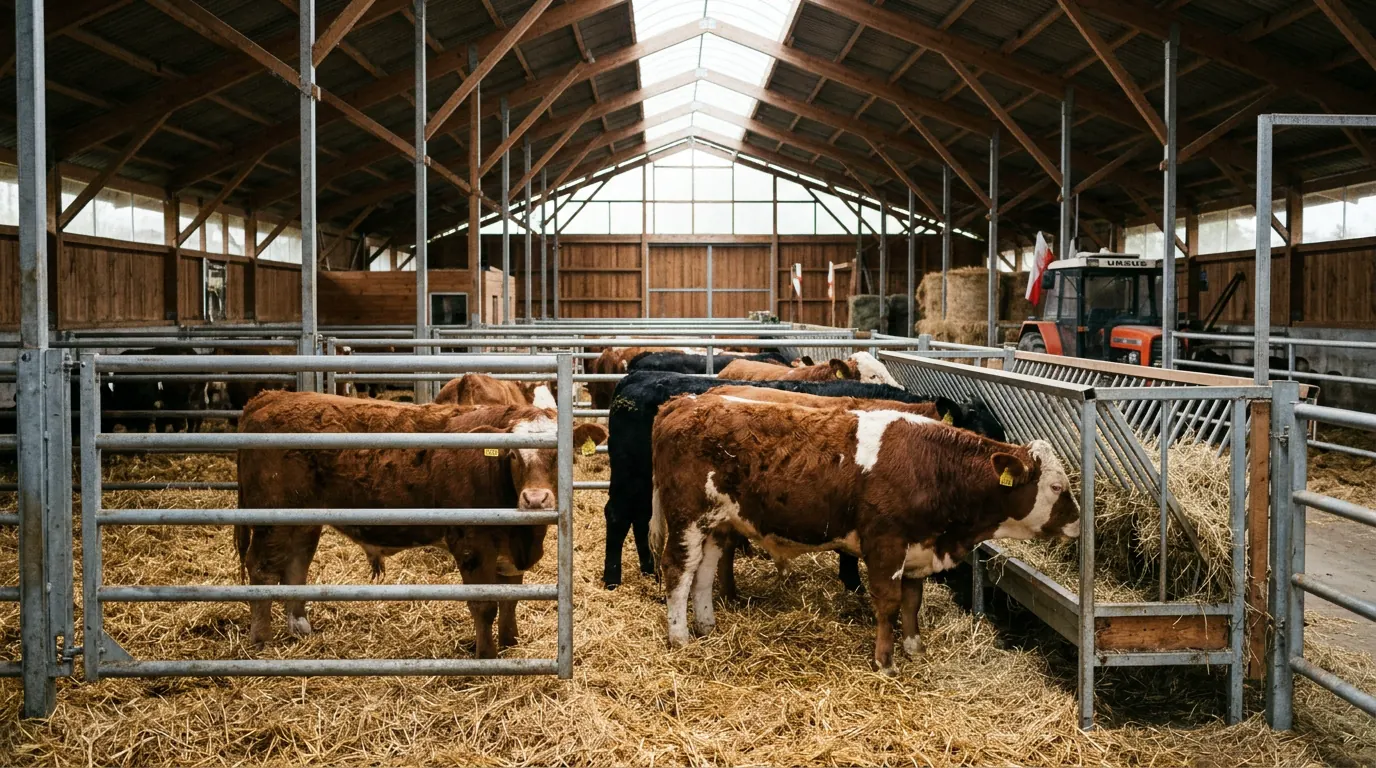
Check cow hooves every day, because lameness is one of the first signs of illness. A cow that spares a leg eats less and walks to the feed barrier less often. People say cow "hooves" or "claws". Each leg has two toes, and each toe ends in a horny claw.
How to tell if a cow is lame
According to EFSA (the European Food Safety Authority), lameness is the inability to walk normally and smoothly on one or more limbs. The EFSA panel proposes a simple two-point scale: 0 means no lameness, 2 means lameness. The more animals score 2, the worse the situation in the herd. The scoring is easy, but you must see every animal moving.
What we cover below
We cover herd scoring, digital dermatitis, the effect of flooring and bedding, hoof trimming and what to do about treatment. For the wider picture of diseases, see the table of cattle diseases.
Lameness: how to count it and how common it is in cattle
Daily walk-through
The Teagasc Beef Manual lists lameness among the signs of poor health, together with loss of appetite, no rumination, coughing and swollen joints. A good stockperson looks at each animal individually at least once a day. Animals at higher risk, such as cows in late pregnancy, are checked more often. Walk through calmly and at the same times each day, so the animals do not run from you and move naturally. That is when gait shows best. Note any cow you suspect of lameness and watch her again on the next round.
How often finishing cattle go lame
EFSA cites several studies. In a 1983 study, lameness affected 4.75% of bulls on slatted floors and 2.43% on straw bedding. In 63 farms in Austria, Germany and Italy, the average was 1.8% to 2.3%, with a range of 0% to 23%. On one large Italian farm, with data from about 18,000 animals over a year, locomotor disorders affected 3.97% of young bulls. The wide range shows that a lot depends on conditions on each farm.
Hoof diseases: digital dermatitis and horn damage
Digital dermatitis
Digital dermatitis is a bacterial infection of the heel bulbs that causes ulcers. EFSA describes severity grades on the M scale, but notes that scoring them requires restraining the animal, as with hoof trimming. Professional hoof trimmers or vets do this. A walk-through alone therefore does not find every case. If you suspect infection in the herd, call a vet and agree a plan to examine several animals.
Damage to the hoof horn
EFSA also lists lesions where the horn of the claw splits. Added to these are mechanical injuries, for example an infected inflammation of the sensitive tissue after a claw puncture, which was seen more often in cattle on slatted floors. Necrotic lesions were more common in pens with straw. Treat every hoof wound seriously, because infection can spread through the whole limb. If you see swelling, heat or severe pain, contact a vet.
Floor, bedding and barn fittings and their effect on hooves
Slatted floor or deep bedding
An Italian study from 2019 covered eight finishing farms. Mild lameness in young bulls was 1.23% and did not depend on floor type. Severe lameness, which led to earlier culling, was more common on concrete slatted floors (1.86%) than on deep bedding (0.56%). When you choose a housing system, compare these results with what your farm can do. We describe building design in our articles on the loose-housing barn and the cattle shelter.
Floor roughness and hoof wear
EFSA cites a recommendation by Steiner and co-authors that about 20% of the floor area in dairy barns be covered with an abrasive material that wears the hooves enough. A rough surface becomes smooth over time, so check the floor's condition. Dairy cows walk longer distances than beef cattle, which are usually kept in smaller groups. For dimensions and fittings, see our article on the cow barn.
Hoof trimming: when and who does it
Trimming in beef and dairy cattle
Hoof trimming shortens and levels the horn so that weight is spread evenly across both toes. EFSA notes that functional trimming is not routine in beef cattle. The reasons are the short finishing cycle and the high risk of injury to the person doing the job. In suckler cows, which stay in the herd for many years, and in dairy cows, trimming is needed more often. Agree timing with a hoof trimmer or vet, because it depends on breed, floor and the condition of the animals.
How to prepare the animal and the place
Trimming is done in a special crush or on a tilt table. Do not try to trim a cow you cannot hold safely, because you risk injury to her and to yourself. Plan a spot with a hard, dry floor and a calm approach. After trimming, record the date and the animal's number, so you know which animals need checking.
Treating hooves and recording procedures
When to call the vet
Call a vet if a cow has been lame on one leg for several days, has a swollen or wounded hoof, or if several animals in the herd are lame. The vet chooses the medicine, dose and length of treatment. Ask about the withdrawal period, which is the time after a medicine is given when milk or meat is not fit for consumption. The product leaflet and the vet's advice give the withdrawal times. Remember that a cow with a sore hoof eats less, which can favor the metabolic disorders described in our article on ketosis in cows.
Record every case
Keep notes: cow number, which leg, date of first observation, score on the 0 or 2 scale, the procedure and the vet's advice. They help you spot repeated problems in one group or one part of the barn. We describe feeding the right ration in our article on what cows eat, and herd rules for dairy in our article on dairy cow farming.
Frequently asked questions
What is a cow's hoof called?add
A cow's hoof is a horny cover over the end of the toe. Each leg has two claws, and people often call them hooves.
Do cows have hooves or claws?add
A cow has cloven hooves, which means two horny claws on each leg. In everyday speech people say "cow hoof", and both words are used.
How do you tell if a cow is lame?add
Watch the animal move. EFSA proposes a two-point scale: 0 means no lameness, 2 means lameness. Score every animal, ideally during the daily walk-through.
Do beef cattle need hoof trimming?add
According to EFSA, it is not routine in beef cattle, because the finishing cycle is short and the risk of injury to the person doing it is high. In cows kept for a long time and in dairy cows it is needed more often. Agree the decision with a hoof trimmer or vet.
Who should trim cow hooves?add
A qualified hoof trimmer or a vet does it. It needs the animal restrained, so do not attempt it without proper equipment.
Which floor is better for cow hooves?add
Results are mixed. In the Italian study from 2019, severe lameness was more common on concrete slatted floors (1.86%) than on deep bedding (0.56%). Floor roughness and condition also matter.
Sources & resources
- linkEFSA AHAW Panel — Welfare of beef cattle (EFSA Journal 23:9518)
- linkTeagasc — Teagasc Beef Manual — Section 7: Animal Health
- linkChief Veterinary Inspectorate (Główny Inspektorat Weterynarii) — gov.pl/web/wetgiw
- linkNational Research Institute of Animal Production (Instytut Zootechniki PIB) — izoo.krakow.pl
Prepared by: DlaFerm Team based on data from the sources listed · Publisher: INSTA-TECH sp. z o.o.
Record hoof treatment and withdrawal periods in the Treatment and Withdrawal module
The Treatment and Withdrawal module lets you keep the procedure, the vet's advice and the withdrawal date in one place. Create a free farm account in DlaFerm or get in touch, and we will show you how to use it. Details: <a href="/ewidencja-leczenia-i-karencja-lekow">Treatment and Withdrawal</a>.
Phone
+48 796 258 151