Drake or duck: how to tell the sex of ducks and ducklings
You can tell a drake by his voice, plumage and body size. In young ducklings these signs appear only with time, so you confirm the sex step by step. We describe the proven signs in adult birds and the rules for handling ducklings.
verifiedFrom the team that has organised work on poultry farms for years.
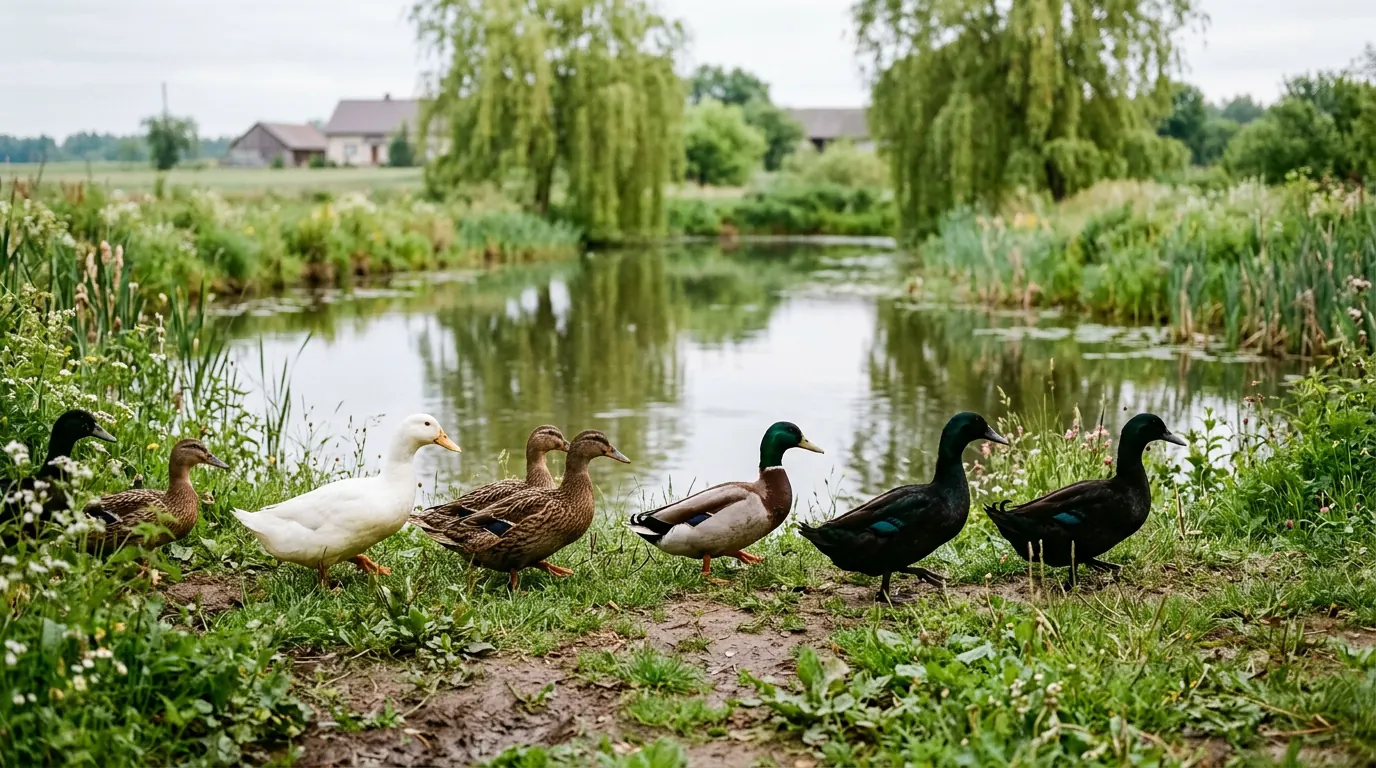
A male duck, called a drake, differs from a female duck in voice, plumage and usually in body weight. The duck quacks loudly, while the drake is quieter and hoarser. In many breeds the drake also has different feather colors than the duck. These signs depend on the breed, so you can be sure only after you combine several of them.
Why the sex of your ducks matters on the farm
Sex decides which birds you keep in the breeding flock, which go for meat and which become layers. A mistake at purchase leaves you with too many drakes or no layers. We cover the general rules for sexing birds in our article on sexual dimorphism in birds. Here we focus on ducks only.
Voice and behavior: the most reliable sign in adult ducks
The duck's quack and the drake's hoarse voice
In most breeds the duck quacks loudly and clearly, especially when she calls the flock or something alarms her. The drake is quieter, with a hoarse voice like a hiss or a whisper. This is the simplest way to check the sex of an adult bird, because you do not need to catch or handle it. A short watch of the flock is enough. A bird that quacks loudly is a duck. A quiet bird is not necessarily a drake, because some ducks stay silent when nothing disturbs them.
Behavior in the flock
The drake guards the females, chases other birds in the mating season and tries to mount them. The duck more often looks for a nest and lays her eggs in the same place. Watch the flock in the morning and evening, when the birds are most active. If you keep a larger number of ducks, write down which birds you identified as drakes. The Muscovy duck is naturally quiet, so you cannot base the sex on its voice.
Plumage and color: what drakes of different breeds look like
Differences in feather color
In some breeds the drake and the duck have clearly different colors. According to the FAO handbook, in the Rouen duck the drake is light grey with a green neck, and the female is light brown, like wild mallards. This color pattern makes the sex easy to judge from a distance. In other breeds both sexes look alike, so you have to look for other signs. You will find descriptions of individual varieties in our overview of duck breeds and in the article on rare duck breeds.
The curled tail feather
In many breeds the drake has a few feathers at the end of the tail that curl upward in a characteristic tuft. The duck has a straight tail. This sign appears only in adult or nearly adult birds, so you cannot use it on young ducklings. Not every breed shows it, so its absence does not settle the sex. Treat it as a confirmation of other signs, not as the only proof.
The Muscovy duck
You recognize the Muscovy duck by the red, fleshy growths around the beak and eyes. FAO describes it as a meat breed that comes originally from Central America. The drake is usually clearly larger than the duck, and his growths are more developed. The exact differences depend on the breeding line.
Size and body weight of the drake and the duck
The drake is heavier than the duck
A drake usually reaches a higher body weight than a duck of the same breed. According to the ALPCO handbook, the standard weight of the Pekin is 4.0 kg for the drake and 3.6 kg for the duck. The difference is clear, but not big enough to judge by eye in a single bird. Compare birds of the same age from the same flock, preferably by weighing them on a scale.
The Muscovy duck for fattening
FAO states that a Muscovy duck fattened for meat reaches a weight of 3 to 5 kg. The final weight depends on how you keep the bird and on the feed, and the breed grows more slowly than other meat breeds. You can compare weight norms for different species in the table of poultry body weight. We describe feed rations in the article on feeding geese and ducks.
The sex of ducklings: when you can tell
Why young birds are hard to sex
A hatchling does not yet show the differences in voice, plumage or body weight that separate adult birds. In the first days of life only an examination of the sex organs gives a reliable answer, and an experienced person must do it. A wrong examination can injure the duckling. So when you buy ducklings, ask the hatchery whether it sells birds with confirmed sex and how the sex was determined. We describe where to buy in the article on where to buy geese, ducks and guinea fowl.
How to judge the sex as the birds grow
With age the voice starts to differ: some birds quack loudly, others rasp or stay silent. The moment when the change becomes audible depends on the breed and the rearing conditions, so check it in the breed handbook. When the birds start to feather, differences in feather color appear, if the breed has them. Judge the sex several times, at intervals, and write down the results before you decide to sell birds or remove them from the flock.
What to do with the sex information: flock, layers and rules
Makeup of the breeding flock
The number of drakes per duck is set by the recommendations for the breed. We do not give a figure without naming the breed, because it depends on the type of use. Check it in the breed handbook or ask an adviser at your ODR (Poland's regional agricultural advisory center). With laying breeds such as the Khaki Campbell, you need drakes only for hatching. According to FAO, this breed under good conditions lays 250 to 300 eggs a year, and the Pekin according to ALPCO about 160 eggs.
Reporting to the database
According to Dz.U. 2023 poz. 2829 (Poland's Journal of Laws; legal state as of 23.11.2026), the duty to report events to the computer database applies to operators that keep at least 100 birds of the species duck or Muscovy duck. The same applies to operators that hold at least 500 eggs. At that flock size, keep records split by sex and age group. The requirements for housing are described in the article on the duck house, and the general rules on the page about the legal standards for keeping ducks.
Frequently asked questions
How do you tell a male duck from a female duck?add
Start with the voice: the duck quacks loudly, the drake is quieter and hoarser. Then check the plumage, including the curled tail feathers in many breeds, and the body weight. Combining several signs gives a more reliable answer.
Do male ducks quack?add
The drake has a voice, but it is quieter and hoarser than the duck's quack. In the Muscovy duck both sexes are quiet, so you cannot rely on voice there.
When can you tell the sex of ducklings?add
The differences in voice and plumage appear as the birds grow, and the timing depends on the breed. An earlier check is done only by an experienced person who examines the duckling. Check the details in the breed handbook or ask the breeder.
Is a drake bigger than a duck?add
Usually yes. According to the ALPCO handbook, the standard weight of the Pekin is 4.0 kg for the drake and 3.6 kg for the duck. Compare birds of the same age.
How do you recognize a Rouen drake?add
According to the FAO handbook, the Rouen drake is light grey with a green neck, and the female is light brown, like wild mallards. Such color differences occur in breeds where color depends on sex.
How many drakes do you need for the ducks in a flock?add
The number depends on the breed and the purpose of keeping. Check the breed handbook or ask an ODR adviser, because there is no single value for all ducks.
Sources & resources
- linkDuties of poultry keepers (ARiMR, Poland's Agency for Restructuring and Modernisation of Agriculture)
- linkAssam (ALPCO) — Duck Management Guide
- linkFAO — Duck Keeping in the Tropics (Better Farming Series)
- linkInstitute of Animal Science PIB (Instytut Zootechniki) — izoo.krakow.pl
Prepared by: DlaFerm Team based on data from the sources listed · Publisher: INSTA-TECH sp. z o.o.
Record your ducks by sex in the DlaFerm house records
The house records module lets you keep groups of birds, their sex and age, and the number of birds in the flock in one place. Create a free farm account in DlaFerm or get in touch.
Phone
+48 796 258 151