How to Tell a Hen from a Rooster and a Duck from a Drake
You can tell a hen from a rooster, and a duck from a drake, by a few lasting traits: comb, wattles, spurs, plumage and voice. Sexual dimorphism means the differences between male and female of the same species, and it shows best in adult birds. We explain what to look at and what not to treat as a sure sign.
verifiedFrom the team that has organised work on poultry farms for years.
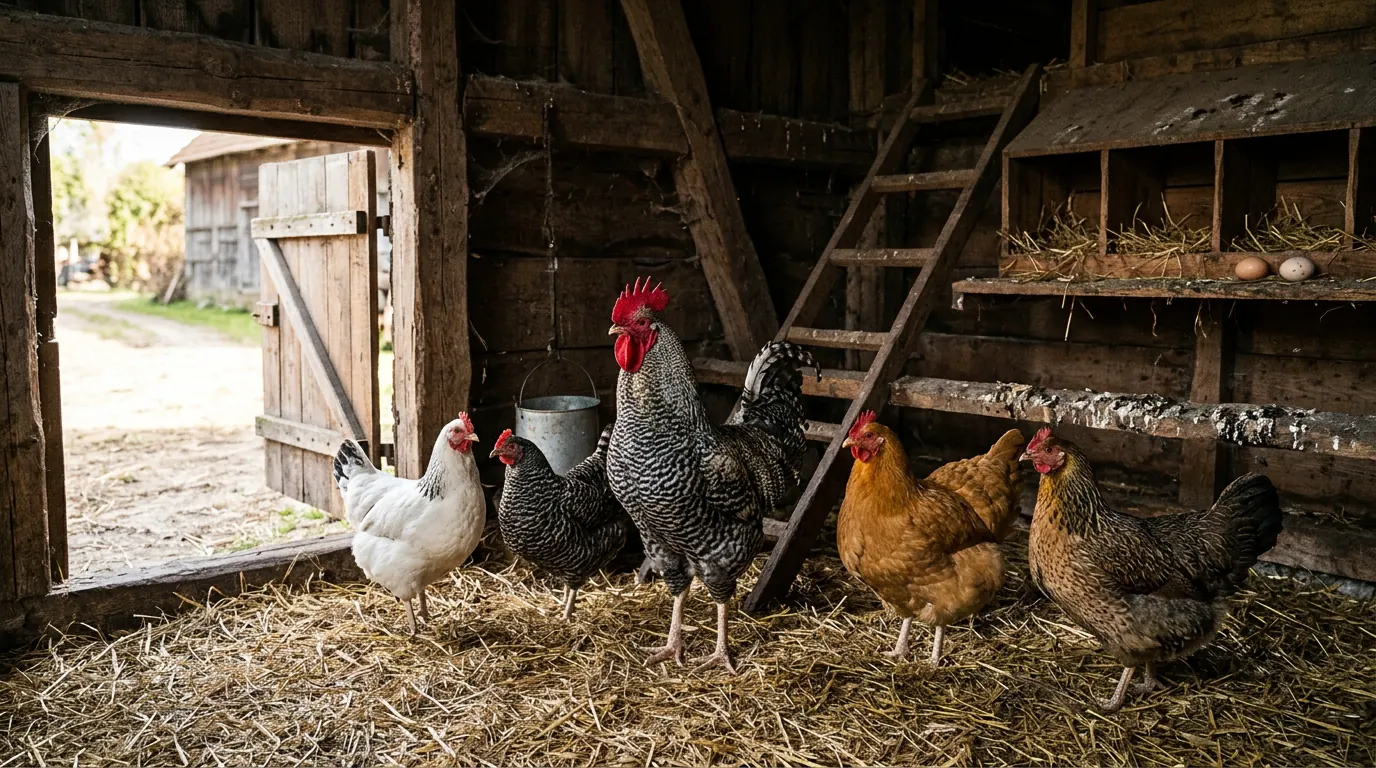
You can tell a hen from a rooster by the comb, wattles, spurs and the feathers on the neck and tail. You can tell a duck from a drake mainly by voice and by the drake's tail feathers. These differences are called sexual dimorphism: traits in which the male and female of one species look different. In poultry they are clearest in adult birds and often hard to see in young ones. We cover crowing in a separate text, why a rooster crows.
Why the differences are biggest in adults
Sex traits develop under sex hormones, which start to act as the bird matures. So roosters and drakes look clearly different only once they reach adult age. In young birds both sexes look alike, and a sure call takes practice or a test. Keep this in mind when you plan a flock, before you decide how many males to keep in the house.
How to recognize a rooster by looks
Comb, wattles and spurs
Roosters usually have a larger, more prominent comb and wattles, which are the folds of skin under the beak. Males have spurs on the legs, while hens usually have none or only small stubs. Spurs grow with age, so an older rooster has clearer ones. Judge these traits together, because a single one can mislead in young birds or in breeds with an unusual build.
Neck and tail feathers
Roosters have long, pointed feathers on the neck, called hackles or a mane, and long feathers in the tail. Hens have shorter, more rounded feathers. Some breeds are an exception, as their hens also have showy tails, so always check the breed standard when you buy.
Body shape
Roosters are usually larger and heavier, with broader shoulders and a taller stance. Hens are rounder, with a fuller body. The size difference is easy to see when you compare two birds of the same breed, but it is not enough to judge one bird on its own.
Voice and behavior
Crowing
Crowing is the rooster's most typical signal. Males crow in the morning and during the day, and answer other roosters. A hen does not crow, but she may cluck after laying an egg. Crowing is still not a sure sign of sex: a young hen may sometimes crow, and a rooster may stay silent for a long time, especially when young.
Behavior in the flock
The rooster guards the flock, signals danger and calls hens to food. He often runs ahead of the group and gets to the feeder first. Hens more often scratch in the litter and call their chicks. These behaviors vary and depend on the pecking order, so treat them as a supplement, not the main way to tell sex.
How to recognize a drake
Voice
A duck quacks loudly, with a typical rhythmic rise and fall. A drake makes a quieter, raspy or short sound, because his voice organ is less developed. The difference is easiest to hear in adult birds. In a mixed flock you catch it quickly when you compare two voices side by side.
Tail feathers and plumage
Drakes have curled feathers in the tail, called sex feathers, which ducks lack. In many breeds drakes also have lighter or more contrasting plumage on the head and neck. In mandarin ducks the color differences are very clear, as we describe in Mandarin duck.
Mulards and hybrids
Mulards are hybrids from crossing a Pekin duck and a Muscovy duck. In hybrids, dimorphism is often weaker than in purebreds, so a sure call rests on a set of traits, not one. You can read more about this group in Mulard ducks.
Sex of chicks: what you can tell early
Why early sexing is hard
In the first days of life, chicks of both sexes look almost the same. Differences in comb, spurs and plumage appear only with time. Hatcheries use sexing methods, but they take practice and are not open to every keeper. In practice, some chicks stay undetermined for a while.
Sexing by down color
In some breeds and hybrid lines you can tell sex from down color, because the trait is linked to sex. This is called autosexing. To learn whether a line has this trait, check the breeder's documentation. If in doubt, talk to a vet or an adviser at a poultry company.
Planning a hatch
If you incubate eggs, expect that some chicks will be the sex you do not need. Before you start, write down the goal of the flock: laying, breeding or meat. We describe how to prepare an incubator in how to set humidity in an incubator.
Recording sex and flock numbers
Record sex for each bird or group
Once you know the sex, write it in your records with the date and how you determined it. That makes it easy to see how many roosters or drakes are in the flock and when to change the ratio. Entries also help during inspections and when you plan the next placements. You can keep these records in the poultry house records module.
Mixed flocks and their ratios
A laying flock usually keeps fewer males than females, but the exact ratio depends on breed, age and the goal of the flock. With bigger flocks, keep the overview in one place, not in a notebook. Poultry farm management software lets you keep flock numbers and events in one place.
When the traits mislead
Young birds and birds after changes
Young roosters may go a long time without spurs or a clear comb, and hens sometimes have a larger comb than weaker males. Injury, disease or hormonal changes can also alter looks. If a bird looks unusual, do not rely on looks alone. Check your judgment with a vet.
Differences between breeds
Each breed has its own standard, and dimorphism varies a lot between them. In some breeds males and females look almost the same, which makes judging hard. Before you sex birds of a new breed, read its description. You can find more on starting and running a flock in how to keep hens for eggs.
Frequently asked questions
How do you tell a hen from a rooster?add
A rooster has a larger comb and wattles, spurs on the legs, and long feathers on the neck and tail. A hen has these traits less developed or not at all. The surest way is to judge the bird on several traits at once, not on one.
How can you tell a drake from a duck by voice?add
A duck quacks loudly and rhythmically, while a drake makes a quieter, raspy sound. The difference is easiest to hear in adult birds. In young ducks the voice can be similar and harder to judge.
Can you tell the sex of chicks?add
In some breeds and hybrid lines, sex shows in down color. In other cases, early sexing takes practice and can be unreliable. If it matters for your breeding plan, ask the breeder or a vet.
Do only roosters crow, and never hens?add
Crowing is typical for roosters, but it is not a sure sign of sex. A young rooster may stay silent for a long time, and a hen can be loud. Treat voice as one trait, not the only test.
Do mulards show clear sexual dimorphism?add
In mulards, which are hybrids, dimorphism is often weaker than in purebreds. Sexing then relies on a set of traits, such as size and behavior. If in doubt, check your judgment with a vet.
Does recording sex matter in a small flock?add
Yes, because it shows the ratio of males to females and helps you plan the next placements. A note with the date and method also helps with later checks. With few birds, simple but regular records are enough.
Sources & resources
- linkNational Research Institute of Animal Production (Instytut Zootechniki PIB) — izoo.krakow.pl
- linkChief Veterinary Inspectorate (Główny Inspektorat Weterynarii) — gov.pl/web/wetgiw
- linkMinistry of Agriculture and Rural Development (Ministerstwo Rolnictwa i Rozwoju Wsi) — gov.pl/web/rolnictwo
Prepared by: DlaFerm Team based on data from the sources listed · Publisher: INSTA-TECH sp. z o.o.
Do you keep a flock and want to know how many birds of each sex you have?
DlaFerm.pl farm management software keeps your flock records in one place. Create a free farm account in DlaFerm.pl and see how it works in your poultry house.
Phone
+48 796 258 151