Ancona Chicken: The Spotted Laying Hen from Italy
The Ancona is a light, lively laying breed from Italy with black feathers tipped in white. It lays white eggs, does well on free range and copes poorly with being shut in a cramped coop. We cover looks, laying, housing needs and where the Ancona stands among other breeds.
verifiedFrom the team that has organised work on poultry farms for years.
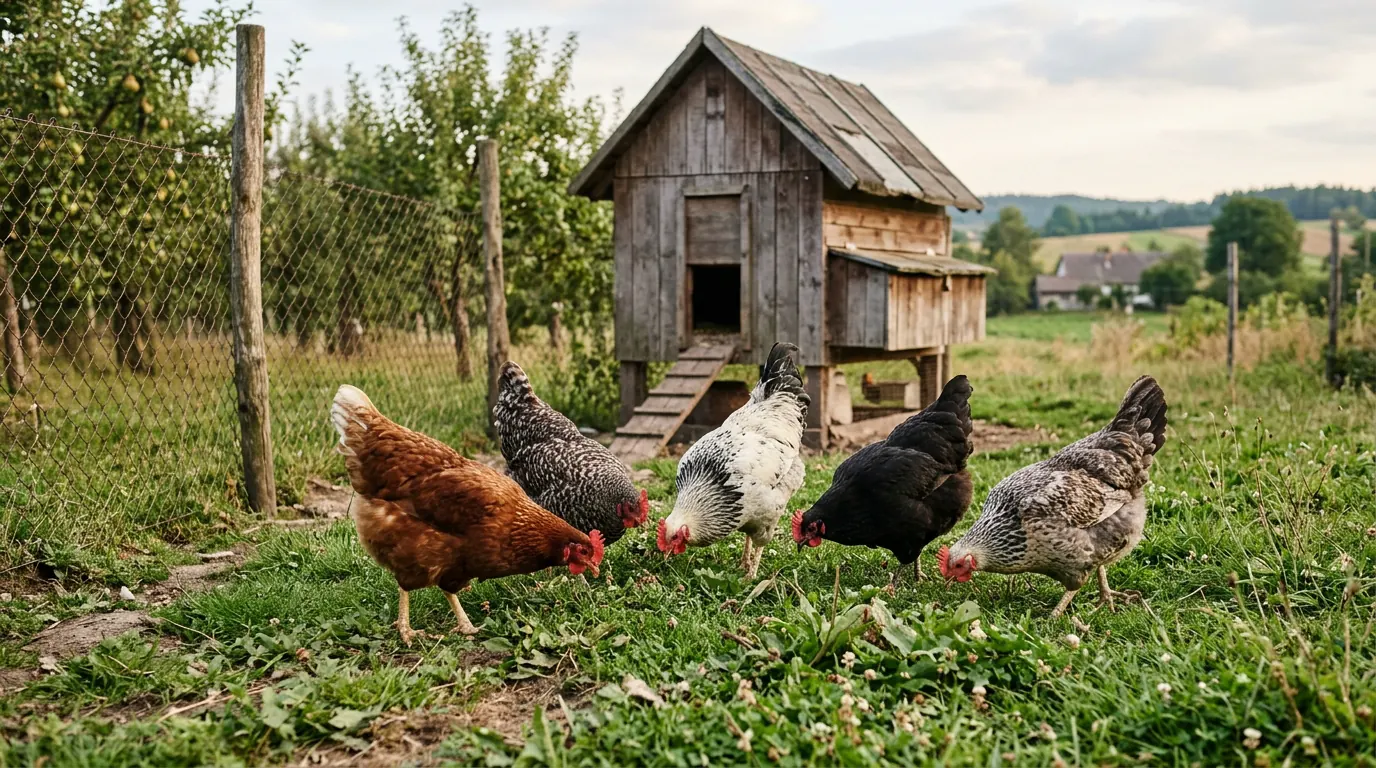
The Ancona is an Italian breed of light laying hen. You can spot it by its black feathers with a white spot at the tip of each one. It lays white eggs, is active and flighty, and flies well. It does best on open free range, not in a cramped, closed coop. People keep it for eggs, for the look of the flock, or for both.
The name comes from the Italian port city of Ancona on the Adriatic. The breed belongs to the Mediterranean class of chickens: light, quick to mature and bred for laying. Below we describe how to recognize it, what to expect from the eggs and how to set up its housing, so you can compare it with other breeds in our catalog, such as the Welsummer or the Rainbow hen (tęczanka).
Origin and looks of the Ancona
Where the Ancona comes from
The Ancona comes from central Italy, around the port of Ancona. It belongs to the Mediterranean group of breeds, which also includes the Italian Leghorn. These hens were kept for centuries as light layers, not for meat. They reached Great Britain and the United States in the 19th century, and that is where the breed standards were written down. For detailed data on the breed's history and standard, check publications of the Institute of Animal Science (Instytut Zootechniki PIB) in Poland and the associations of pedigree poultry breeders.
What an Ancona hen looks like
The plumage is black with a greenish sheen, and every feather ends in a white spot. The spots usually grow in number with age and with each molt, so an adult hen looks more speckled than a young one. The body is slim and light, with a high-carried tail. The legs are yellow with dark spots, and the beak is yellow with a dark tinge. The comb is single and large, and on hens it usually flops to one side. The cock has an upright, erect comb.
Varieties and the bantam version
Most often you will meet the black variety with white spots. There is also a bantam Ancona, smaller and calmer, kept mainly for show and ornament. If you want eggs, choose lines of the standard-size Ancona. When you buy, ask the breeder where the birds come from, because the gap between show lines and production lines can be clear. We wrote more about finding a seller in the guide on where to buy laying hens.
Laying and eggs of the Ancona
How many eggs an Ancona lays
The Ancona counts among the good pedigree layers. As a rough guide, the breed gives a similar number of eggs to other light Mediterranean hens, but the actual result depends on the line, feed, light and age of the birds. Figures quoted online are often too high because they come from the best flocks. You can only learn real laying rates from your own records. Write down eggs day by day and compare flocks after a year of use, as we describe in the text on hens after one year.
Eggs: color and size
Ancona eggs have a white shell. They are medium in size and sell mainly to buyers who do not care about shell color. If you sell eggs direct and customers look for brown ones, the Ancona will be harder to sell than breeds with colored eggs. Against other white eggs, only the look of the hen itself sets the Ancona apart. Shell color says nothing about the nutritional value of the egg.
Is the Ancona good for meat
No. It is a light, slim breed with little meat on the carcass. You can of course cook the young cockerels from breeding, but economically it pays to keep these hens for eggs only. If you want a dual-purpose breed, see the descriptions of the Sussex or the Plymouth Rock, which give eggs and a decent carcass.
Temperament and range needs
Temperament
Anconas are active, alert and rather flighty. They dislike being caught or stroked and react fast to sudden movement and noise. They fly well, so they will clear a low fence. Watch the cocks: they can be aggressive toward people, especially when the flock is too crowded. Hens are less troublesome, but they also need calm handling, because stress lowers laying.
Range and fencing
The Ancona handles free range very well and can find a lot of food on its own. The range fence must be higher than for heavy breeds, and the netting well stretched. Some keepers clip the flight feathers of one wing or cover the range with netting from above. An open range has a downside too: you must protect the flock from foxes, martens and birds of prey. You will find the differences between housing systems in the text on cages, litter and aviary systems.
Incubating and rearing
Ancona hens are poor sitters. In many Mediterranean breeds, selection for laying has weakened the broody instinct. If you want your own chicks, plan on an incubator or a broody hen of another breed. After hatching, the young grow fast and start laying early. First give them warmth and feed matched to their age, as covered in our guide to chicken feed by age.
Coop, winter and flock health
Coop and nest boxes
The Ancona has no special demands on the type of coop, but it needs a dry, ventilated house without drafts. Put nest boxes in a quiet spot in half-light, because flighty hens dislike laying in plain view. Too few nest boxes leads to eggs laid on the floor. For flock management, a record of eggs laid and deaths is enough, and it is easy to keep in the coop records module.
Winter and the comb
The large single comb and easily chilled skin make the Ancona sensitive to frost. In hard frosts the comb and wattles can freeze. Provide dry litter, a ventilated but draft-free coop and drinkers with water that does not freeze. A longer day in winter boosts laying, but change the lighting gradually. If combs on your cocks or hens change, look up the causes in the text on the listless hen.
Health and treatment
Anconas are a hardy breed as long as they have dry ground and good feed. Disease risk grows with crowding, damp and contact with wild birds. Biosecurity rules are the same as for other chickens, and they are described by the Chief Veterinary Inspectorate (Główny Inspektorat Weterynarii). For any treatment, a vet chooses the medicine and dose, and you keep to the withdrawal period before eggs go on sale or onto your own table. Treatment records are easier with the treatment and withdrawal period module.
Ancona or another laying breed
Who the Ancona suits
Choose the Ancona if you have free range, want white eggs and like a decorative flock. Rule it out if you need calm, tame hens for children, or broody hens to raise chicks. Flightiness also makes work harder when you enter the coop often. For a general overview of breeds and start-up costs, see laying hens: where to start.
Breeds to compare
For brown eggs and a calmer nature, look at the New Hampshire or the Orpington. A cold-hardy breed is, for example, the Orlov (orłowska). For a cold climate and a heavier flock, also check the Wyandotte. When you compare breeds, look not only at egg numbers but also at feed cost, hardiness and how easy the eggs are to sell.
Frequently asked questions
What color eggs do Ancona chickens lay?add
The Ancona lays medium-size eggs with a white shell. Shell color depends on the breed and does not change the nutritional value of the egg.
How many eggs does an Ancona lay per year?add
The Ancona is a good layer, but the number of eggs depends on the line, feed, lighting and age of the hens. Check it in your own flock by recording eggs, and when you buy, ask the breeder for the results of their line.
Are Ancona chickens good for a small backyard?add
Not the best. They are active, flighty hens that fly well and like free range. In a small yard they need a high fence or netting over the top, or they will fly over to the neighbors.
Are Ancona hens good broody hens?add
Usually not. The breed was selected for laying and sits on eggs poorly. For your own breeding, use an incubator or a broody hen of another breed.
Are Anconas cold hardy?add
Yes, if they have a dry coop without drafts. The large comb is the weak point and can freeze in hard frost, so keep litter dry and water unfrozen.
Where can I buy Ancona chickens?add
Best from pedigree poultry breeders and breeders' associations that know where the birds come from. Ask about age, vaccinations and production line, because show lines may lay less.
Sources & resources
- linkInstitute of Animal Science PIB — izoo.krakow.pl
- linkChief Veterinary Inspectorate — gov.pl/web/wetgiw
- linkMinistry of Agriculture and Rural Development — gov.pl/web/rolnictwo
Prepared by: DlaFerm Team based on data from the sources listed · Publisher: INSTA-TECH sp. z o.o.
Keep your laying records in coop records
The coop records module in DlaFerm lets you log eggs, deaths and flock events, so you can compare the Ancona with other breeds on your own numbers. Create a free farm account or get in touch.
Phone
+48 796 258 151