Chicken feed: starter, grower, layer (table by age)
Chicken feed changes as the bird ages, because its need for energy and protein changes. Starter supports the first weeks, grower supports growth, and layer feed keeps up egg production. Below we set out the feeding phases from breeder company data and show what that data does not cover for laying hens.
verifiedFrom the team that has organised work on poultry farms for years.
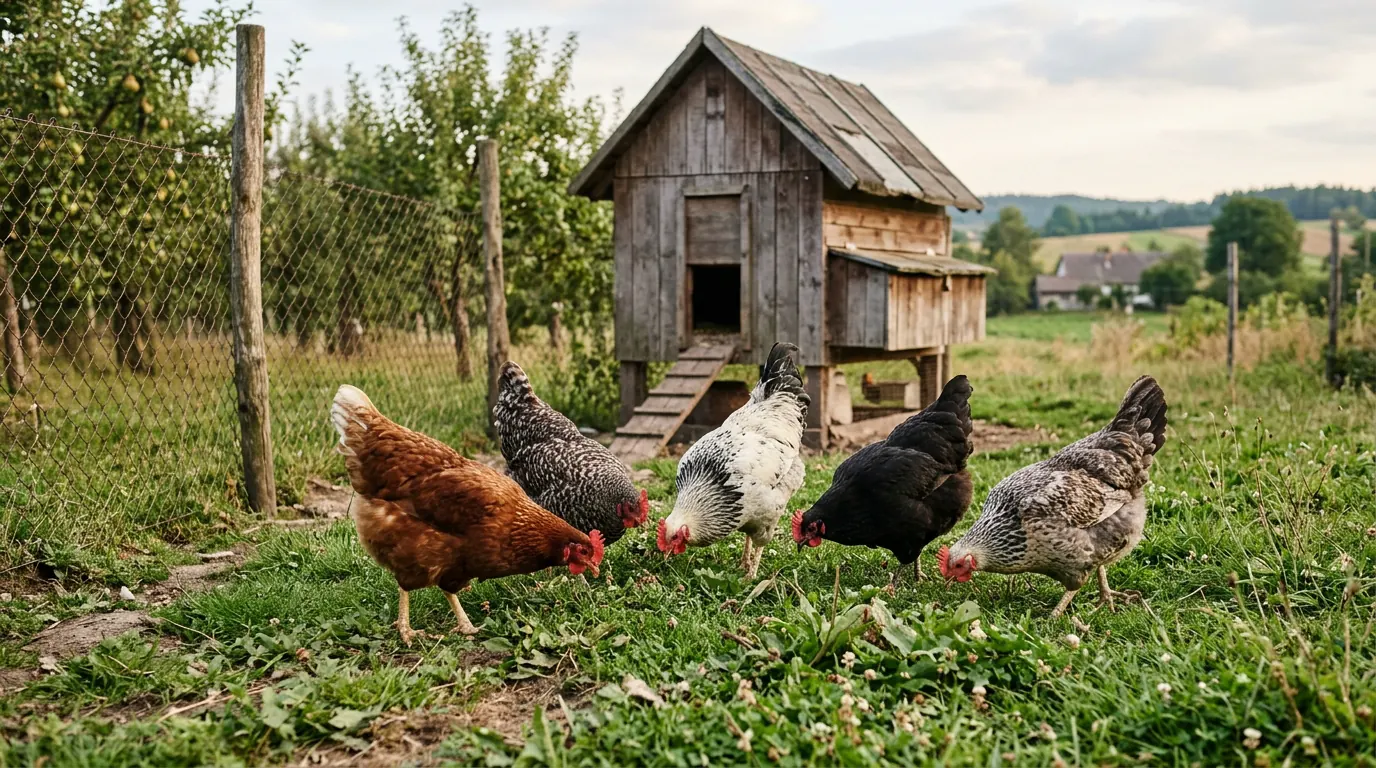
In the first weeks of life, chickens get starter feed, then grower, and laying hens move on to layer feed. Each phase has a different energy and protein density, so you do not feed one mix for the whole cycle. Plan feed changes by the age and weight of the birds, not by the calendar alone. Before you choose a ration, check how much the birds actually eat and how they grow. A poultry farm management program helps you keep these records.
What the breeder data shows
The best documented feeding phases come from breeder handbooks for broilers (meat chickens) and parent stock. Ross 308 / 308 FF Broiler Nutrition Specifications 2022 gives 2975 kcal/kg for the starter phase (0–10 days), 3050 kcal/kg for grower (11–24 days), 3100 kcal/kg for finisher 1 (25–39 days) and 3125 kcal/kg for finisher 2 (from 40 days to slaughter). These figures are for broilers with a live weight of 2.0–3.5 kg, not for laying hens. They do show the principle: a younger bird needs a denser, more digestible feed, and as it grows, an exact balance of energy and amino acids matters more.
Table of phases by age
Here are the feeding phases. Broilers, Ross 308: starter 0–10 days, 2975 kcal/kg; grower 11–24 days, 3050 kcal/kg; finisher 1, 25–39 days, 3100 kcal/kg; finisher 2, from 40 days to slaughter, 3125 kcal/kg. Parent stock, Ross 308 Parent Stock Nutrition Specifications 2021: energy 2800 kcal/kg in all phases, minimum crude protein 19.0 % (starter 1, 0–21 days), 17.0 % (starter 2, 22–42 days) and 14.0 % (grower, 43–105 days). We have no confirmed table for commercial laying hens, so we give no figures for them.
Starter feed: the first weeks
Starter feed gives the bird its earliest access to nutrients. Ross 308 / 308 FF Broiler Performance Objectives 2022 recommends a highly digestible, balanced feed from the start phase. The Ross Parent Stock Management Handbook 2023 stresses that the physical quality of starter feed is as important as its composition, so use sieved crumb or mini pellets. According to the same handbook, starter feed is usually given for about 28 to 42 days, depending on the line and phase.
Water, feeders and humidity
Ross 308 / 308 FF Broiler Performance Objectives 2022 recommends that birds have easy access to water and feed at placement, with the move to automated feeders and drinkers at about day 4–5. Watch humidity in the house too, and keep relative humidity above 50 % RH. For a repeatable start, set up an automatic chicken drinker before the flock arrives.
Grower feed: even growth
The grower phase is long and has the biggest effect on body shape and flock uniformity. The Ross Parent Stock Management Handbook 2023 notes that birds pick out larger pieces of grain from the mix if it is not ground well, which gives them an unbalanced diet. Diluting the grower feed is one way to even out feed intake. According to the same handbook, whatever the level of dilution, you must strictly control the ratio of energy to lysine.
Lysine and energy
Ross 308 Parent Stock Nutrition Specifications 2021 gives a maximum digestible lysine of 0.72 % in starter 2 (22–42 days) and 0.52 % in grower (43–105 days). Excess lysine goes into breast development, so when you change the ration, do not raise protein without recalculating energy. A nutrition adviser or the feed producer sets the ration, not the farmer by eye.
Layer feed: keeping up egg production
Layer feed differs from broiler feed. Hens need constant access to calcium, because forming the eggshell is a heavy load on the body. The materials behind this guide have no energy and amino acid table for commercial laying hens, so we give no figures for them. Agree the base ration with the feed producer and an adviser, and check results in your records. See also feed for laying hens and lime, shells and grit for hens.
Grit and feed form
Grit helps birds digest, and calcium supports the shell. A vet or adviser sets the rules and amounts. When you switch to layer feed, check that the pellet or mix form lets birds eat it without picking through it. The bird's age and breed also matter, see laying hen breeds.
The house and the feeding space
Conditions in the house affect feed intake. Before changing the feeding, check the laying hen house requirements, especially the number of feeder spaces and access to perches. On a free range run, birds pick part of their feed themselves, so watch whether they all eat the same ration.
Withdrawal period in medicated feed
Ross 308 / 308 FF Broiler Nutrition Specifications 2022 states that withdrawal feed should be given in line with local requirements for drug withdrawal periods. In Poland, follow the veterinary medicine rules in ISAP, the Internet System of Legal Acts (isap.sejm.gov.pl), and never set a withdrawal period from memory. Record each treatment and the withdrawal end date in treatment and withdrawal records.
Who chooses the drug and dose
The vet always chooses the drug and dose. The keeper is responsible for the record, the dates and the paperwork. When you change feed for a treatment, ask the vet whether a medicated feed is needed at all and for how long.
Feed use and indicators
Feed intake changes from week to week, so build your table from your own observations. The Ross Broiler Management Handbook 2025 says that when growth is poor, the first things to check are access to feed and water, ventilation and the quality of the start. At each phase change, compare intake with the table and note your conclusions.
Indicators and stock
Convert feed intake to weight gain, the FCR (feed conversion ratio), and follow it through the cycle. The FCR and EPEF online report helps. You can check silo levels and the rate of use in feed silo monitoring.
How to plan a change of phase
Plan the feed change date before the flock arrives and put it in the schedule. Give old and new mixes side by side for a few days and watch the birds. Ross 308 / 308 FF Broiler Performance Objectives 2022 recommends monitoring crop fill and live weight at 7 days, because this shows whether the start is going well.
What to record
Record bird age, feed phase, daily intake and control weight. After the cycle you can then see which phase change gave the better result. Keep the entries in a poultry farm management program.
Frequently asked questions
What should I feed chickens in the first weeks?add
The first weeks are the starter phase. Ross 308 / 308 FF Broiler Nutrition Specifications 2022 gives 2975 kcal/kg for broilers at 0–10 days. We have no confirmed figure for laying hens, so agree the ration with the feed producer.
When should I switch from starter to grower feed?add
For Ross 308 broilers the starter phase ends after day 10 and grower runs from day 11 to 24. According to the Ross Parent Stock Management Handbook 2023, starter is given for about 28 to 42 days, depending on the line. Decide by weight and feed intake.
Is layer feed the same as chick feed?add
No. Layer feed has different proportions of protein, energy and calcium, because the hen forms an eggshell. We give no figures for commercial laying hens because we have no confirmed figures for them.
Does medicated feed change the withdrawal period?add
Yes, feed with a drug is subject to a withdrawal period. Ross 308 / 308 FF Broiler Nutrition Specifications 2022 recommends giving withdrawal feed in line with local requirements. The vet sets the period, and you keep the record.
How do I check that the feed is being used well?add
Watch feed intake, control weight and gain. The Ross Broiler Management Handbook 2025 lists access to feed and water as the first check when growth is poor. Compare results with the phase table and record them weekly.
How much does chicken feed cost?add
The price depends on the composition, form, order size and current commodity prices. We give no amounts because they change weekly. Check the current offer with your feed supplier and work out the cost through FCR.
Sources & resources
- linkRoss Parent Stock Management Handbook 2023 (Interactive)
- linkRoss 308 / 308 FF Broiler Performance Objectives 2022
- linkRoss Broiler Management Handbook 2025
- linkRoss 308 / 308 FF Broiler Nutrition Specifications 2022
- linkRoss 308 Parent Stock Nutrition Specifications 2021
- linkISAP, Poland's Internet System of Legal Acts — isap.sejm.gov.pl
Prepared by: DlaFerm Team based on data from the sources listed · Publisher: INSTA-TECH sp. z o.o.
Do you track feed use in every phase?
The feed silo monitoring module shows stock levels and the rate of use in one place. Create a free farm account in DlaFerm.pl and move your feeding phase table into it.
Phone
+48 796 258 151