American chicken breeds: Delaware, Dominique, Java, Buckeye
Delaware, Dominique, Java and Buckeye are old American dual-purpose breeds, kept for both eggs and meat. We cover where they come from, how they differ and which farm each one fits.
verifiedFrom the team that has organised work on poultry farms for years.
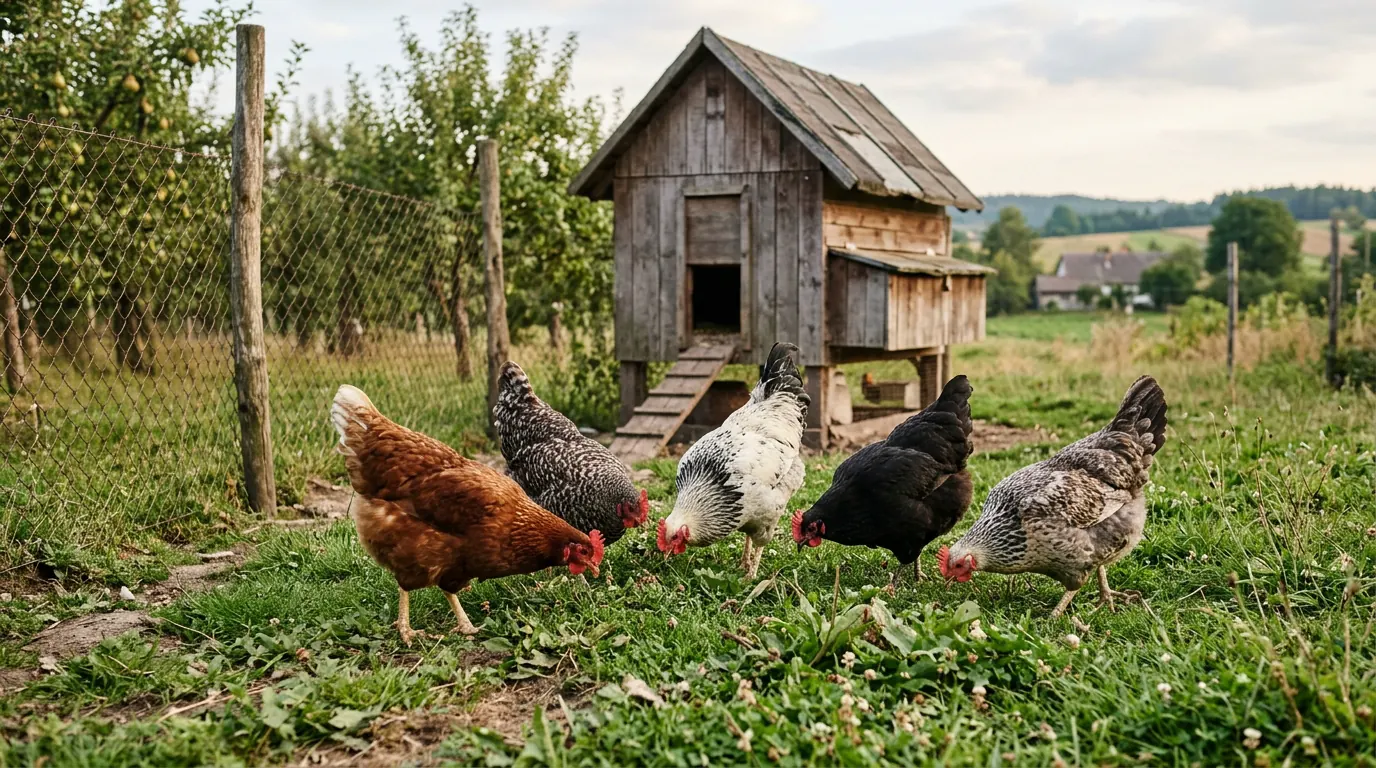
American chicken breeds were developed in the 19th and early 20th centuries as farm birds. They were meant to lay all year and give meat from your own yard. Four of them (Delaware, Dominique, Java and Buckeye) are rare today and kept mostly in small flocks. If you want a backyard hen that copes on free range and needs no special feed, each one is worth a look.
What sets these four breeds apart
All four are medium to fairly heavy birds. They handle changeable weather and cold well. The Delaware is white with black barring on the neck and tail. The Dominique has gray, cross-barred feathers and a rose comb. The Java is black with a green sheen, or mottled. The Buckeye has dark red, mahogany plumage and a low pea comb. For a wider comparison of working breeds, see our overview of meat chicken breeds and our guide to laying breeds.
The Delaware chicken
Origin and appearance
The Delaware was created in the state of Delaware in the 1940s by crossing New Hampshire and Barred Plymouth Rock hens. Breeders wanted a fast-growing meat chicken that also laid well. The bird is white, with black bars on the neck feathers, wings and tail. Chicks and young birds are light in color, which helps when you judge a plucked carcass: the skin is pale and free of dark feather remains.
Productivity and temperament
The Delaware lays brown eggs and grows into a good meat bird for small-scale keeping. The breed is calm, easy to handle and does well on free range. It grows more slowly than modern broiler chickens, so it does not suit intensive production. It works for keepers who want meat and eggs from one flock. In our section on meat breeds you can compare it with other working birds.
Dominique: the oldest American breed
Barred plumage and rose comb
The Dominique is regarded as one of the oldest chicken breeds developed in the United States. It has light gray, evenly barred plumage and a low rose comb that handles frost well because it rarely freezes. The eggs are brown, and the hens go broody readily and look after chicks well. It is a medium-sized, calm bird that copes well with farm keeping.
Who this breed suits
The Dominique does well on free range, finds part of its own food and needs no expensive feed. It suits a small flock at home, and keeping it also helps preserve a breed that is not popular. For feeding, use a balanced mix with grain. We describe the proportions in our article on grains for laying hens.
The Java chicken
Varieties and build
The Java has a long, broad body and strong legs. It comes in a black variety with a greenish sheen and in mottled varieties, where black and reddish-brown feathers mix with white. The comb is single and the skin is yellow. The birds grow slowly but reach a good body weight, and the meat has a reputation for good taste, which is why they were once raised for sale.
Keeping requirements
The Java copes well on free range and is fairly hardy. The hens lay brown eggs at a moderate rate, so it is more a meat-and-egg bird than a typical layer. It needs a roomy coop and run, because heavy birds mature slowly. For larger breeds, also see our list of the largest chicken breeds and our description of the Jersey Giant, to compare build and growth rate.
The Buckeye chicken
Breed history
The Buckeye comes from the state of Ohio and was developed in the late 19th century by Nettie Metcalf. It is the only American chicken breed with a pea comb, which protects well against frost. The plumage is a deep mahogany red. The breed was created as a working bird for farm keeping, and you can still see that in its condition and hardiness.
Temperament and productivity
The Buckeye is regarded as one of the more active dual-purpose breeds: the birds forage eagerly and catch small rodents and insects. The hens lay brown eggs and do well in a cool climate. They are curious and tame easily. On a small farm they help keep pests down, but they need a large run. For comparison with European farm breeds, see British chicken breeds and Polish native breeds.
Which breed to choose and how to keep it
Quick comparison
If meat matters most, choose the Delaware or the Java. If frost hardiness matters, take the Dominique or the Buckeye, since both have low combs. All four breeds lay brown eggs and are not kept for show, although many people keep them out of sentiment. We cover ornamental chickens separately in our overview of ornamental chicken breeds.
Housing, feed and health
Dual-purpose breeds need a dry, airy coop, access to a run and feed suited to their age. Check the feathers and look for external parasites from time to time. You can add diatomaceous earth to the dust bath. Buy chicks and breeding birds from reliable breeders. Your county veterinary officer (powiatowy lekarz weterynarii) will tell you about the duty to register a flock and about biosecurity. The Chief Veterinary Inspectorate (Główny Inspektorat Weterynarii) publishes the current requirements.
Frequently asked questions
What are the American chicken breeds?add
The best-known American farm breeds are the Delaware, Dominique, Java and Buckeye. All are dual-purpose birds, kept for eggs and meat. They lay brown eggs and do well on free range.
What is the Delaware chicken good for?add
The Delaware was developed as a meat chicken that also lays well. In small-scale keeping it gives meat and brown eggs. It grows more slowly than broiler chickens, so it does not suit intensive production.
What is the difference between a Dominique and a Java?add
The Dominique has gray, barred plumage and a rose comb, while the Java is black or mottled and has a single comb. The Dominique is smaller and handles frost well. The Java has a heavier build and gives more meat.
Does the Buckeye chicken tolerate winter well?add
Yes. The Buckeye has a low pea comb that rarely suffers frostbite. It still needs a dry coop sheltered from the wind. Damp harms these birds more than cold does.
Where can you buy American chicken breeds in Poland?add
Your best bet is breeders belonging to pedigree poultry associations, and poultry shows. Ask about the birds' origin and the health of the flock. You agree the price directly with the breeder, because it depends on line, age and pedigree.
Sources & resources
- linkNational Research Institute of Animal Production (Instytut Zootechniki PIB) — izoo.krakow.pl
- linkChief Veterinary Inspectorate (Główny Inspektorat Weterynarii) — gov.pl/web/wetgiw
- linkMinistry of Agriculture and Rural Development — gov.pl/web/rolnictwo
Prepared by: DlaFerm Team based on data from the sources listed · Publisher: INSTA-TECH sp. z o.o.
Keeping several breeds in one coop?
The <a href="/program-do-ewidencji-kurnika">coop records</a> module in DlaFerm lets you log laying, losses and feed separately for each flock. Create a free farm account or get in touch.
Phone
+48 796 258 151