Landes goose: French breed, eggs, fattening and weight
The Landes is a gray French medium-weight goose selected for fatty liver production. According to FAO, an adult gander weighs 6.0 kg and a goose 5.0 kg, and lays 40 eggs a year. We cover looks, weight, egg output, use and care.
verifiedFrom the team that has organised work on poultry farms for years.
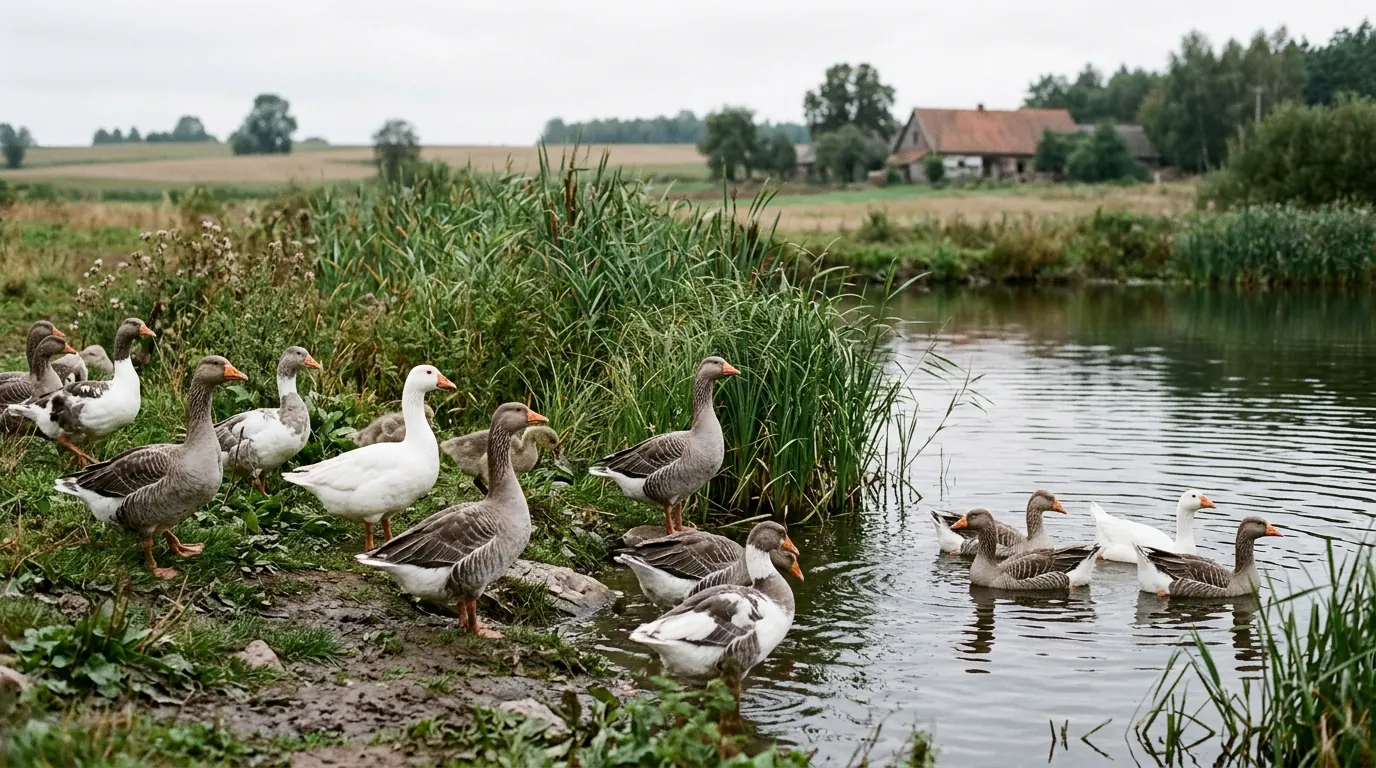
The Landes is a goose breed from France, kept mainly for fattening for liver. Both sexes have gray plumage and orange to yellow legs and bills. According to FAO, an adult gander weighs 6.0 kg and a goose 5.0 kg. Egg output is modest: FAO gives 40 eggs per goose a year, each weighing 170 g.
A breed descended from the Toulouse goose
According to FAO, the Landes descends from gray Toulouse geese. Today its plumage looks like the wild greylag goose, but the bird is much larger. The breed went from France to other countries, mainly Hungary, where it was used to produce fatty livers. Several Landes lines have been selected for exactly this purpose. We describe a native Polish goose of similar looks in our article on greylag-type geese (gęgawa).
Landes goose weight: what keepers ask
Keepers ask most often about weight, egg output and fattening. You will find the answers below, with a comparison to other goose weight classes and tips on what to watch in care. Prices of goslings and birds depend on the breeder, the season and the origin, so we give no amounts.
What a Landes goose looks like
Plumage, legs and bill
According to FAO, both sexes of the Landes are gray, and their legs and bills range from orange to yellow. The bird looks like the wild greylag goose but has a much heavier body. When buying, check that birds have even gray plumage and correctly colored legs and bills. For breed standard details, see the descriptions of the Institute of Animal Science (Instytut Zootechniki PIB) or ask a breeders' association.
Descent from the gray Toulouse goose
The gray Toulouse goose is the ancestor of the Landes. The breed went from France to other countries, mainly Hungary, where breeders valued its ability to store fat in the liver. Several lines exist today that were selected for this. When buying, ask about the line and what it was selected for. We describe another goose breed used for feathers and liver in our article on the Hungarian goose.
Landes goose weight of adult birds
Weight according to FAO
According to FAO, an adult Landes gander weighs 6.0 kg and a goose 5.0 kg. These figures come from the breed description in a publication on goose production. They apply to adult birds, not to young birds for slaughter. Real weight in your flock depends on the line, feeding, age and housing. Weigh a sample of birds and record the results every season.
Weight according to EFSA: medium-weight geese
EFSA classes the Landes as a medium-weight goose, along with the Italian, Hungarian and Diepholz breeds. Geese in this group reach 5.5–7.5 kg: females 5.5–6.5 kg, males 6.5–7.5 kg. Heavy geese such as the Embden, Pomeranian or Toulouse weigh 7–10 kg. Light geese such as the Czech and Alsatian weigh 4–5.5 kg. The Landes sits in the middle, and the difference from the FAO figures comes from different lines and measuring methods.
Egg output of the Landes goose
How many eggs a Landes goose lays
FAO gives 40 eggs per female a year, at 170 g per egg. That is little compared with breeds kept for reproduction. EFSA notes that liver-type geese, meaning the Toulouse and Landes, have medium or weak reproductive traits. If you plan a breeding flock, count goslings realistically, not by the best results. For a general overview of goose laying, see how many eggs a goose lays in a season.
What this means for the keeper
Weak laying affects the cost of a gosling and the number of geese you need in the breeding flock. Ask the breeder about hatch results in their line, egg fertility and the age of the females. Compare with breeds with better reproductive traits, for example the Chinese goose. You can control set dates and the hatching calendar more easily in the flock placement planning module.
Fattening and use of the Landes goose
A liver-type goose
EFSA describes the Landes and the Toulouse as liver-type geese: heavy or medium-weight, with great fattening ability. According to EFSA, they can produce livers of up to 1,500 g. Meat breeds such as the Embden and Pomeranian grow faster and give better meat, but they also have medium or weak reproductive traits. So you choose the Landes for the liver, not for the number of goslings.
Fattening and welfare
Liver fattening raises animal welfare concerns, and rules govern how it is done. Before you start, check the current requirements with the Chief Veterinary Inspectorate (Główny Inspektorat Weterynarii) and your county veterinary officer (powiatowy lekarz weterynarii). This covers records and housing conditions too. You will find assessments of goose welfare on farms in the EFSA scientific opinion listed in our sources.
Keeping Landes geese in practice
Where to start
Choose the origin of the birds and the goal: liver, meat or a breeding flock. Each goal needs a different line selection. We describe free-range breeds with other traits in our articles on the Sevastopol goose and the tundra goose. For specific feeding, stocking density and range norms, check the guides of ODR (Poland's agricultural advisory centers) and the Institute of Animal Science (Instytut Zootechniki PIB), because they depend on the line and the system.
Flock records
Keep records: placement date, number of birds, sample weighings, losses, treatment and hatch results. With a breed that reproduces poorly, such data show whether the flock pays. A farm management system keeps them in one place. A vet always prescribes treatment, chooses the medicine and dose, and gives the withdrawal period.
Frequently asked questions
How much does a Landes goose weigh?add
According to FAO, an adult gander weighs 6.0 kg and a goose 5.0 kg. For medium-weight geese, which include the Landes, EFSA gives 5.5–7.5 kg: females 5.5–6.5 kg, males 6.5–7.5 kg. Results in your flock depend on the line and feeding.
How many eggs does a Landes goose lay?add
FAO gives 40 eggs per female a year, weighing 170 g each. EFSA rates the reproductive traits of liver geese as medium or weak.
Where does the Landes goose come from?add
The breed comes from France and descends from gray Toulouse geese. According to FAO, it was also widely used in Hungary to produce fatty livers.
What does a Landes goose look like?add
Both sexes have gray plumage, with orange to yellow legs and bills. According to FAO, its plumage resembles the wild greylag goose, but it is much larger.
What is the Landes goose used for?add
It is a liver-type goose selected for fattening. According to EFSA, livers can reach up to 1,500 g. Check fattening rules with the Chief Veterinary Inspectorate (Główny Inspektorat Weterynarii).
Is the Landes a heavy goose?add
According to EFSA, it is a medium-weight goose, along with the Italian, Hungarian and Diepholz breeds. Heavy geese such as the Toulouse and Embden weigh 7–10 kg according to EFSA.
Sources & resources
- linkFAO — Goose Production (Animal Production and Health Paper No. 154)
- linkWelfare of ducks, geese and quail on farm (Scientific Opinion, EFSA Journal 21(5):e07992, full article)
- linkInstitute of Animal Science PIB — izoo.krakow.pl
- linkChief Veterinary Inspectorate — gov.pl/web/wetgiw
Prepared by: DlaFerm Team based on data from the sources listed · Publisher: INSTA-TECH sp. z o.o.
Keeping geese? Run your flock in the DlaFerm farm management system
Record placements, weighings, losses and hatch results in one place, and with a poorly laying breed you can work out whether the flock pays. Create a free farm account in DlaFerm or get in touch.
Phone
+48 796 258 151