Fighting geese: Steinbacher, Arzamas and Tula
Fighting geese are breeds once kept for goose fights. Today people keep them for their looks, character and meat. We describe the three most often named: the German Steinbacher and the Russian Arzamas and Tula geese. We also cover what they need and what Polish law says about animal fights.
verifiedFrom the team that has organised work on poultry farms for years.
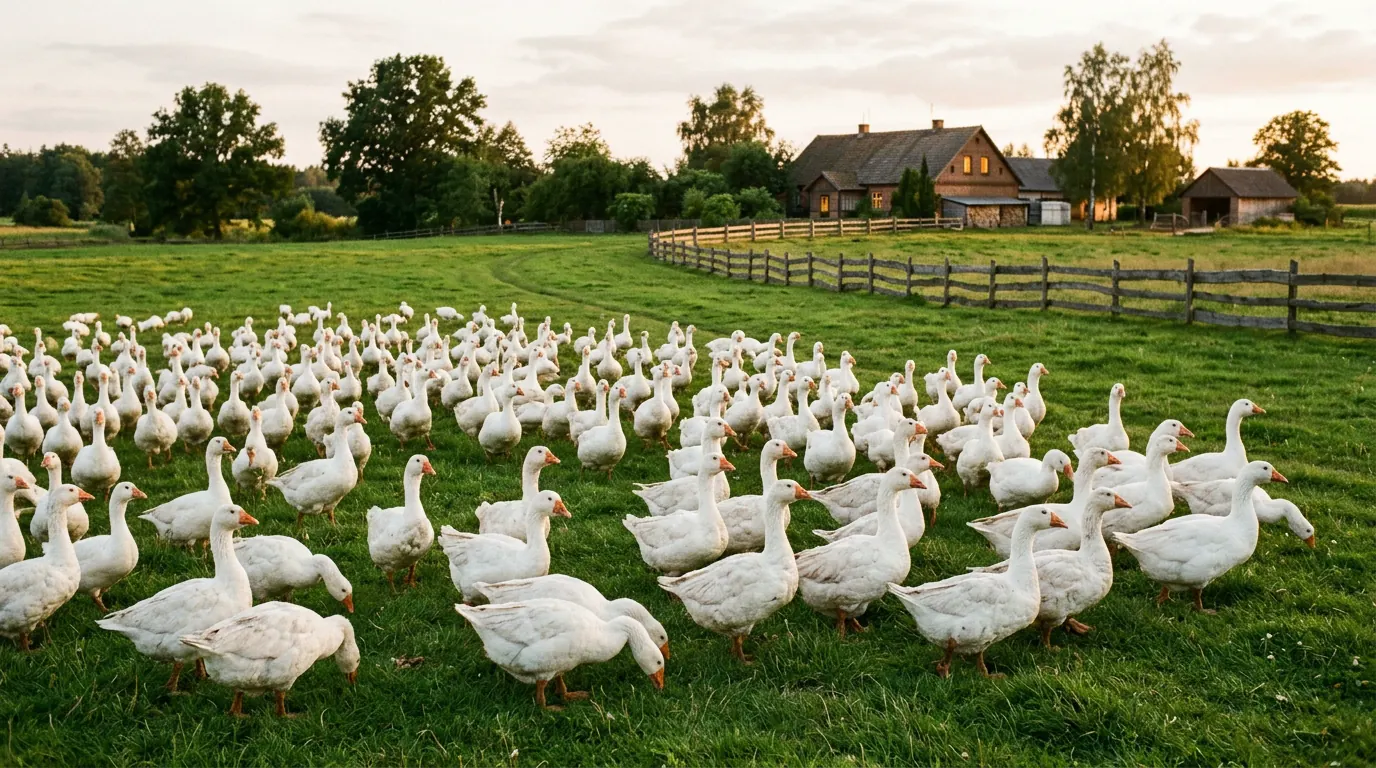
A fighting goose is not a separate species. It is a group of breeds developed from the domestic goose (whose ancestor is the greylag goose) for goose fights. Breeders picked strong, bold birds with a powerful neck and a short, sturdy bill. The group includes the German Steinbacher and the Russian geese from Arzamas and Tula.
Why keep fighting geese today
Animal fights are banned in Poland by the Animal Protection Act, so today's breeding has a different purpose. People keep these geese as ornamental birds, to preserve breeds with an interesting history, and for meat for their own use. For production they do not compete with the commercial breeds in our overview of goose breeds. You buy them for character and rarity, not for profit.
Where fighting geese come from
The Steinbacher from Germany
The Steinbacher is a German breed, also called the fighting goose (Kampfgans). It comes from the area around Steinbach-Hallenberg in Thuringia. Breeders developed it as a compact bird with a short bill, and over time it was shown at poultry exhibitions. Today it is rare and kept mainly by enthusiasts. For a detailed description of colors and the standard, check breeders' association standards, as they differ from country to country.
Arzamas and Tula from Russia
The Arzamas and Tula geese come from Russia and are named after the regions where they were kept. Both grew out of Russia's long tradition of goose fights. The Tula is often described as a bird with a clearly curved bill and a knob on the forehead, and the Arzamas as a breed with a strong, noble build. Descriptions in the literature differ in detail, so when you buy, ask about the breeding line and the standard the breeder selects by.
How to recognize fighting geese
Body build
Fighting geese are usually stocky and muscular, with an upright stance and strong legs. The neck is strong, and the bill is shorter and heavier than in utility geese. The Tula stands out with a curved bill and a knob at its base. The Steinbacher has a short, heavy bill. Exact measurements and body weights are given in the breed standards. Real values depend on the line, age and feeding, so do not expect identical birds in every flock.
Sex and dimorphism
In many geese it is hard to tell female from male at a glance, and the similar build of fighting breeds makes it harder. Ganders are usually larger, with a thicker neck and head. Vent sexing, which means examining the cloaca, is more reliable. We describe the methods in how to tell a goose from a gander. Knowing the sex helps when you choose a breeding flock.
Temperament and behavior
Ganders can be aggressive
Selection for fighting spirit left its mark on behavior. Ganders, especially in the breeding season, can defend territory and attack other birds and people. An adult gander hits with its wing and pinches with its bill, which can leave bruises. Keep them away from children and visitors, and move calmly and confidently when you work in the pen. Not every bird is aggressive, but expect it.
Mixing with other birds
It is better to keep fighting geese in separate pens, apart from ducks, chickens and calmer goose breeds. Stronger birds drive weaker ones away from the feeder and drinker and can injure them in a tight pen. If you mix a flock, do it as early as possible, while the birds are goslings, and watch whether any bird dominates too much. In serious conflicts, separate the birds before injuries happen.
Egg laying, hatching and meat
Egg laying and incubation
Geese lay seasonally, starting in early spring, and the number of eggs depends on breed, age and feeding. In fighting breeds laying is usually low and cannot be compared with laying breeds. We cover how many eggs a goose lays in a season in the article on goose egg laying. When you plan a hatch, read about geese incubating eggs, because incubation length and brood care need preparation.
Meat
You can get meat and fat from fighting geese, but these breeds grow more slowly and gain less than commercial geese, so they perform worse economically. If carcasses matter to you, pair them with meat breeds or with native ones, described in the text on the Pomeranian and Kartuzy geese. For selling fat, see goose fat and rendered goose lard.
Housing and care needs
Pen and shelter
These birds are strong, so the fence must be sturdy and higher than for calm breeds. Provide a dry, ventilated house with litter and access to a run with green forage. We describe the details in the article on housing requirements for geese. For ganders in the breeding season, build separate pens to avoid fights over females and nests.
Feeding and health
Adult geese make good use of green forage and grass, and concentrate feed tops up their ration during laying and in winter. We describe the principles in the text on feeding geese and ducks. Keep up biosecurity and check the flock regularly for worm infections and salmonella. A vet always chooses medicines and doses, and also sets the withdrawal period before you sell meat and eggs.
Law and goose fights
Poland's Animal Protection Act bans organizing animal fights and taking part in them. Keeping historically fighting breeds is allowed, because they are ordinary goose breeds. You can check the current text of the act in ISAP, Poland's Internet System of Legal Acts (legal state as of 23.11.2026). If you are unsure how a rule applies to you, ask the county veterinary officer (powiatowy lekarz weterynarii). To keep your flock in order, you can keep records in the program for duck and goose breeding.
Frequently asked questions
What is a fighting goose?add
It is a goose of a breed once developed for fights, with a strong build and a combative temperament. The group includes the Steinbacher and the Arzamas and Tula geese. Today they are kept mainly as ornamental and native birds.
What are the fighting goose breeds?add
The most often named are the Steinbacher from Germany and the Arzamas and Tula geese from Russia. We describe other breeds in our overview of goose breeds. Different sources may give slightly different lists.
Are fighting geese aggressive?add
Ganders can be aggressive, especially in the breeding season, because they defend territory and nests. Behavior depends on the line and the individual bird. Keep them apart from other birds and from children.
Is it legal to organize goose fights in Poland?add
No. The Animal Protection Act bans animal fights. You can, however, legally keep breeds that were once used for fighting. You can check the current text of the rule in ISAP.
Are fighting geese good for meat?add
You can get meat from them, but they grow more slowly and gain less than commercial breeds. For profit, meat breeds are better. People choose fighting geese for character and rarity.
How many eggs does a fighting goose lay?add
Laying is usually low and seasonal. The exact number depends on breed, line, age and feeding. Breed standards and the breeder of that line give approximate results.
Sources & resources
- linkNational Research Institute of Animal Production (Instytut Zootechniki PIB) — izoo.krakow.pl
- linkInternet System of Legal Acts (ISAP) — isap.sejm.gov.pl
- linkChief Veterinary Inspectorate (Główny Inspektorat Weterynarii) — gov.pl/web/wetgiw
- linkMinistry of Agriculture and Rural Development — gov.pl/web/rolnictwo
Prepared by: DlaFerm Team based on data from the sources listed · Publisher: INSTA-TECH sp. z o.o.
Manage your goose flock in DlaFerm
In DlaFerm you can record your flock, hatches, events and treatments in one place, including rare breeds. Create a free farm account or get in touch with us.
Phone
+48 796 258 151