European goose breeds: Diepholz, Celle, Franconian and Czech
Diepholz, Celle, Franconian and Czech geese developed in central Europe from local farm geese. We describe where they come from, what they look like and what they are used for, and how to choose a breed for your own flock.
verifiedFrom the team that has organised work on poultry farms for years.
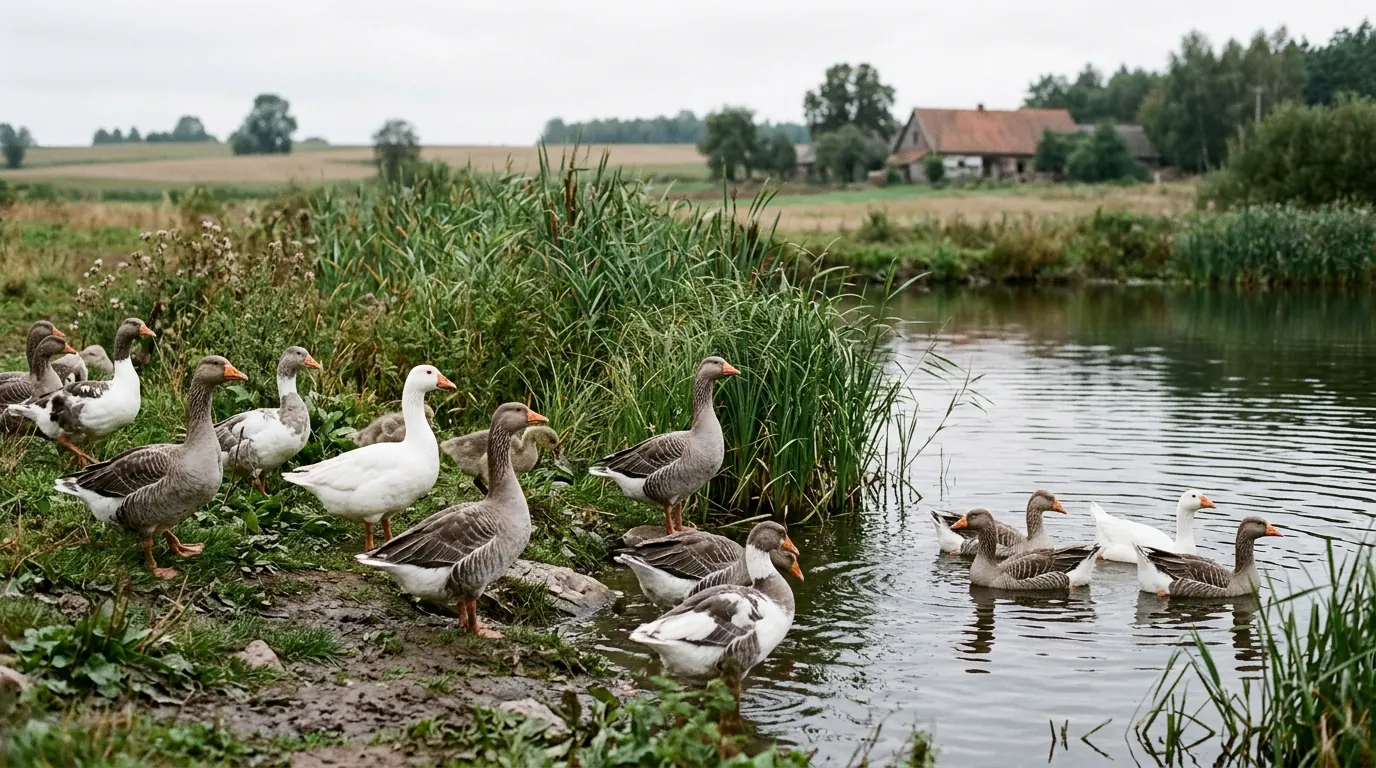
Most European goose breeds are old farm geese that keepers selected for years to suit local conditions: climate, pasture and the way geese were kept. The ones named most often in breed catalogs are the German Diepholz, Celle and Franconian geese, and the Czech goose. All are utility geese, so people keep them for meat, feathers and hatching eggs, not for looks. In Poland these breeds are rare, so check where the breeding stock comes from before you buy.
Where these breeds come from
All domestic geese descend from wild geese, as we explain in our article on the ancestor of the domestic goose. The western and central European breeds developed in separate regions. The names Diepholz and Celle come from German towns in Lower Saxony, and Franconian comes from Franconia. They share one trait: they suit pasture-based keeping and a cool, damp climate. For a wider overview, see our catalog of goose breeds.
Diepholz goose
Appearance and origin
The Diepholz goose comes from the area around the town of Diepholz in Lower Saxony. The breed standard describes white plumage, an orange bill and legs, and light eyes. The build is fairly light and upright, so the bird looks slimmer than heavy meat breeds. This build suits walking on pasture and grazing green forage, which saves real money on feed in backyard keeping.
What Diepholz geese are good for
The breed is a utility goose with moderate body weight and good mothering traits. Do not treat it as a goose for intensive fattening. Exact weights and laying results depend on the breeding line, so ask the breeder for data from their own flock or check the breed descriptions of the Institute of Animal Science (Instytut Zootechniki PIB). We cover egg numbers per season in our article on goose egg laying.
Celle goose
The Celle goose comes from the area around the town of Celle, also in Lower Saxony. It is white and has a reputation as a hardy, calm breed that copes well with free-range keeping. Its calm temperament makes flock work easier, especially when you keep ganders with geese during the breeding season.
How it differs from Diepholz
Both breeds are white and German, so people often mix them up. You tell them apart by the breed standard: shape, body carriage and head proportions. If you buy for a breeding flock, ask for a written record of the birds' origin and see the parents. You can sex young birds using the rules in how to tell a goose from a gander.
Franconian and Czech geese
Franconian goose
The Franconian goose comes from Franconia in southern Germany, a region with a long tradition of raising geese for meat. Breeding literature describes its coloring in varying detail, because the breed grew out of local populations. Before you buy, ask which standard the breeder uses for selection.
Czech goose
The Czech goose comes from the Czech lands. It is kept as a utility goose with a calm temperament and good suitability for pasture. It is close to the native Polish breeds we describe in our article on the Pomeranian and Kartuzy geese. When you compare these breeds, look at performance in a specific flock: egg laying, hatchability and chick survival.
How to choose a breed for your flock
Start with your goal
First decide whether you keep geese for meat, for your own use, or to sell goslings. Light breeds such as Diepholz use pasture well but give less meat than heavy breeds. Native breeds have one advantage: it is easier to buy birds with confirmed origin. Also check how available the breeding stock is, because with rare breeds goslings are often reserved long before the season.
Check the birds before you buy
Buy from a breeder who shows you the parents and the flock, and ask for data on the birds' health. Judge condition: clear eyes, dry nostrils, a steady walk and even plumage. Check the notification and veterinary rules with the Chief Veterinary Inspectorate (Główny Inspektorat Weterynarii) and your county veterinarian, because they depend on the number of birds and how you keep them.
Keeping European goose breeds
Pasture, feed and housing
These geese make good use of grass and green forage, but they also need supplementary feed. We describe the feeding rules in our article on feeding geese and ducks. The house should be dry, ventilated and have clean bedding. You will find the requirements in our text on housing for geese.
Hatching and flock management
Good mothering is an asset of utility breeds, but still plan for brooding: nests, quiet and access to water. Details on incubation time are in our article on a goose sitting on eggs. Record laying dates, hatches and losses, because after two seasons you will see which geese are worth keeping in the breeding flock.
Frequently asked questions
What is a Diepholz goose?add
It is a German breed from the Diepholz area, white with an orange bill and legs. It is a utility goose with a light, upright build. Check the exact performance traits with the breeder of the specific flock.
What is the difference between a Celle and a Diepholz goose?add
Both are white breeds from Lower Saxony. They differ in the breed standard: body proportions and shape. Celle is described as a calm, hardy breed.
Are European geese suited to keeping in Poland?add
Yes. These breeds are adapted to a cool climate and pasture keeping, so Polish conditions suit them. The harder part is buying birds with confirmed origin, because they are rare breeds in Poland.
How many eggs does a Diepholz goose lay?add
Goose laying is seasonal and depends on the line, the age of the bird and feeding. Get exact numbers from the breeder of the flock you buy from, or from the descriptions of the Institute of Animal Science (Instytut Zootechniki PIB).
Where can I find information about goose breeds?add
Start with the Institute of Animal Science (Instytut Zootechniki PIB), which keeps breed descriptions. Check the rules for keepers with the Chief Veterinary Inspectorate and on the Ministry of Agriculture website.
Sources & resources
- linkInstitute of Animal Science PIB (Instytut Zootechniki PIB) — izoo.krakow.pl
- linkChief Veterinary Inspectorate (Główny Inspektorat Weterynarii) — gov.pl/web/wetgiw
- linkMinistry of Agriculture and Rural Development — gov.pl/web/rolnictwo
Prepared by: DlaFerm Team based on data from the sources listed · Publisher: INSTA-TECH sp. z o.o.
Track your goose flock in the coop records
In the DlaFerm coop records module you can log flock numbers, losses and hatches for each group of birds. Create a free farm account or get in touch with us.
Phone
+48 796 258 151