Beef carcass cuts: how a carcass is divided, cut names and dressing percentage
A beef carcass is split into sides, quarters and cuts, and each has its own trade name. We describe the quarter categories, the cuts the market tracks and what drives dressing percentage. The figures come from studies by Poland's Institute of Animal Science (IZ PIB) on Polish Holstein-Friesian (PHF), Simmental and crossbred cattle.
verifiedFrom the team that has organised work on poultry farms for years.
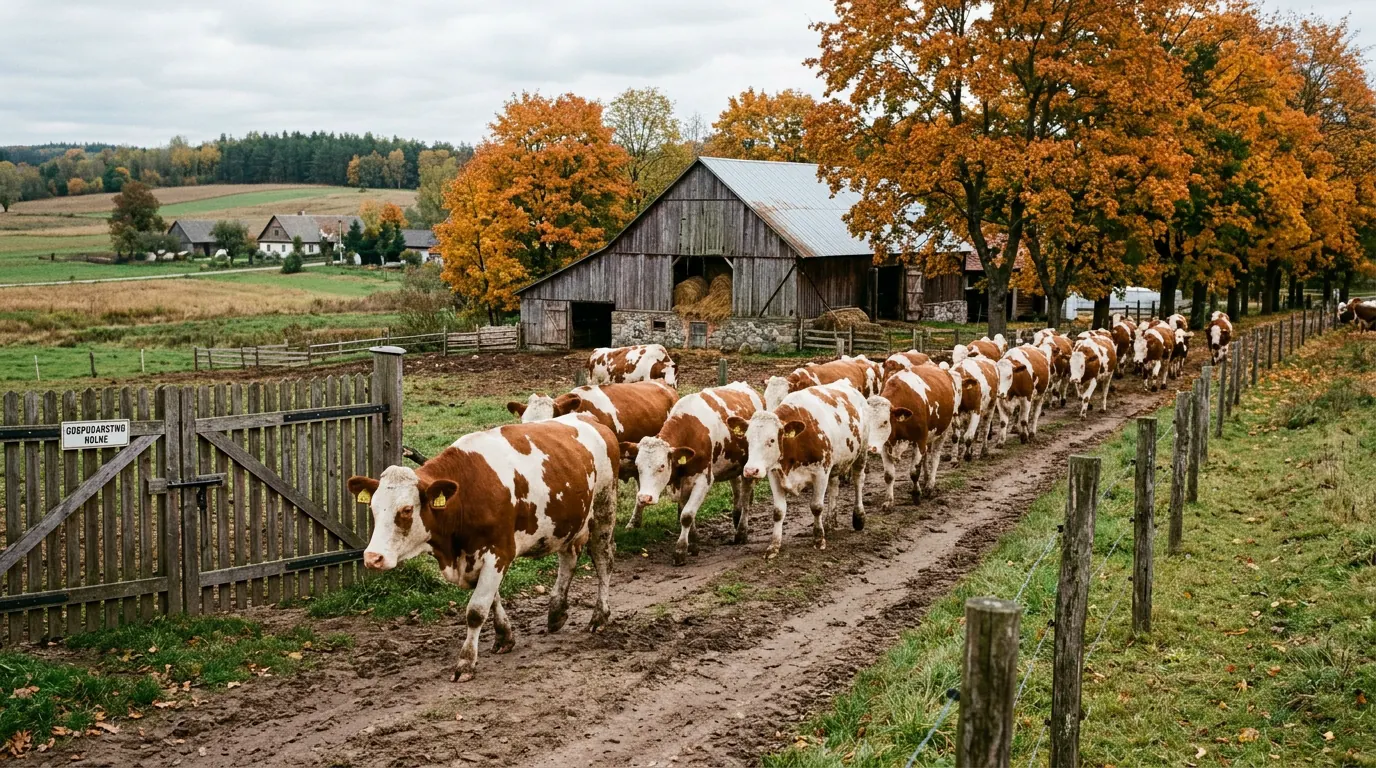
After slaughter, a cow or bull gives a carcass. It is split into two sides, and each side into a forequarter and a hindquarter. Cuts such as bone-in rump steak or boneless topside are taken from the quarters. So beef is sold in several forms: as a whole carcass, as quarters or as cuts. For you as a farmer, the price depends on the animal category, the carcass class and the dressing percentage.
Parts of a cow in market terms
Farmers ask about "parts of a cow" and "cow meat", while the trade uses the names of quarters and cuts. Quarter sales are described by animal category: A means bulls under 2 years, D means cows. The animal's body structure, where carcass assessment starts, is covered in cow anatomy: stomach, udder, teeth and digestive system. Names for male cattle and their categories are explained in bull, steer, ox: what to call a male cow.
How a beef carcass is divided
From carcass to quarter
After slaughter, the carcass is split along the spine into two sides. Each side is cut into a forequarter and a hindquarter. Fore and hind quarters are the basic unit of wholesale trade. Sometimes compensated quarters are sold: these combine front and rear parts to even out their proportions. Detailed cutting is done only at the meat plant, so you usually do not influence the cuts. You do influence how much meat, and of what quality, ends up in each quarter.
Cuts the market tracks
Among beef cuts, the official methodology for recording market data names two: bone-in rump steak and boneless topside meat. Businesses that produce beef carcasses, sides, quarters or cuts and have been notified by Poland's minister of agriculture record their sales prices in PLN per tonne and their volume in tonnes. The duty comes from the Regulation of the Minister of Agriculture and Rural Development of 13.08.2004 on collected market data (Dz. U. 2004 Nr 192, poz. 1971, as amended, Poland's Journal of Laws). You do not report these prices as a farmer, but the summaries help you judge which cuts hold their price.
Beef quarters from bulls and cows
Category A and category D
The methodology of Poland's Ministry of Agriculture and Rural Development (MRiRW) separates forequarters, hindquarters and compensated quarters into two categories. Category A covers bulls under 2 years, category D covers cows. A forequarter from a bull under 2 years and a forequarter from a cow are therefore quoted separately, and so are hindquarters. The same part of the body has a different price depending on the animal it comes from. When planning a sale, check which category the buyer will put your animals in. Current rates are on the page slaughter cattle prices; we give no amounts here because they change from week to week.
Dairy cow or beef cattle
A culled dairy cow and a young beef-breed bull give carcasses with a different build and eating quality. In dairy herds, high milk yield and large herds make it harder to check each cow, as WMODR Olsztyn (a regional agricultural advisory center) notes in its paper on cow fertility. The animal's condition before slaughter affects carcass quality. To improve cows' condition before sale, start with the ration, described in what cows eat.
Dressing percentage: how much carcass you get from a live animal
What the IZ PIB studies show
Dressing percentage depends on breed and crossing. According to a monograph of the Institute of Animal Science (IZ PIB) based on comparative studies, PHF cattle reached a dressing percentage of 55.20%, PHF x Simmental crossbreds (PHFxSM) 56.01% and Simmental (SM) 56.09%. The EUROP carcass class for these groups was 2.3, 3.1 and 3.6 points. Net daily gain was 627 g, 658 g and 640 g. The groups differ little in dressing percentage but clearly in carcass class, because the class is what tells the buyer how well muscled the animal is.
Extensive production
A paper on slaughter characteristics of meat from organic farms (P. Wójcik, J. Walczak, IZ PIB) cites 1996 research by Goszczyński and colleagues. There the cattle were fed extensively and the dressing percentage was also 53%. This shows that extensive feeding lowers dressing percentage only slightly, as long as the animal reaches a suitable weight. In organic production, Hereford cattle gained weight in all age groups over three consecutive years of study. So slaughter timing and feed both affect the result, and market forecasts help you pick a date; see the beef cattle price forecast.
Meat, fat and bone in the carcass
Share of meat, fat and bone
The IZ PIB monograph gives the composition of the five basic primal cuts. In PHF cattle, meat made up 70.2%, fat 9.95% and bone 20.03%. In PHFxSM crossbreds it was 73.24% meat, 7.37% fat and 19.39% bone. In Simmental, meat reached 76.87%, fat fell to 5.08% and bone to 18.05%. The area of the longissimus dorsi muscle was 99.3, 105.7 and 106.1 cm² respectively. The higher the meat share in the primal cuts, the more high-priced cuts you get from one carcass.
Topside and shoulder in crossbreds
In studies of Hereford cattle and Hereford x Limousine crossbreds, described in "Wiadomości Zootechniczne" (a Polish animal science journal), purebred bulls at 8 months had a heavier topside with more meat in that cut. They also had more meat in the shoulder, with less bone weight in the primal cut. At later slaughter, at 24 months, the crossbreds gained a small advantage (2%) in the meat share of the topside. The lesson for you: the value of cuts depends not only on breed but on slaughter age. Discuss your crossing plan and sale timing with an ODR advisor (an adviser from a regional agricultural advisory center).
What to check before you sell an animal
Agreements with the plant
Before selling, ask the plant which category it will put the animal in (A or D), how it grades the EUROP class and whether it pays by carcass weight or live weight. Write down weight, age and delivery date. Disagreements between your assessment and the plant's most often concern carcass class and fat cover. One class can change the price, so keep photos and the animal's documents. We do not describe the rules for transporting animals to slaughter in detail here; look for them in the regulations on the website of the Chief Veterinary Inspectorate (Główny Inspektorat Weterynarii).
Documents and settlement
Selling live animals or meat requires an invoice, and the buyer's plant issues a settlement with the slaughter report. Keep copies of both together with your herd records, so you can compare carcass results with earlier deliveries. Farmers who sell on a larger scale issue invoices in KSeF (Poland's national e-invoicing system), and their summaries show which batches brought better revenue.
Frequently asked questions
How is a beef carcass divided?add
The carcass is split into two sides, and each side into a forequarter and a hindquarter. Cuts such as bone-in rump steak and boneless topside are taken from the quarters. Compensated quarters also appear in wholesale trade.
What are the parts of a cow in the meat trade?add
The market distinguishes forequarters, hindquarters and compensated quarters, plus cuts such as bone-in rump steak and boneless topside meat. Quarters are split into category A (bulls under 2 years) and D (cows).
What is the dressing percentage of cattle?add
According to IZ PIB, PHF cattle reached 55.20%, PHFxSM crossbreds 56.01% and Simmental 56.09%. With extensive feeding, research from 1996 showed 53%. The result depends on breed, age and feeding.
How much meat is in a beef carcass?add
In the five basic primal cuts, IZ PIB found 70.2% meat in PHF, 73.24% in PHFxSM crossbreds and 76.87% in Simmental. The rest is fat and bone.
What is the difference between category A and D?add
Category A is bulls under 2 years, category D is cows. Each has separate quotations for forequarters, hindquarters and compensated quarters.
Where can I check beef and live cattle prices?add
Prices change weekly, so we do not give them here. You will find current live cattle quotations in the slaughter cattle price summary, and market data is published by Poland's Ministry of Agriculture and Rural Development.
Sources & resources
- linkMRiRW (ZSRIR) — Methodology for recording market data from the beef and veal market
- linkIZ PIB — Livestock keeping and breeding over 70 years. Cattle Breeding Department, Sheep and Goat Breeding Department
- linkIZ PIB — WZ — Slaughter characteristics of beef from organic farms (P. Wójcik, J. Walczak)
- linkWMODR Olsztyn (publication on gov.pl) — Relationship between milk yield and cow fertility indicators (U. Steckiewicz)
Prepared by: DlaFerm Team based on data from the sources listed · Publisher: INSTA-TECH sp. z o.o.
Selling cattle or beef? Issue invoices in KSeF with DlaFerm
The <a href="/fakturowanie-ksef">KSeF invoicing</a> module lets you issue and organize sales invoices in one place. Create a free farm account in DlaFerm or get in touch.
Phone
+48 796 258 151