Cow milk: yield per cow, fat and protein
According to 2015 data, the average cow assessed in Poland gave 7582 kg of milk per lactation, with 4.08% fat and 3.36% protein. We compare breeds, explain what changes milk composition and what you need to know about milk straight from the cow.
verifiedFrom the team that has organised work on poultry farms for years.
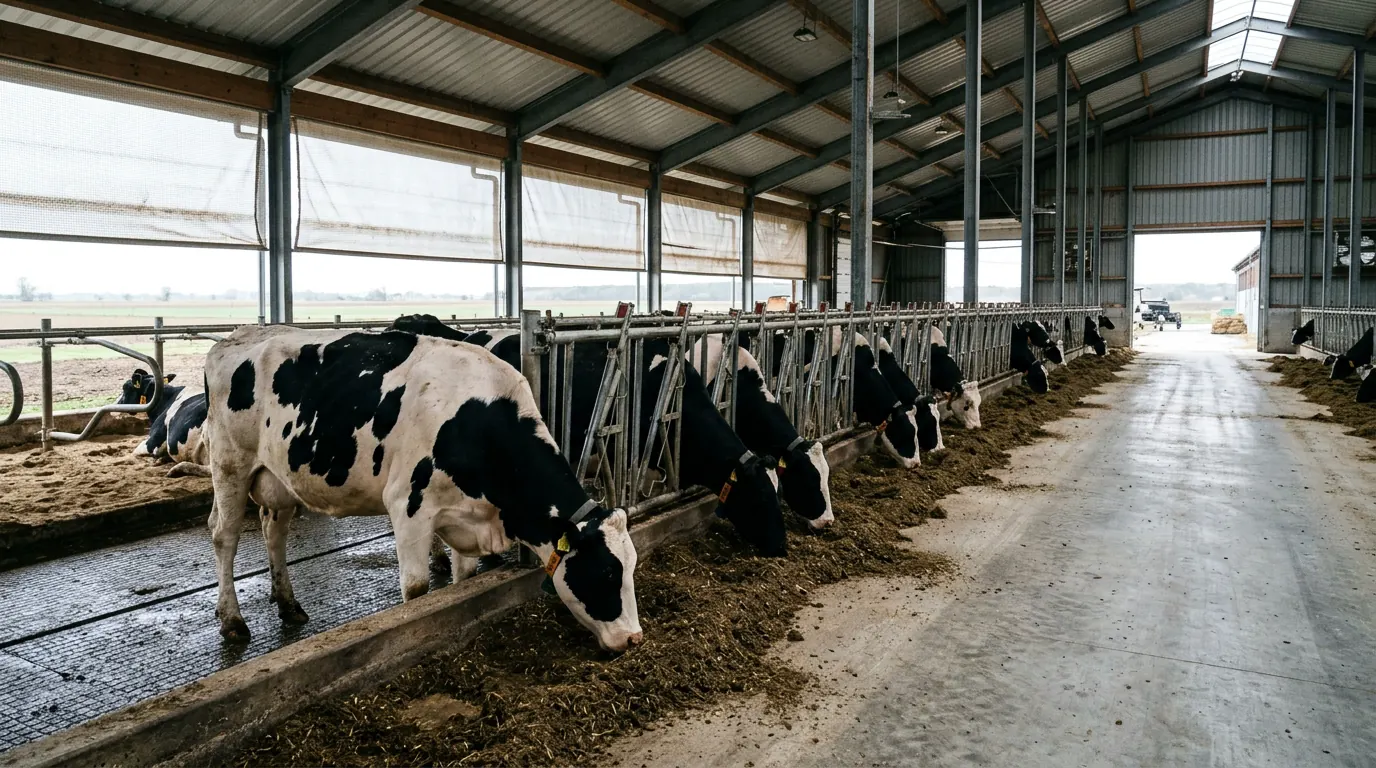
How much milk a cow gives depends on breed, feeding, body condition and stage of lactation. According to the Polish Federation of Cattle Breeders and Dairy Farmers (PFHBiPM, 2015 data), the average cow assessed in Poland gave 7582 kg of milk per lactation. The milk averaged 4.08% fat and 3.36% protein. These are averages from 733,241 cows, so a single cow in your herd can come out clearly higher or lower.
Milk from the cow: what we know about composition
The main components you can measure and compare between cows are fat and protein. They differ by breed: Jersey has the most fat and protein, but gives less milk than the Holstein-Friesian. Below we give figures breed by breed, then describe what affects yield and how to approach raw milk.
Cow milk and daily yield
We cannot give daily yield as one number, because it changes during lactation and depends on the ration. The data we have covers the whole lactation. You can check a cow's daily yield through milk recording or by weighing milk at milking yourself.
How much milk a cow gives: per lactation and per day
How much milk a cow gives in Poland
According to the 2015 PFHBiPM summary, the Polish Holstein-Friesian of the black-and-white variety (636,226 cows) averaged 7742 kg of milk. The average for all of Poland was 7582 kg. For comparison, in 1990 the national average yield per cow was 3126 kg, and for cows under milk recording 4131 kg, according to the same IZ PIB (Poland's National Research Institute of Animal Production) publication. The gap shows how far breeding and feeding have come.
How much milk a cow gives per day
Daily yield is the lactation yield spread over milking days, with a clear peak after calving and a fall in the following months. We do not divide kilograms by days here, because lactation length depends on the herd and calving dates. For a reliable figure, weigh the milk at milking and use milk recording. Plan calving dates with the article on cow pregnancy and the calving calendar.
High-yield records
WMODR Olsztyn (a regional agricultural advisory center) writes that the Holstein-Friesian breed reaches up to 10,000 kg of milk per lactation. At that level calving intervals and open periods get longer, and the number of inseminations per conception rises. High yield therefore needs good feeding and close control of reproduction.
Fat and protein in milk by breed
Dairy and dual-purpose breeds
PFHBiPM summary (2015): Polish Holstein-Friesian, black-and-white variety: 7742 kg, 4.07% fat, 3.35% protein. Red-and-white variety: 7068 kg, 4.15%, 3.37%. Simmental: 6030 kg, 4.12%, 3.46%. Montbeliarde: 7203 kg, 3.97%, 3.49%. Brown Swiss: 7076 kg, 4.30%, 3.54%. Swedish Red: 7029 kg, 4.34%, 3.59%. Norwegian Red: 7052 kg, 4.34%, 3.51%. Crossbreeds: 6728 kg, 4.21%, 3.41%.
Polish breeds and Jersey
Polish Red gave 3588 kg of milk, 4.31% fat and 3.38% protein. Białogrzbieta: 4333 kg, 3.98% and 3.28%. Polish Black-and-White: 4710 kg, 4.11% and 3.30%. Polish Red-and-White: 4635 kg, 4.08% and 3.26%. Jersey: 6009 kg, 5.10% fat and 3.84% protein, the most fat and protein in the summary. We describe the breed in the article on the Jersey cow.
How much fat is in milk straight from the cow
What percentage of fat milk straight from the cow has
On average in Poland 4.08%, according to 2015 data. The spread between breeds is clear: from 3.97% in Montbeliarde to 5.10% in Jersey. Milk from one milking of one cow can differ from the lactation average. A laboratory test of a sample shows the exact fat in your milk.
Milk straight from the cow and feeding
WMODR advises raising the energy concentration of the ration: a larger share of concentrates, maize silage, care over the harvest date of green crops for silage, and fat supplements such as whole rapeseed. You can read about cow rations in the article What cows eat. We give no specific amounts, because they depend on yield and herd condition.
Protein in cow milk
Protein in milk: typical values
The Polish average in 2015 was 3.36% protein. Large breeds range from 3.26% (Polish Red-and-White) to 3.59% (Swedish Red). Jersey reaches 3.84%. If you sell milk to a dairy, protein and fat assessment affects your payment. The rules are set in your contract with the buyer, so check them with the dairy.
Milk and cow anatomy
Milk is made in the udder, and its composition also depends on udder health and rumen function. We write about the udder and digestive system in the articles Cow anatomy and How many stomachs a cow has.
What affects yield and fertility
Transition period and body condition
WMODR points out that you should maximize feed intake after calving by preparing the cow in the transition period, the last three weeks of pregnancy. Breeding after calving usually falls in the period of highest yield and biggest deficit of energy, protein, minerals and vitamins. Reproduction problems occur most often in cows underfed on energy.
Fertility and yield
Reproductive disorders are the second most important problem in dairy cow keeping after mastitis, and a reason for culling. Worse fertility indicators show up most often in high-yielding herds. The bigger the herd, the harder it is to control feed intake and spot signs of heat. We describe the cycle in the article Cow reproductive system.
Milk straight from the cow: what to watch
Milk straight from the cow for family use and for sale
Raw milk should come from a healthy, tested cow, be milked cleanly and be chilled quickly. For direct sale rules and veterinary requirements, check with the Chief Veterinary Inspectorate (Główny Inspektorat Weterynarii) and your county veterinarian (powiatowy lekarz weterynarii), who can tell you what applies on your farm. We describe the principles and give no figures we cannot verify here.
Treatment and withdrawal period
Milk from a treated cow must not be put on the market during the withdrawal period. The vet chooses the medicine, dose and length of the withdrawal period. Record treatments and dates in one place, for example in the Treatment and withdrawal module in DlaFerm. We cover colostrum and milk for calves in the article on calf rearing.
Frequently asked questions
How much milk does a cow give per day?add
Daily yield changes over the lactation, peaking after calving. The data we have is per lactation: on average 7582 kg in Poland in 2015 data. You can check daily yield by weighing milk at milking.
How much milk does a cow give per lactation?add
In 2015 the Polish Holstein-Friesian of the black-and-white variety averaged 7742 kg and the Jersey 6009 kg. WMODR says the Holstein-Friesian reaches up to 10,000 kg per lactation.
What percentage of fat is in milk straight from the cow?add
On average 4.08% in Poland (2015 data). Montbeliarde 3.97%, Jersey 5.10%. Test a sample to see the result for one cow.
How much protein is in cow milk?add
On average 3.36% in Poland. Large breeds range from 3.26% to 3.59%, Jersey 3.84%.
Which cow milk has the most fat?add
According to the 2015 PFHBiPM summary, Jersey milk: 5.10% fat and 3.84% protein. It gives less milk than the Holstein-Friesian, though.
Is milk straight from the cow safe?add
It depends on the cow's health, milking hygiene and chilling. Check the raw milk rules with your county veterinarian. After treating a cow, the withdrawal period set by the vet applies.
Sources & resources
- linkIZ PIB, Wiadomości Zootechniczne: Current state and prospects of dairy cattle breeding in Poland (T. Piechowska, PFHBiPM), WZ LIII(2015)2:36–45
- linkWMODR Olsztyn (publication on gov.pl): The relationship between milk yield and cow fertility indicators (U. Steckiewicz)
- linkChief Veterinary Inspectorate (Główny Inspektorat Weterynarii): gov.pl/web/wetgiw
Prepared by: DlaFerm Team based on data from the sources listed · Publisher: INSTA-TECH sp. z o.o.
Track withdrawal periods after treating cows with the Treatment and withdrawal module
The Treatment and withdrawal module in DlaFerm lets you record treatments and withdrawal dates, so milk from a treated cow does not reach sale too early. Create a free farm account in DlaFerm or get in touch.
Phone
+48 796 258 151