Pigs on Pasture and Green Forage
Grass for pigs means two things in practice: pasture, where pigs graze the plants themselves, and green forage, which is fresh cut plant material fed in the trough. Green forage is a cheap source of nutrients, but it does not replace a complete feed. We explain what to sow, how much to feed, and which biosecurity and ASF rules you must meet.
verifiedFrom the team that has organised work on poultry farms for years.
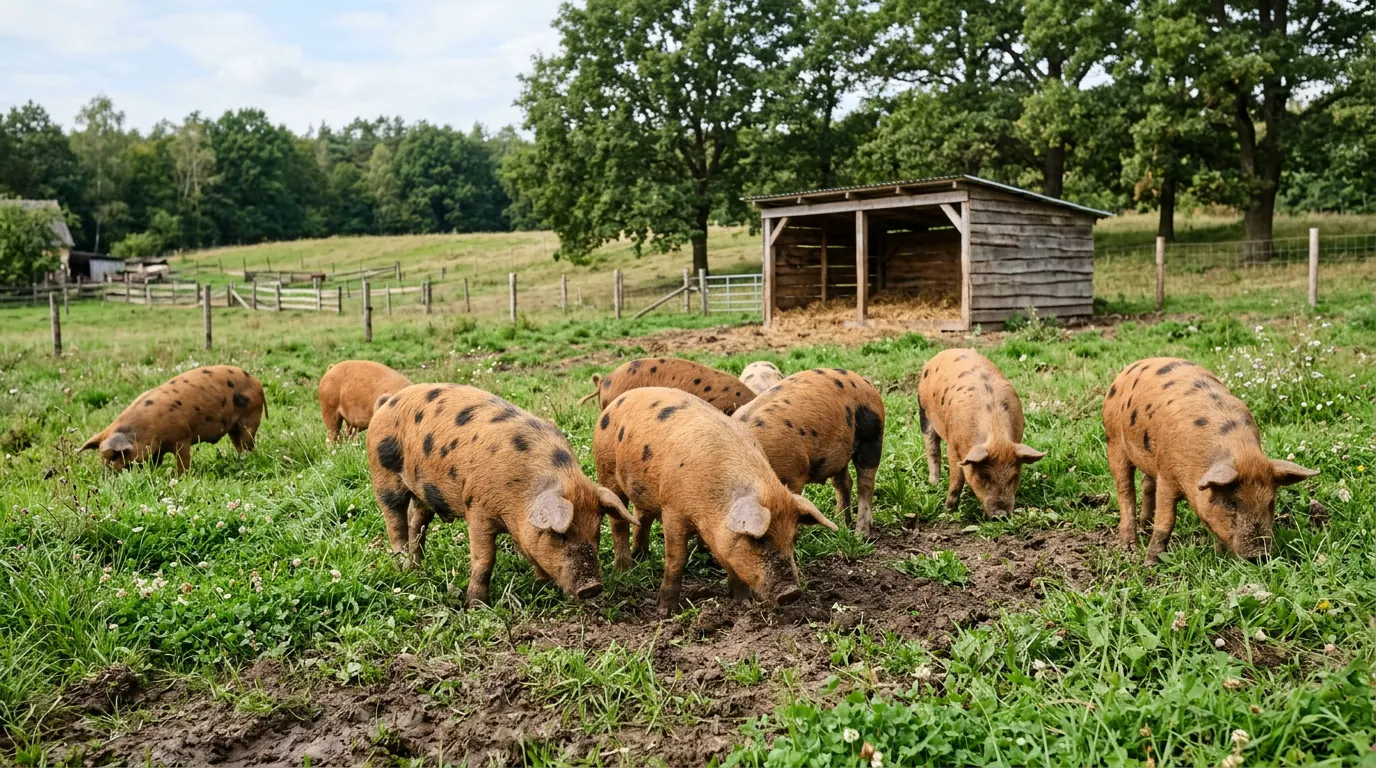
Grass for pigs means two things in practice: pasture, where pigs graze the plants themselves, and green forage, which is fresh cut plant material fed in the trough. Both are cheap sources of nutrients, but neither replaces a complete feed. Green forage is high in water, usually 70–85%, so on its own it cannot cover the energy and protein needs of fattening pigs. It works well as a supplement, especially for older animals and pregnant sows. We describe the complete ration in a separate guide to pig feed.
Who this suits
Green forage and pasture are most often used in organic production and on farms with larger outdoor runs. The organic pig production guide published by IZ PIB (Poland's National Research Institute of Animal Production) says grass forages are mostly used on larger runs and pastures, while legume forages are used much more often. On a smaller farm green forage also makes sense. You just need to match plants, amounts and safeguards to the number of animals and the area. Before you start, check the biosecurity rules and the ASF status of your area in your county.
Pasture for pigs: what to prepare
Fencing and rooting
Pigs root: they dig up and break the sod looking for roots and insects. A pasture without reinforced fencing quickly turns to mud, and the animals can get out. The fence should be sturdy, protected along the bottom edge against digging, and fixed firmly to the posts. At every pasture provide drinking water and shade, because pigs do not sweat and overheat easily in hot weather. We do not give fence dimensions, because they depend on breed, age of the animals and the terrain. Agree the details with an adviser.
Which plants to choose
Grass mixes and legumes are the usual choice. The IZ PIB guide says alfalfa contains about 20–25% protein in dry matter and is rich in calcium. Among legume forages the guide also lists clover and serradella. The choice depends on soil, climate, and whether the pasture is only a run or also a source of feed. Before sowing, check that the chosen species are not harmful to pigs, and discuss the mix with a local farm adviser.
Green forage in the trough: what and how much to feed
Which animals benefit
The IZ PIB guide describes green forages as a valuable, cheap source of nutrients, rich in vitamins and minerals, with milk-boosting properties. Older animals, dry sows, pregnant sows and older fattening pigs gain the most. A water content of 70–85% means a lot of bulk with little dry matter. So green forage works as a supplement to the diet, not its base. Fattening pigs on a full feeding program get feed of fixed composition, and you add green forage in an amount that does not upset the balance.
Amounts given in the guide
The guide says that up to 10 kg of alfalfa green forage per day is acceptable for sows, and up to 6 kg per day for fattening pigs. These are upper limits from a publication, not a recommendation for every farm. Forage composition changes from cut to cut, and the herd has different needs depending on age and physiological state. Before you make green forage a regular part of the ration, talk to your vet or a feeding adviser. Record how much and which forage you feed, so you quickly notice any change in herd condition.
Biosecurity and ASF: before you put pigs on grass
What the GIW base document says
The base document on farm biosecurity rules from GIW (Poland's Chief Veterinary Inspectorate), in its part on feeding and watering pigs, lists a ban on feeding green forage, kitchen waste and feed that has not been heat treated. It also lists feed produced on your own farm from raw materials without quarantine and control. Water for drinking and washing must be fit to drink, and your own water source must be tested microbiologically at least once a year. These rules cover biosecurity of the whole farm, so when you plan pasture and green forage, ask your vet how they apply to your farm. You can write up a ready plan in the biosecurity plan generator.
ASF: forage from restricted areas
The Ministry of Agriculture regulation of 12.03.2026 on measures to control African swine fever (Dz.U. 2026 poz. 344, Poland's Journal of Laws) covers green forage and grain from restricted areas and from areas listed in Annex II to Commission Implementing Regulation (EU) 2023/594. Feeding such forage is banned, unless it has been treated to inactivate the virus or stored for at least 30 days in a place wild boar cannot reach. A similar rule applies to straw for bedding, where the period is 90 days. Legal state as of 22.11.2026. Before you mow a meadow next to a forest, check the area status in ISAP (Poland's legal acts database) and with your county veterinary officer. We describe the symptoms of the disease in the article on ASF.
Green forage in the daily pig diet
Green forage next to feed
Green forage is a supplement, and the diet rests on feed of known composition. Set the amount of forage so the animals still eat their whole portion of complete feed. When forage replaces part of the feed, the balance of protein, energy and minerals shifts, and you see the effect only after a few weeks in weight gain and condition. For fattening, plan feeding phases according to the program you use. Introduce green forage gradually, so the animals' digestive system gets used to the larger volume.
Silage from green forage
The IZ PIB guide lists silage from grasses and legumes, with added potatoes or other root crops, as bulky feed for pigs. Silage lets you keep the green mass for longer and cut losses after mowing. Ensiling needs the mass to be packed well and the silo sealed tightly, otherwise fermentation is uneven. You will find what fermented feed is and how to prepare it in the guide to fermented feed.
Recording pasture and green forage
What to put in your log
Note the date of grazing or feeding of green forage, the plant species, the place it was cut, and whether the meadow lies in a restricted area. Also record which group of animals used the pasture and what else you feed. When you buy green forage or silage from another farm, record the supplier and the delivery date. Such entries help in a biosecurity inspection and make it easier to show where feed came from if an inspector asks.
How to keep this in DlaFerm
In DlaFerm.pl you keep records in the app for pig farmers, and you link the feeding and health plan of the herd with your records. If you give animals a medicine on pasture, the entry goes to the treatment and withdrawal period records, where the system tracks the dates. The vet always chooses the medicine and dose, and the withdrawal period follows the vet's instructions. We describe the documents you must keep in the guide to rules and paperwork for pig farmers.
Frequently asked questions
Can pigs graze on pasture all year round?add
It depends on climate, the type of animals, and whether the pasture is fenced and has water. In winter and wet periods pasture gets damaged, so plan a replacement area. Agree grazing dates with an adviser, taking sod condition and weather into account.
Can I feed my pigs fresh grass from my own meadow?add
Feed green forage only if the meadow is outside an ASF restricted area and the forage is used in line with biosecurity rules. The GIW base document lists a ban on feeding green forage in the context of biosecurity, so talk to your vet before you decide. If in doubt, apply treatment or storage as set out in the regulation.
How much green forage per day can I give a fattening pig?add
The IZ PIB guide says up to 6 kg of alfalfa green forage per day is acceptable for fattening pigs, and up to 10 kg for sows. These are upper limits, not a standard for every farm. Set the amount with your vet or a feeding adviser, depending on forage composition and herd condition.
Can green forage replace complete pig feed?add
No. Green forage is high in water, so it gives a lot of bulk but little dry matter and few nutrients. Treat it as an addition that enriches the diet, especially for older animals and pregnant sows.
What plants should I sow on a pig pasture?add
Most often grass mixes and legumes such as alfalfa, clover or serradella. The IZ PIB guide says alfalfa is rich in protein and calcium. The choice depends on soil and climate, so pick plants with a local adviser.
Sources & resources
- linkGIW (Poland's Chief Veterinary Inspectorate): base document on farm biosecurity rules (derogation from testing), v. 5.0
- linkIZ PIB: Organic pig production guide (ed. E.R. Grela)
- linkMinistry of Agriculture / Journal of Laws: Regulation of 12.03.2026 on measures to control African swine fever (Dz.U. 2026 poz. 344)
- linkISAP, Poland's online database of legal acts: isap.sejm.gov.pl
Prepared by: DlaFerm Team based on data from the sources listed · Publisher: INSTA-TECH sp. z o.o.
Running a pasture or feeding green forage?
The pig farmer app in DlaFerm.pl helps you keep feeding, treatment and biosecurity records in one place. Create a free farm account and see how it works in practice.
Phone
+48 796 258 151