Pig feed: prestarter, starter, grower, finisher
Pig feed is split into phases because a weaned piglet and a finishing pig need different levels of protein, energy and amino acids. We describe four phases, the body weight ranges where the feed changes, and textbook figures you can compare your own results with.
verifiedFrom the team that has organised work on poultry farms for years.
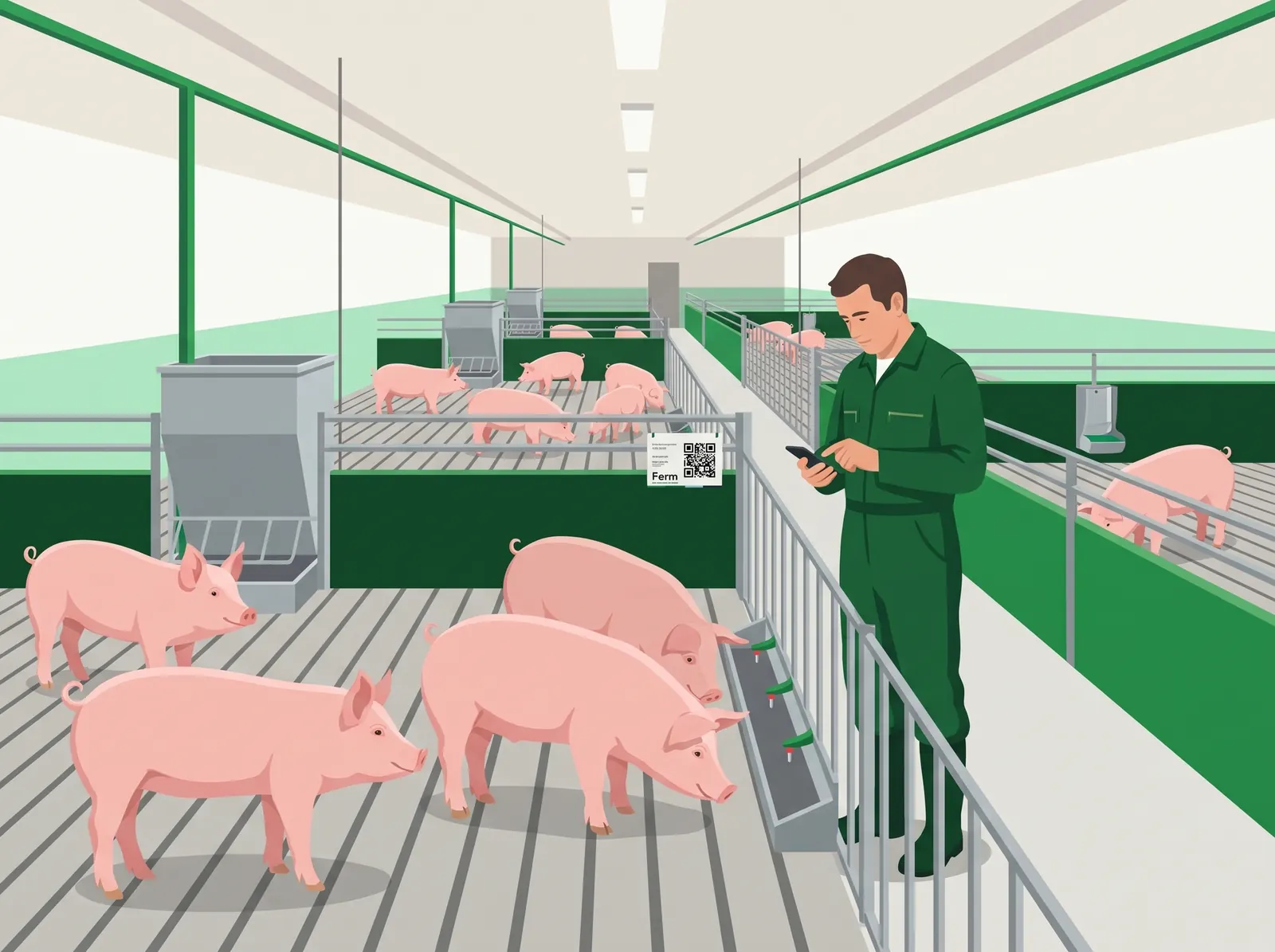
Pig feed is usually split into four phases: prestarter and starter for piglets, grower for young fattening pigs, and finisher for pigs close to slaughter. Body weight sets the limits of each phase, not the calendar, because growth rate depends on genetics, health and housing conditions. The PIC Wean to Finish manual gives a weight range of 5.5 to 28.6 kg for the nursery and 27.2 to 126 kg for finishing. These ranges show which feed stage covers which part of a pig's life. We also describe how to match feed to your herd on the page for the pig farmer app.
Why feed is split into phases
A weaned piglet has a different digestive tract from a finishing pig, and a high-protein finisher feed does not suit what a young piglet can digest. In practice you use several recipes: easily digestible ingredients and additives at the start to help the move from sow's milk to solid feed, and a more energy-dense diet at the end of finishing. The Topigs Norsvin manual for TN Duroc progeny describes multi-phase feeding as the basis of its approach. The better the feed matches the phase, the fewer nutrients go to waste.
Prestarter, starter, grower and finisher
Prestarter and starter for piglets
You give prestarter to piglets right after weaning. It suits a young digestive tract, with well-chosen protein and additives that ease the move to solid feed. A diagram from KPODR (the Kujawsko-Pomorski agricultural advisory center in Minikowo), based on LfL piglet feeding strategies, shows several options: prestarter, weaning feed, and a health-supporting or performance-supporting feed. Its example assumes weaning at 3.5 weeks. Starter takes over after prestarter. Do not change both feeds on the same day, and check feed intake and health during the first days after weaning. A vet or feeding adviser chooses the composition and additives. If feed is combined with medicines, see our guidance on treatment records and withdrawal periods.
Grower and finisher
Grower is the feed for young fattening pigs after the nursery, usually from a weight close to 27 kg, the lower limit of finishing in the PIC table. Finisher is for the last stage of finishing before slaughter. Topigs Norsvin states that TN Duroc finishing pigs deposit protein well and grow fast, so the diet must cover their daily needs. In the table for this line, weight rises from 25 kg to 42.5 kg over 22 days, and the SID lysine requirement rises from 14.1 g to 19.2 g per day. These values apply to one feeding option, so choose recipes to suit your own feed and the weight of your herd.
Weight ranges and FCR
Daily gain and FCR in the PIC program
According to the PIC manual, under the full program the nursery reaches a daily gain of 0.487 kg and finishing 0.955 kg. The feed conversion ratio (FCR) is 1.31 in the nursery, 2.33 in finishing and 2.13 over the whole cycle from weaning to slaughter. Weaker levels in the same table give a finishing FCR of 2.59 and 2.80, and a whole-cycle FCR of 2.37 and 2.56. These figures are reference points for a well-run farm, not a guaranteed result. Conditions in your barn may give different values, and it is worth comparing changes over time using your own data.
How to calculate FCR for each phase
FCR is feed used divided by weight gained in the same period. Calculate it separately for the nursery and for finishing, so you can see whether the problem lies with the piglets or the finishers. Record feed use from the silo or from deliveries, and the weight at placement and at sale. The FCR and EPEF online module puts these figures together from your farm data, so you do not have to recalculate them by hand in a spreadsheet.
How much feed a pig eats from piglet to slaughter
Example from an ODR Lubań costing
In a costing by ODR Lubań (an agricultural advisory center), published by PODR (a regional advisory center), a 30 kg piglet becomes a 110 kg finishing pig, so the gain is 80 kg. Average feed use per 1 kg of gain is 3.06 kg in one option and 2.81 kg in the other, depending on the intensity level. The difference of 0.25 kg per kilogram of gain comes to about 20 kg of feed per animal at an 80 kg gain. Always work out costs with your own feed and your own prices, because market prices change often. You can check them with your feed supplier and the agricultural chamber.
Finishing time and fat in the PIC model
The PIC comparison scenarios assume 110 days of finishing and a daily gain of 0.864 kg or 0.890 kg. FCR was 2.45 without added fat and 2.30 with 3% fat. The authors assume that each 1% of added fat improves gain by 1% and FCR by 2%, and they note that this response depends on the system and the season. Feed cost per kilogram of gain includes manufacturing and delivery, not only the price of ingredients.
How to move between phases without losses
Change by weight, not by schedule
Plan the move to the next phase from weighing a sample of the herd, not from the date alone. In a group of 20 animals, weigh several from each pen and calculate the average. If part of the herd is clearly lighter, the move for the whole group may need to wait, or you may need to split the group. Have the new feed in the silo ahead of time and run the old feed out as planned, with no gaps at the feeders.
Mixing feeds over several days
Gradual mixing is the most common method: part old and part new feed for several days, with a growing share of the new one. Agree the length of the transition with your adviser, because it depends on the feeding system and the type of feed. Write the day of the change in your log, so that if gains drop you know since when the new recipe has been in use. Also record feed use from the silo, because changes in appetite often show there first.
Feed stock and deliveries
Checking the silo level
Running out of feed mid-phase usually costs more than changing a recipe on time. Before you order a delivery, check how many days the current use will last. With several phases in one barn, each silo empties at a different rate, so forecast each one separately. A silo sensor and a days-left forecast show the level without climbing a ladder. We describe the details in feed stock under control and in the silo monitoring module.
Sugar factory by-products and substitute ingredients
A sugar factory by-product such as beet pulp has a different composition and moisture content from complete feeds, so it is harder to add to a recipe without changing the energy and protein of the whole diet. Before you put it in a piglet diet, have the composition analyzed and talk to a feeding adviser. Record ingredient changes in your feed log, so that after a few weeks you can compare gains with the previous recipe.
Feed and the ASF rules
The rules on controlling African swine fever (ASF) change quickly. The Regulation of Poland's Ministry of Agriculture and Rural Development (MRiRW) of 12.03.2026 on ASF control measures was published in Dz.U. 2026 poz. 344 (Poland's Journal of Laws), and we give the legal state as of 22.11.2026. Check the restrictions on feed ingredients and origin in the text of the regulation or with the county veterinarian (powiatowy lekarz weterynarii), not in a summary. In your herd records, note where the feed came from and when it went into the silo. We describe herd protection in the biosecurity plan generator.
Frequently asked questions
At what weight should I switch to grower feed?add
Set the limit after weighing a sample of the herd, not by age alone. The PIC manual puts the nursery at 5.5 to 28.6 kg and finishing at 27.2 to 126 kg, so the switch between phases falls within these ranges. Your feeding adviser can set the exact moment for your farm.
What is the difference between prestarter and starter?add
You give prestarter to piglets right after weaning, and it suits a young digestive tract. Starter takes over after prestarter. Composition and additives depend on the producer and the genetic line, so leave the matching to your adviser.
What is a good FCR for a finishing pig?add
The PIC manual gives a finishing FCR of 2.33 under the full program, and 2.59 and 2.80 at weaker levels. For the whole cycle from weaning to slaughter the target is 2.13. Judge the result in your own barn over time and compare it with your previous cycle.
How much feed does a finishing pig eat?add
It depends on growth rate and intensity. In the ODR Lubań costing, with an 80 kg gain, use was 3.06 or 2.81 kg of feed per 1 kg of gain. Calculate use from your own deliveries and weighings.
Can I feed pigs kitchen scraps?add
We do not recommend it. Feeding kitchen scraps to pigs is restricted by animal health rules, and during an ASF threat the rules are especially strict. Check the scope in the regulation in Dz.U. 2026 poz. 344 and with your vet.
How often should I weigh the herd?add
Weigh a sample at every change of phase. During a longer finishing period, weigh fixed groups every few weeks to see the spread of weights in the pen. Record results straight away, so you do not have to guess at sale.
Sources & resources
- linkIZ PIB — Organic pig farming guide (ed. E.R. Grela)
- linkPIC — PIC Nutrition and Feeding Guidelines (metric)
- linkPIC — PIC Wean to Finish Guidelines
- linkTopigs Norsvin — Feeding Manual TN Duroc progeny
- linkKPODR Minikowo — Pig behavior and welfare (P. Dorszewski et al.)
Prepared by: DlaFerm Team based on data from the sources listed · Publisher: INSTA-TECH sp. z o.o.
Do you calculate FCR for each phase separately?
The FCR and EPEF online module puts together results phase by phase from your farm data, and silo monitoring shows your feed stock. Create a free farm account in DlaFerm.pl and enter your first cycle.
Phone
+48 796 258 151