Wilanów hen: breed and egg laying
You judge a Wilanów hen by laying rate, egg weight and flock survival. This guide shows which data to keep, how to read the results and how feed and housing change them. We give no benchmark figures for this breed, because no reliable figures are published.
verifiedFrom the team that has organised work on poultry farms for years.
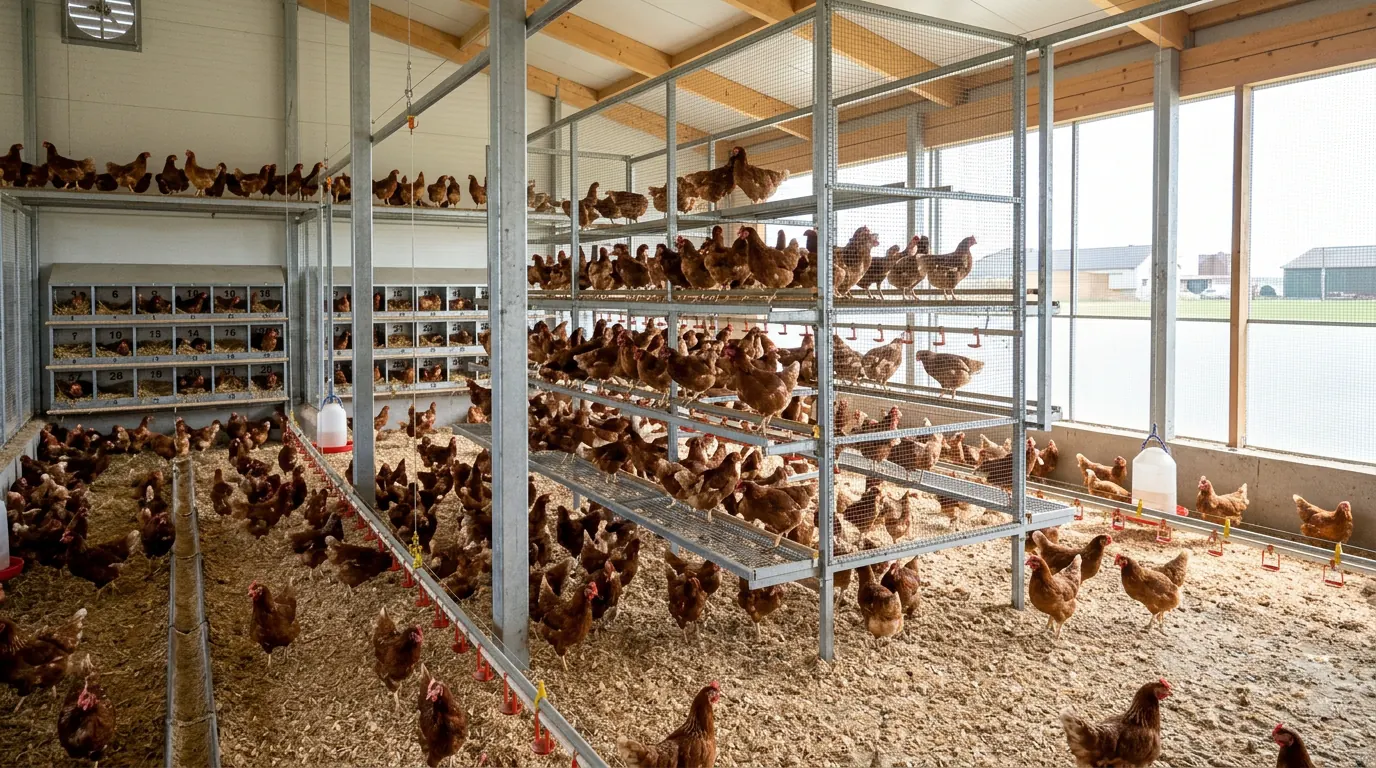
You judge the laying of a Wilanów hen the same way as for any breed: eggs laid per bird in a given week, egg weight and flock mortality. No norms are published for this breed, so we give no numbers here. Set your benchmarks with a breeders' club or from your own records for the first weeks of lay. Below we show what to record, how to read the results and which factors change them most often.
What we do not know for sure
Our sources deal mainly with parent lines of modern hybrids, not with pure breeds. Still, the Ross handbooks show what data to keep in a laying flock and how to calculate results. That method carries over to the Wilanów hen, but handbook figures are not a norm for this breed. Do not copy them into your own plan without comparing them with what you see in your henhouse. Base every decision on your own records from several cycles.
What to record in a laying flock
Eggs per bird
The Ross handbook for parent stock requires you to record eggs produced per bird daily, weekly and cumulatively. This shows you not only the flock average but also the course of the cycle: start of lay, peak and decline. Keep one table per group, because a difference between houses quickly exposes a feed or water problem. The easiest place is the henhouse records, where each day's data sits in one place.
Mortality and culls
Record deaths and culled birds every day, then weekly and cumulatively. A rise in mortality in one week with steady feed is a signal to check the house and flock health, not just a line to write down. For each case note the date and the cause, if you know it. A vet will judge whether diagnostics are needed; good records help the vet see a trend, not a single day.
Egg weight and floor eggs
Egg weight
The Ross handbooks recommend recording average egg weight daily and weekly, and total egg mass, which is the number of eggs multiplied by average weight. This matters because a flock may lay fewer but heavier eggs, and then the mass result can stay similar. Compare these values with your own benchmark from the first weeks, not with tables for another breed. You can calculate production indicators against feed in the FCR and EPEF online module.
Floor eggs
Record eggs laid outside the nests separately, because the handbooks list them as a separate item. A rising share of floor eggs usually points to a nest problem (number, height or position) rather than to laying itself. Check that nests are dark and easy to reach, and place them where the hens look for them. If the share keeps rising despite changes in the house, describe the problem to your vet or adviser.
Feeding and laying
Energy in the feed
The Ross nutrition specifications for parent stock give values at a common energy level of 2800 kcal/kg. Scale nutrient values proportionally when your feed has a different energy level, especially for digestible lysine. The guidelines themselves say the ration is set from body weight and laying performance, not from the table alone. We describe ready rules for layers in layer feeding.
Ration and clean-up time
Change the feed portion gradually and watch whether the hens eat it in a reasonable time. The handbook treats clean-up time as a check that every bird gets its share. If some hens eat everything and others almost nothing, uniformity of weight and laying drifts apart. Record feed use per bird daily and cumulatively, because without it you cannot calculate FCR or judge whether the ration was right.
Lighting, water and temperature
Lighting
The Ross handbook requires you to record the lighting program: hours and light intensity. A change in day length or a sudden dimming can change flock behavior and the timing of lay. Set a fixed schedule and log every change with a date. If you change hours with the season, note how laying reacted in the following days. A simple table at each house is enough.
Water and microclimate
The handbook gives daily water use and the water-to-feed ratio as a control indicator. A change in this ratio without a change in the ration often means a problem with drinkers or temperature. Check drinkers daily and record water use together with feed. Record outside and inside temperatures and humidity as minimum and maximum, because these decide whether the flock is comfortable.
Wilanów hen next to other laying breeds
Point of reference
If you want to compare the Wilanów hen with other breeds, use the same age, the same lighting program and the same feed. Differences in laying often come from conditions, not from the breed. For context, read about the Messa hen and the Leghorn hen, and find the full overview in the article on laying hen breeds. Do not assume that the result of one breed carries over to another without a trial in your own house.
Treatment, withdrawal period and eggs
Treatment and selling eggs
A vet always chooses the medicine and the dose. When treating layers, the egg withdrawal period matters; your vet and the medicine's documentation give it. Record the name, the date given and the end of the withdrawal period, and set aside and mark the eggs from that period. Records in treatment and withdrawal records help you avoid a mistake when selling. Rules on veterinary supervision are described by the Chief Veterinary Inspectorate (Główny Inspektorat Weterynarii), and you can check the current text of the acts in ISAP, Poland's online database of legal acts.
Frequently asked questions
How many eggs does a Wilanów hen lay?add
We give no figure, because no norms are published for this breed. Set a benchmark with a breeders' club or from records of the first weeks of lay in your own house. Compare results with your flock's own history, not with tables for hybrids.
What is laying rate per bird?add
It is the number of eggs laid by one hen in a given period, counted daily, weekly and cumulatively. The Ross handbooks require this record for parent stock. Set the result against feed intake and mortality, because only together do they give the full picture.
How do you calculate egg mass?add
Record average egg weight daily and weekly. Egg mass is the number of eggs multiplied by the average egg weight. Compare results over time, not on a single day.
Why do hens lay eggs outside the nests?add
Most often there are too few nests, they are badly arranged, or they are dark and hard to reach. Record floor eggs separately to see the scale of the problem. If the share keeps rising despite changes in the house, talk to your vet.
What feed should you give laying hens?add
The feed and ration depend on body weight, laying rate and the raw materials used, so there is no single universal table. The Ross norms give values at 2800 kcal/kg, which you must scale. Set the feeding plan together with a nutrition adviser.
Can you sell eggs after treatment?add
Do not sell eggs from the withdrawal period. Your vet and the medicine's documentation set that period. Record the date given and the end of the withdrawal period, and if in doubt, stop sales and ask your vet.
Sources & resources
- linkRoss Parent Stock Management Handbook 2023 (Interactive)
- linkRoss 308 Parent Stock Nutrition Specifications 2021
- linkChief Veterinary Inspectorate (Główny Inspektorat Weterynarii) — gov.pl/web/wetgiw
- linkInternet System of Legal Acts (ISAP) — isap.sejm.gov.pl
Prepared by: DlaFerm Team based on data from the sources listed · Publisher: INSTA-TECH sp. z o.o.
Do you keep a laying flock?
The DlaFerm henhouse records module logs daily laying rate, egg weight and mortality in one place. Create a free farm account and enter your flock's first data.
Phone
+48 796 258 151