Holstein-Friesian (HF) cattle: use in Polish beef herds
Holstein-Friesian is a dairy breed, but in beef farming its cows serve as dams in commercial crossbreeding with beef bulls. We explain the breed codes in Poland's records, how the share of beef blood changes over generations, and what to expect when you fatten crossbreds.
verifiedFrom the team that has organised work on poultry farms for years.
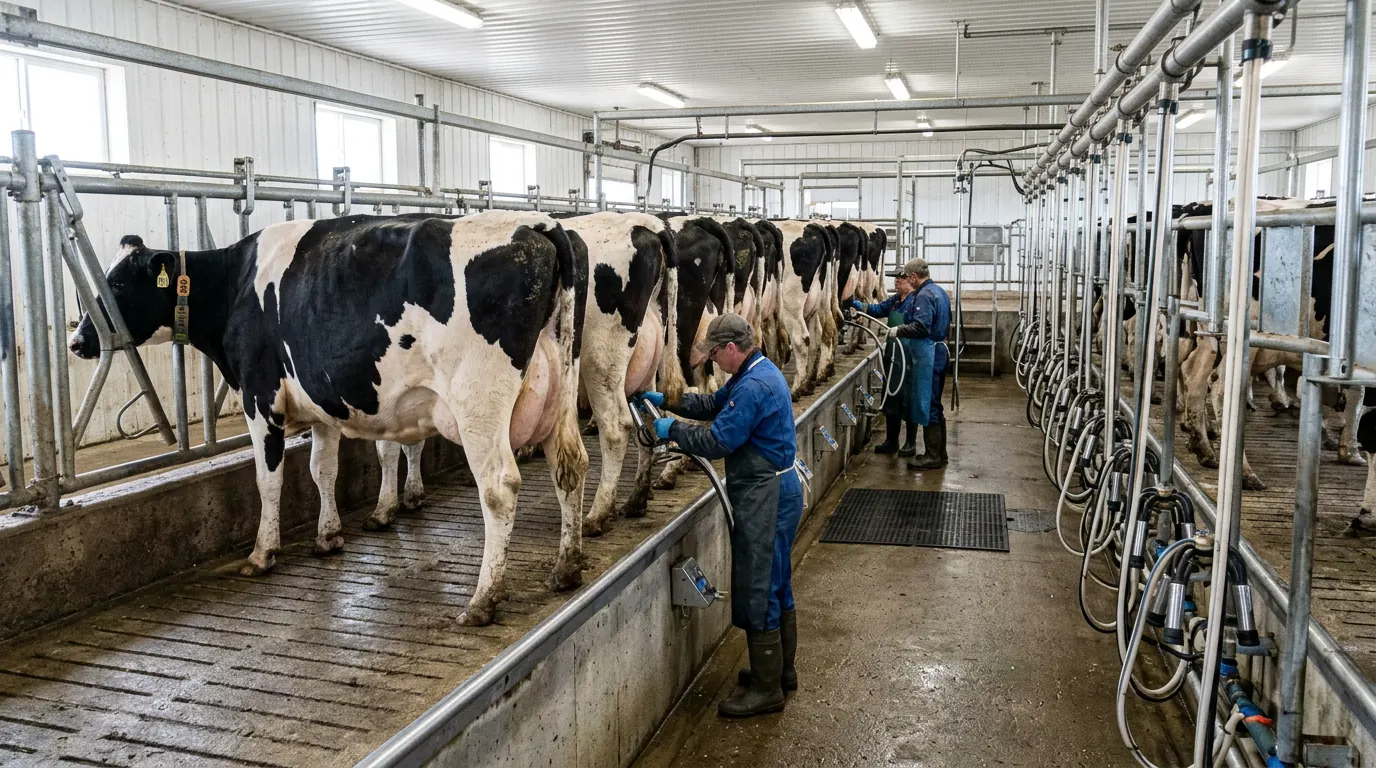
Holstein-Friesian (HF) is a dairy breed. According to the letter-code list of Poland's ARiMR (Agency for Restructuring and Modernisation of Agriculture), the black-and-white variety is coded HO and the red-and-white variety is coded RW. In beef farming, HF cows are not an end in themselves. Farmers use them as dams for commercial crossbreeding with beef bulls, for example Limousine, and sell the offspring as weaned calves or fattening stock. This model makes use of the large number of dairy cows and gives carcasses better than those of a pure dairy breed.
Why HF still makes sense in beef farming
HF cows are widely available in dairy herds, and their calves sired by beef bulls are crossbreds with better fattening traits. In studies by the Institute of Animal Science, National Research Institute (IZ PIB) with Simmental bulls, crossbred bulls gained weight faster and had a higher dressing yield than HF bulls. Crossbred cows also kept satisfactory milk yield with a higher protein content. This approach suits farms that want to sell beef cattle without building a pure beef herd from scratch.
Holstein-Friesian in the breed list
Breed codes in ARiMR records
In the letter-code list, the Polish Holstein-Friesian black-and-white variety has the code HO and the red-and-white variety has the code RW. The Polish black-and-white (ZB) and Polish red-and-white (ZR) breeds have their own codes. Crosses with beef breeds are marked MM, and crosses without beef breeds are marked MS. Before you register animals or sell young stock, check the current list at gov.pl/web/arimr. A wrong code makes later settlements and herd documentation harder.
HF as a dam or as a bull
In a beef herd, HF females mostly serve as dams of crossbreds. HF males give worse fattening results than crossbreds sired by beef bulls, so raising them rarely pays as a goal on its own. When you plan the herd, note which calves stay in the herd and which go to fattening. This makes it easier to assess results after each cycle.
Grading up away from dairy blood
Share of beef blood across generations
Grading up means gradually lowering the share of dairy blood. An HF cow mated to a Limousine bull gives heifers with up to 50% beef blood (R1). Later generations, mated to a bull of the same breed, reach up to 75% (R2), 87.5% (R3) and 93.7% (R4). In the IZ PIB example, offspring with more than 90% beef blood come only in the fourth year of planned matings.
Simple crossbreeding: the F1 generation
You can limit yourself to simple commercial crossbreeding. An HF cow and a beef bull then give the F1 generation, which according to IZ PIB has good fattening and individual traits. This option needs fewer years of planning than multi-generation grading up. When you choose a bull, compare the working traits of the breed, for example Angus, with your farm's goals: daily gain, ease of calving and muscling class.
Suckler cows and calf rearing
A beef dam in the IZ PIB model
In the model described by the IZ PIB Nutrition Department, a medium-frame beef dam weighs about 500 kg, calves in February and rears the calf to about 250 kg. Green forage use is set at 80%. These assumptions let you work out feed needs before winter. HF crossbred cows in this system need the same attention as beef cows, because their weight and needs are similar. The suckler cow system is also described for everyday herd practice.
Paddock quality sets the stocking rate
The IZ PIB table on feeding in organic farming shows that stocking rate per hectare depends on paddock quality. On a very good paddock, dry matter yield and animal numbers are clearly higher than on a poor one. Do not copy someone else's numbers onto your meadows. Measure the yield of your paddock, work out the animals' needs, and only then set the stocking rate. On weak pasture, supplement feed in dry spells and check the condition of the animals every few weeks.
Herd health and calf welfare
Treatment and withdrawal periods
A vet chooses the medicine and the dose. Your job is to record every medicine given, the date, and the calculated end of the withdrawal period, before an animal goes to slaughter or milk goes to the dairy. The withdrawal rule applies to both meat and milk and differs by product. Keep the records in the treatment and withdrawal module so you do not rely on memory when you sell animals.
Calf welfare and transport
Council Directive 2008/119/EC sets minimum standards for the protection of calves in the EU. Check the national rules that implement it in Poland's Internet System of Legal Acts (ISAP), as of 22.11.2026. When weaning and transporting, watch the time without access to water, the lying space and the health of the calves. Report suspected lumpy skin disease to a vet at once, because it is a notifiable disease.
Profitability and selling crossbreds
What drives the price
The price of beef cattle depends on the animal's category (young bull, heifer or cull cow), weight, muscling and fat class, and the current market. Quotations change often, so we do not rely on a single figure. Check current prices at market centers and with buyers, and compare results within the same category and weight. You usually sell crossbred cows under different rules than calves for rearing.
Run the numbers before you decide
Before you change your production direction, calculate farm income from beef cattle at different levels of intensity. A publication from PODR Lubań (a regional agricultural advisory center) gives sample calculations for such a comparison. Include the costs of feed, vet care, labor, insurance and building depreciation. The gap between plan and result usually comes from costs that were left out earlier.
Herd registration and animal data
Cattle register and IRZplus
The cattle register is kept in IRZplus, ARiMR's online animal register, and ARiMR oversees animal identification and registration. Data on births, slaughter and movements should match what you record on the farm. Differences between your records and the register make inspections and sales harder. Check the current requirements at gov.pl/web/arimr. If you want to link data with sensors and the register, see the IRZplus integration.
Frequently asked questions
Can you use Holstein-Friesian cows for beef production?add
An HF cow is a dairy breed, but it can serve as a dam in commercial crossbreeding with a beef bull. Crossbreds sired by beef bulls have better fattening traits than pure HF bulls. Back the decision with a calculation for your own farm.
What ARiMR code does an HF cow have?add
The Polish Holstein-Friesian black-and-white variety has the code HO and the red-and-white variety has the code RW. Crosses with beef breeds are marked MM. Check the current list at gov.pl/web/arimr.
How many crossing generations give offspring with over 90% beef blood?add
In the IZ PIB example, offspring with more than 90% beef blood come in the fourth year of planned matings. The generations give 50%, 75%, 87.5% and 93.7% beef blood. Set the mating plan well in advance.
How much does an HF cow or HF bull calf cost?add
The price depends on age, weight, origin and the current market, so we give no figures. Check quotations with buyers and at market centers, and compare prices within the same category and weight.
Can you keep HF cows in an organic system?add
Yes. IZ PIB describes a model in which a dairy breed on an organic farm is gradually replaced by a beef breed. Stocking rate depends on paddock quality, so work it out for your own meadows. Check the organic requirements with your certifying body.
When should you report a suspected cattle disease?add
Report any suspected disease to a vet at once. This applies especially to lumpy skin disease, which is a notifiable disease. A vet always chooses the medicine and the dose.
Sources & resources
- linkARiMR — List of letter codes for marking cattle breeds
- linkIZ PIB — WZ — Breed selection and breeding work in beef cattle herds under organic conditions (P. Wójcik, A. Czubska)
- linkIZ PIB — WZ — Current state and prospects of beef cattle farming and breeding in Poland (H. Grodzki et al.), WZ LIII(2015)2:77–87
- linkIZ PIB — Livestock farming and breeding over 70 years. Cattle Breeding Department, Sheep and Goat Breeding Department
- linkIZ PIB — WZ — Feeding beef cattle under organic farming conditions (K. Bilik et al.)
- linkEU Publications Office — Council Directive 2008/119/EC laying down minimum standards for the protection of calves
Prepared by: DlaFerm Team based on data from the sources listed · Publisher: INSTA-TECH sp. z o.o.
Do you run a beef herd with crossbreds?
Our IRZplus integration keeps your animal data in one place. Create a free farm account and see how it works on your own farm.
Phone
+48 796 258 151