Angus (Aberdeen Angus) cattle: breed, beef, breeding
Angus (Aberdeen Angus) is a beef breed with a solid black or red coat, valued for early slaughter maturity and easy calving. Below we cover the breed codes, research data from Poland's IZ PIB, and the rules for breeding heifers and using bulls.
verifiedFrom the team that has organised work on poultry farms for years.
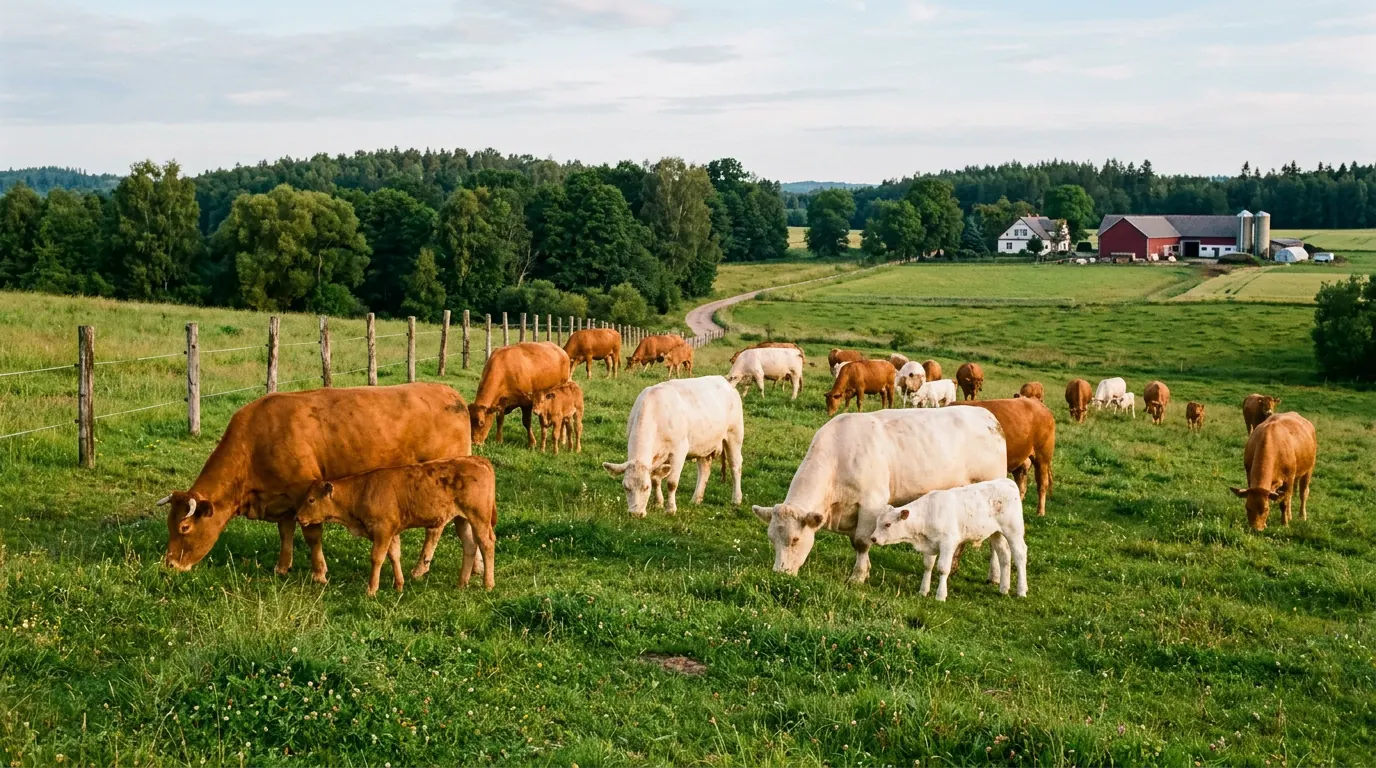
Angus, also called Aberdeen Angus, is a beef breed that comes from Great Britain. In Poland farmers keep it in beef herds and use it for commercial crossbreeding. The animals are polled (hornless), low-set and well muscled. According to IZ PIB (Poland's Institute of Animal Production, National Research Institute), crossing with Aberdeen Angus bulls pays off when you want early slaughter maturity in fattening cattle and easy calving, especially in areas with good feed.
Breed codes in documents
In the letter-code list of ARiMR (Poland's Agency for Restructuring and Modernisation of Agriculture), as of 22.11.2026, black Angus has the code AN and red Angus has the code AR. The two varieties are separate entries, so check the coat color when you register animals. Herd records are easiest to keep in software linked to the reporting system, for example through the integrations with IRZplus (ARiMR's online animal register) and sensors.
Angus performance traits
Daily gain in IZ PIB studies
In an IZ PIB summary from 2015 (data standardized to 210 days of age), red Angus bull calves averaged 268.8 kg body weight and a daily gain of 1117 g. Heifers of the same breed reached 241.9 kg and 1004 g. In the same table, Limousine bull calves reached 274.7 kg and 1095 g. The data cover red Angus only, and black Angus is not shown separately, so we do not apply these numbers to the whole breed. Compare them with your own weighings of calves at the same age. For another beef breed, see Limousine.
How long cows stay in the herd
Table 6 of this IZ PIB study covers 418 red Angus cows. Cows in their first calving made up 18.4%, and 1.9% of animals stayed beyond ten calvings. These figures show how fast a herd renews itself. The longer a cow stays in the herd, the more it pays to raise the heifer well.
Breeding heifers and using bulls
Heifer weight at breeding
According to a leaflet from WMODR Olsztyn (a regional agricultural advisory center in Poland), a heifer reaches breeding maturity at about 2/3 of the body weight of an adult cow of her breed. For Angus and Hereford, the best weight for heifers to be bred is about 360–380 kg. Large-frame breeds such as Charolais or Simmental are bred at 400–420 kg. Weighing before breeding helps you avoid breeding too early. See also the Hereford breed.
Early breeding and calves
Heifers bred early give birth to smaller and often less vigorous calves. They also need to be well grown so older cows do not dominate them after calving. If you want cows to stay in the herd for a long time, heifers must be well raised before first breeding. You can plan breeding and calving dates in the stocking and cycle planning module.
Young bulls in the herd
Bulls reach full breeding maturity at 18–24 months of age. With moderate use, breeding service can start as early as 15 months. From the start of the season, record the number of matings and the bull's condition. This helps you spot overwork early.
Bull evaluation: WM, WR and WOZ
Since 2007, the Polish Association of Beef Cattle Breeders and Producers has evaluated the performance and breeding value of beef cattle together with IZ PIB. According to an IZ PIB paper from 2018, the evaluated breeds include Black Angus (AN) and Red Angus (AR). The evaluation rests on three parameters: the muscling index (WM), the development index (WR) and the combined performance index (WOZ). Bulls are ranked within the breed in descending order of WOZ.
Natural service and artificial insemination
Bulls evaluated this way are used for natural service in beef herds and for artificial insemination in commercial crossing with dairy cows. Before you buy a bull, check his place in the breed ranking, not just how he looks in the show ring. The ranking makes it easier to pick the right bull from the offer.
Managing the herd and withdrawal periods
Treatment records
Record every medicine you give with the date, the product name and the withdrawal period. The vet who looks after your herd always chooses the medicine and the dose. You are responsible for keeping records and observing the withdrawal period before slaughter or sale. It is convenient to keep these records in the treatment and withdrawal period log.
Annual herd plan
Putting calvings, weanings and checks in one calendar lets you prepare space and labor for the calves ahead of time. Update animal data at every change in the herd right away, not after the fact. Farm management software collects these dates in one place.
What drives the economic result
The result of a beef herd depends on the number of calves raised, the selling weight, feed cost and labor. Beef cattle prices change regularly, so we give no amounts in this guide. You can check current quotes in market reports and with buyers. Run the calculation in the calculators for farmers.
Costs and revenue
For the calculation, enter feed cost per cow and calf, veterinary cost, the cost of raising heifers and sales revenue. With cows that stay in the herd for a long time, the cost of raising a heifer is spread over more calvings. Data from your own herd is more reliable than general summaries, so collect it year after year.
Frequently asked questions
How do you tell black Angus from red Angus?add
In the ARiMR code list, black Angus has the code AN and red Angus has the code AR. Record the coat color as shown in the animal's documents. If in doubt, ask your vet or a beef cattle breeding adviser.
At what age should you breed an Angus heifer?add
There is no single age. WMODR Olsztyn says a heifer reaches breeding maturity at about 2/3 of an adult cow's weight. For Angus and Hereford, the best weight at breeding is about 360–380 kg. Base your decision on weighing and on the animal's condition.
At what age can an Angus bull start breeding?add
Bulls reach full breeding maturity at 18–24 months of age. With moderate use, breeding service can start as early as 15 months. It is wise to use a young bull less and watch his condition.
How do you choose a bull for your herd?add
Check the WM, WR and WOZ indexes from the evaluation run by IZ PIB together with the Polish breeders' association. Bulls are ranked within the breed by WOZ. Pick an animal higher in the ranking that fits the goal of your herd.
What daily gain do Angus bull calves have?add
In the 2015 IZ PIB summary, red Angus bull calves averaged 268.8 kg at 210 days and a daily gain of 1117 g. The data cover red Angus only, so do not apply them to black Angus without your own weighings.
Can I give medicines to my cattle myself?add
The vet always chooses the medicine and the dose. You record every treatment and observe the withdrawal period before slaughter or sale. Missing records make a herd inspection harder.
Sources & resources
- linkARiMR — List of letter codes for marking cattle breeds
- linkIZ PIB — WZ — 60 years of IZ work on beef cattle (J. Trela et al.), WZ XLIX(2011)4:11–56
- linkIZ PIB — WZ — Current state and prospects of beef cattle husbandry and breeding in Poland (H. Grodzki et al.), WZ LIII(2015)2:77–87
- linkIZ PIB — WZ — New methods of evaluating the performance and breeding value of beef cattle (Z. Choroszy et al.), WZ LVI(2018)3:17–23
- linkWMODR Olsztyn (gov.pl) — Reproduction in beef cattle herds (leaflet)
Prepared by: DlaFerm Team based on data from the sources listed · Publisher: INSTA-TECH sp. z o.o.
Do you keep a beef cattle herd?
The farm management program in DlaFerm.pl helps you keep herd records and breeding dates in one place. Create a free farm account and see how it works in practice.
Phone
+48 796 258 151