Guinea fowl noise: why they screech and how to cut it down
Guinea fowl call to stay in touch with the flock, to warn of danger and to react to strangers. You cannot remove the noise completely, but you can reduce it a lot through the site, the coop, stocking density and feeding. Below we describe the causes and the steps that work in practice.
verifiedFrom the team that has organised work on poultry farms for years.
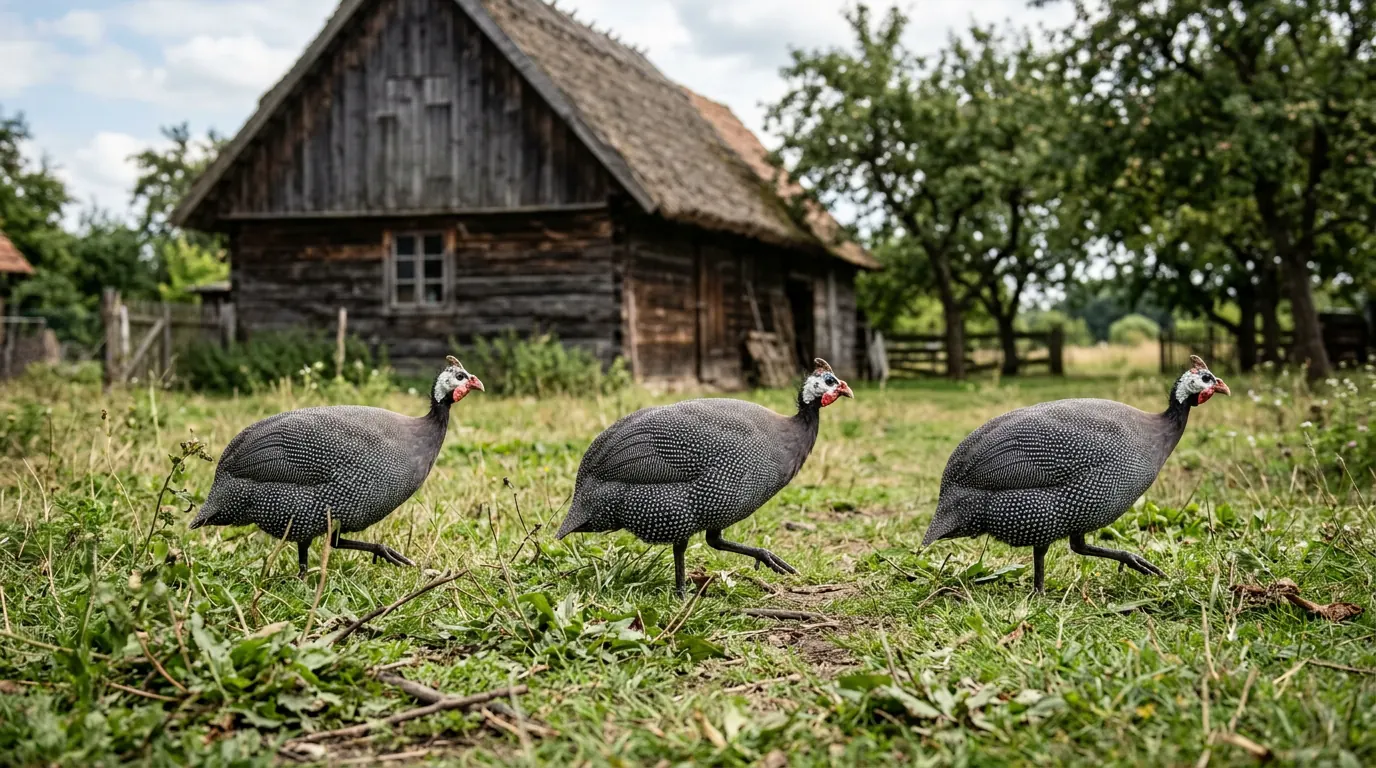
Guinea fowl screech because calling is their basic way of talking to the flock. Birds warn each other of danger, call stragglers back and react loudly to anything new. You cannot bring the noise down to zero, but you can limit its causes: from where the birds sleep, through how you feed, to the size and makeup of the flock. Below we explain where the noise comes from and what to change on your farm.
Screaming as a warning
Guinea fowl have a strong watchful instinct. When one spots a predator, a dog, a cat or a person nearby, it raises the alarm and the rest of the flock quickly repeats it. The sound is sharp and carries far, so even a short reaction to a passing car or a bird of prey can be heard across the neighborhood. Males and females make different calls. We describe how to tell them apart in our guide: male and female guinea fowl: how to tell them apart.
Where guinea fowl screaming comes from
Calling within the flock
Guinea fowl live in groups and keep contact by voice. A bird that has lost the others calls, and the flock answers. In the coop and on the run this contact can get very loud, especially when birds are split between several buildings or when the run has no cover to gather behind. You usually hear long series of short sounds that come back every few minutes.
Alarm at a threat
The alarm call is the loudest. Guinea fowl react to movement overhead, sudden noise, and strange dogs and cats. That is why the screaming often breaks out in the evening or early morning, when birds notice changes around them or try to hide. Watch at what time and in what situation the noise gets worse. Notes from these observations help you work out the cause later.
Sex and age of the bird
Both sexes call, but different sounds serve different purposes. Young birds learn their voice from the flock and make less distinct sounds, which can confuse a new keeper. It helps to know the difference between male and female when you plan the flock, because it affects how many birds you keep on a given area.
When guinea fowl scream the most
Dawn and dusk
Most noise comes at dawn and before dark. Birds wake up and gather, and at sunset they look for a place to roost. If you open the coop late, or birds go out on the run before they are fully awake, the screaming lasts longer. A fixed routine for opening and closing the coop, at the same hours every day, usually settles this period.
Strangers in sight
Guinea fowl react to people, vehicles, animals and birds of prey. Movement along the fence and a passing dog upset them most. Noise can also come from a neighboring flock or from wild birds flying over the run. Before you change anything in the coop, check whether the cause is outside, and place the run so that there is as little movement along the fence as possible.
Stress and boredom
Birds with little to do scream more, from boredom or tension. A cramped run, no cover, too high a stocking density and sudden changes in the flock all push in the same direction. Check the stocking density on your farm and compare it with recommendations. Guinea fowl stocking density explains how to plan the number of birds per area.
How to reduce noise in the coop and on the run
The coop as a place for the night
Guinea fowl need a quiet place in the coop to rest and roost, away from doors and windows where people pass. A well-planned coop limits night panics because the birds cannot see movement outside. We describe the requirements for space, ventilation and perches in our guide: guinea fowl housing requirements. Also make sure the coop door closes quietly, because a bang sets off the whole flock.
A run without movement at the fence
The fence should be high and sturdy enough that birds do not escape or run along it whenever someone walks by. Cover from shrubs or shade netting gives birds shelter and lets them hide from strangers. Put the run away from the road and barking dogs, and if that is not possible, block the view into the run from outside. Our guide on guinea fowl escaping from the run may help too.
Shutting the birds in at night
Closing the birds in the coop before dark reduces screaming at gathering time and during night alarms. Keep a fixed closing time and check that every bird went inside. Birds left outside usually scream longest, because they look for the flock and find no safe place.
Feeding and keeping guinea fowl busy
Spreading out the feeding
Feed guinea fowl at fixed times and spread the feed so birds do not crowd around one feeder. A single small feeder invites shoving, which ends in screaming. Set up several feeding points and drinkers so the feed is shared evenly. We describe feeding rules in a separate guide: feeding guinea fowl. Agree the exact ration with a feeding adviser.
Something to do on the run
Guinea fowl like to scratch in litter and look for food. Scattering grain in the litter, or a varied run, keeps birds busy longer and lowers tension in the flock. Bored birds shut in a small space react loudly to every outside trigger.
Young birds
Rearing young guinea fowl follows a different rhythm than an adult flock, and chicks quickly learn the calls of older birds. If you plan to enlarge the flock, see our guide on rearing: rearing guinea fowl. With big changes in the flock the screaming usually rises for a while before the birds settle.
Noise, neighbors and the rules
Complaints from neighbors
Noise from a farm can lead to a complaint, especially when the flock is close to homes. Rules on nuisance depend on the local development plan and on how the municipality (gmina) reads the environmental protection rules. We give no specific values or act numbers here, because they can change. Before you decide anything, check the current text in ISAP (Poland's online legal acts database, Internetowy System Aktów Prawnych) and ask at your gmina office.
What to do in practice
Write down the days and hours when the noise was loudest and what was happening on the farm at the time. Such a record helps you tell outside causes from problems on your own farm. Talking to a neighbor who names specific hours usually works better than general complaints. Keeping records in the coop records module makes this easier to compile.
Legal status
This text reflects the position on 22.11.2026. Rules on poultry keeping and environmental protection change, so before any decision compare the information with the current text in ISAP, or ask your gmina office or a vet. Poland's Ministry of Agriculture and Rural Development (Ministerstwo Rolnictwa i Rozwoju Wsi) and the Chief Veterinary Inspectorate (Główny Inspektorat Weterynarii) publish current information for keepers.
Frequently asked questions
Why are guinea fowl so loud?add
Guinea fowl screech to keep in touch with the flock and to warn of danger. The alarm goes off at movement overhead, sudden noise and strange animals. The call is sharp because it has to cut through the surroundings.
Do guinea fowl scream all day?add
Most noise comes in the morning and evening, when the flock gathers. During the day the calling is usually rarer and shorter, unless something outside sets it off. Long series during the day are worth checking for a cramped run or stress.
How do you keep guinea fowl quiet at night?add
Shut the birds in the coop before dark at a fixed time and check that all of them went inside. Give them a quiet roosting spot away from doors and windows where people pass. A quiet coop door also limits night panics.
Can you make guinea fowl completely quiet?add
Total silence is not realistic, because guinea fowl communicate by voice by nature. You can still cut the noise a lot through site, run, feeding and stocking density. The result depends on your farm and on what causes the screaming.
Can guinea fowl noise lead to a complaint?add
Yes, noise from a farm can lead to complaints from neighbors, especially near homes. The rules depend on the local development plan and on environmental protection law, which you can check in ISAP. Notes of the noisy hours help when you talk to the office and to neighbors.
When should I call a vet?add
If the screaming comes with apathy, dullness, a change in appetite, or birds start limping or huddling in one spot, contact a vet. Only a vet chooses the treatment and the dose. When you give any medicine, keep to the withdrawal period.
Sources & resources
- linkChief Veterinary Inspectorate (Główny Inspektorat Weterynarii): gov.pl/web/wetgiw
- linkNational Research Institute of Animal Production (Instytut Zootechniki PIB): izoo.krakow.pl
- linkInternet System of Legal Acts (ISAP): isap.sejm.gov.pl
- linkMinistry of Agriculture and Rural Development: gov.pl/web/rolnictwo
Prepared by: DlaFerm Team based on data from the sources listed · Publisher: INSTA-TECH sp. z o.o.
Keeping guinea fowl next to other poultry?
In DlaFerm.pl you keep coop records and stocking in one place, small flocks included. Create a free farm account and see how it works in practice.
Phone
+48 796 258 151