Guinea fowl escaping the run: how to stop it
Guinea fowl can fly, but only for short hops and usually low. Escapes most often come from spooked birds, no roost in the coop and gaps in the fence. You prevent them by covering the run, getting the birds used to the coop and checking the fence regularly.
verifiedFrom the team that has organised work on poultry farms for years.
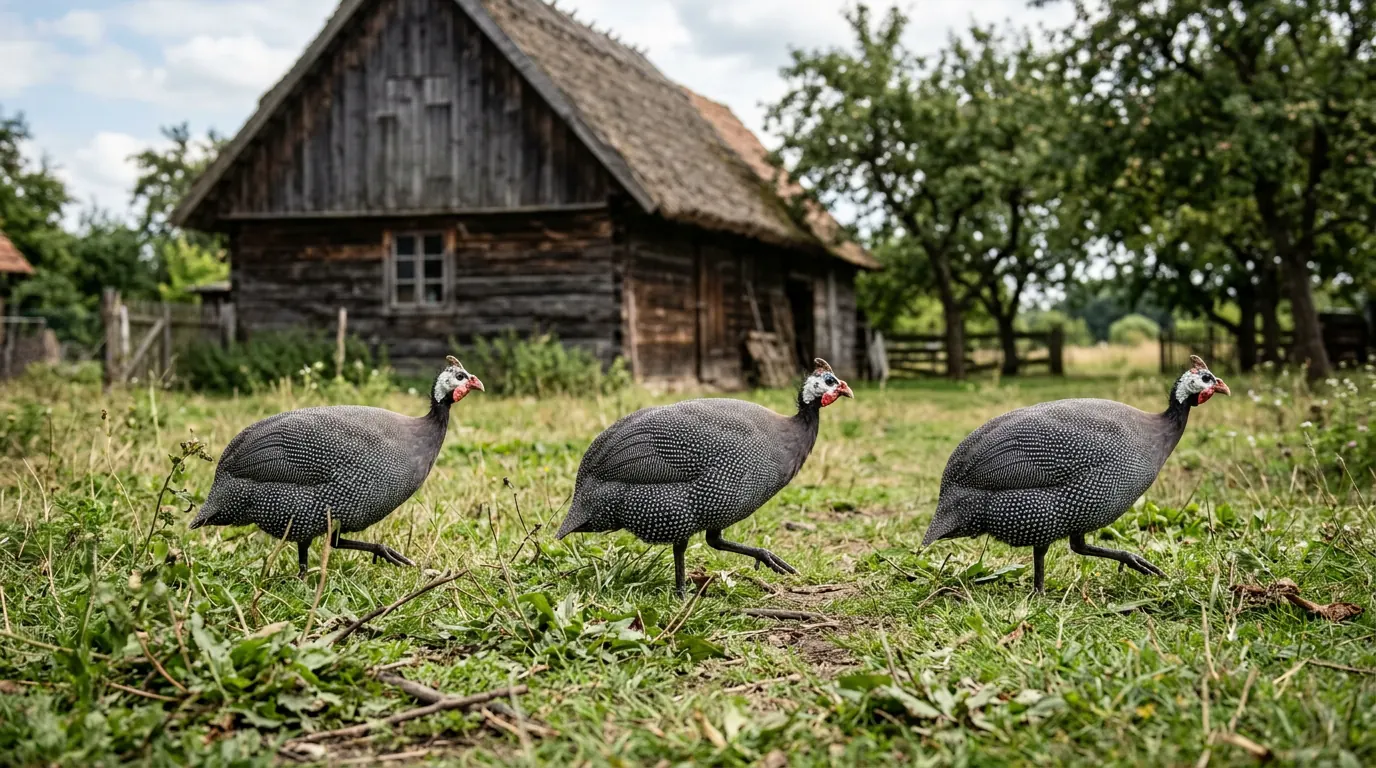
Guinea fowl can fly, though only briefly and usually not very high. Escapes from the run come down to three main causes: the birds are spooked, they have nowhere to roost in the coop, or the fence has gaps and low spots that are easy to clear. To keep guinea fowl from flying out, cover the top of the run, get the birds used to the coop and check the netting often. Below we go through each step from a keeper's point of view.
How to keep guinea fowl from flying out
The simplest and most effective measure is a roofed run or a tall, well-tensioned fence. It matters just as much that the birds want to go back to the coop: feed them in the same place at a set time, shut them in each evening and put roosts inside. Once a guinea fowl learns that a safe place for the night and its food are in the coop, it looks for ways out less often. With an open-top run, also limit spooking, because a frightened bird bursts into flight and clears the lowest part of the fence.
Why guinea fowl fly
A guinea fowl can clear the fence
Guinea fowl do not climb high and fly long distances, but getting over a fence is easy for them. They usually pick the lowest point of the fence or a spot where a pile of branches, a heap of straw or a crate sits. One burst is often enough to land on the other side. So fence height alone is not enough if there is a higher spot to jump onto behind it.
Roosting high
Guinea fowl like to roost on raised perches. If the coop has no roosts or they are too low, the birds choose a tree, a shed roof or a shrub by the fence. From there it is easy to drop onto a neighbor's land. Roosts at the right height inside the coop are one of the simplest ways to keep the birds in a safe place overnight. We cover coop requirements in a separate guide: requirements for guinea fowl housing.
Spooking and stress
Dogs, cats, predators, machinery noise or sudden human movement make guinea fowl bolt. That panic often ends with a flight over the fence, even where the birds normally do not cross it. Limit spooking: set the run away from a busy road, do not walk in quickly and protect it from pets.
A fence that keeps guinea fowl in
Height and roofing
The surest solution is to roof the run with netting, or use netting with an inward-angled top. With an open-top run, choose a fence height so the birds have no high foothold to jump from, and keep trees, shed roofs and stacks away from it, since the birds can easily fly from those. It pays to plan the run for chickens and guinea fowl together, because in most cases the same rules apply to both.
Netting, corners and digging
The most common escape points are corners, gates and sections where the netting sags or is stretched unevenly. The mesh should be small enough that a bird cannot push its head through, and the bottom edge should be fixed firmly to the ground or raised on a board. Walk the whole perimeter every week and check for slack, pulled-out stakes and holes dug by animals. A small hole made by a fox or a dog becomes an escape route for the whole flock.
Gates and entrances
The gate to the run should close on its own or have a latch you can shut in one move. A gate left open during feeding, cleaning or a vet visit is the chance guinea fowl use most often. Each time you enter the run, make sure no one lets the birds out by accident.
How to get guinea fowl used to the run
Feeding in the coop at a set time
Guinea fowl learn the rhythm of the day. If you always feed them at the same time and in the same place, they will return to the coop earlier. Diet also affects behavior: birds with deficiencies or irregular feeding hang around the fence more. We describe guinea fowl feeding separately, and it is always worth following the advice of a vet or a nutrition adviser.
Releasing them gradually
Release young guinea fowl and birds moved to a new coop onto the run gradually. Start with a short stay during the day, under supervision, and lengthen it over the following days. Birds that know the limits of the run and where to return in the evening usually leave the fence less often. After moving birds, always check that all of them came back for the night and note it in your records.
Wing clipping: what to know
What it is and when it is considered
Wing clipping means shortening a few feathers in the wing so the bird cannot take off freely. In practice keepers turn to it when other methods fail, for example with constant flights over the fence. Discuss the decision with a vet, because the procedure affects the bird's balance and behavior. Do not do it yourself without expert knowledge.
Welfare first
Before you consider the procedure, check that the escapes are not caused by husbandry mistakes: a fence that is too low, no roosts, spooking or the wrong diet. You can find the animal protection rules for farms in legal acts available in ISAP (Poland's Internet System of Legal Acts), and if in doubt, ask the district veterinarian (powiatowy lekarz weterynarii). Remove the cause first, and only then consider further steps. Our guide to the animal protection act covers what changes for keepers.
Guinea fowl with chickens and other poultry
Different habits from chickens
Chickens mostly walk on the ground and go to bed early, while guinea fowl are more nervous and more willing to look for high spots. If you keep them together, the fence and roosts must suit both species. We describe mixing poultry species in one place in a separate guide, worth reading before you decide on a shared run. For the basics, see guinea fowl keeping.
One coop, different roosts
In a shared coop, give guinea fowl roosts high enough that they feel safe, but not so high that they fly down from them into the run. Coop entrances should be open at any time of day, and the doors closed in the evening. A well-designed coop is half the success in keeping birds on the farm.
How to keep a record of escapes
Write down every escape
Note the date, the number of birds, the place of escape and the likely cause: spooking, a hole in the netting, an open gate. After a few weeks you will see whether the problem keeps returning in the same place. A coop records program helps, as you can log bird numbers and events in it. Full farm management software also covers planning fence work.
Treatment and health checks after an escape
Birds that flew over the fence may be injured or come into contact with another flock. Discuss every injury or suspected illness with a vet, who chooses the medicine and dose. If you give medicines, record them in the treatment log and observe the withdrawal period before the birds go to slaughter or sale.
Frequently asked questions
Can guinea fowl fly?add
Yes, guinea fowl can fly, though usually only for short hops and not very high. They most often clear the lowest part of the fence or take off onto a raised spot when spooked.
Why do guinea fowl escape from the run?add
The most common causes are spooking, no roosts in the coop (which pushes birds to roost outside), and holes and slack in the netting. Sometimes an open gate during feeding or cleaning is to blame.
How do I keep guinea fowl from flying out?add
Cover the run with netting or a roof, and check the fence every week. Also feed in the coop at a set time and provide roosts for the night, so the birds know where to return.
Can you clip guinea fowl wings?add
Wing clipping is possible, but discuss the decision with a vet. First remove the causes of escapes in the fence and husbandry, because the procedure does not replace a good run.
What should I do if guinea fowl escape onto a neighbor's land?add
Approach the birds calmly with feed, ideally in the same place and at the same time they are used to. If they are off your farm, talk to your neighbor and do not catch them by force, so you do not spook the rest of the flock.
Do guinea fowl go back to the coop at night?add
Guinea fowl return to the coop if it has roosts, food and quiet. When birds roost in trees or on roofs, the cause is usually a lack of a suitable spot in the coop.
Sources & resources
- linkChief Veterinary Inspectorate (Główny Inspektorat Weterynarii) — gov.pl/web/wetgiw
- linkNational Research Institute of Animal Production (Instytut Zootechniki PIB) — izoo.krakow.pl
- linkMinistry of Agriculture and Rural Development (Ministerstwo Rolnictwa i Rozwoju Wsi) — gov.pl/web/rolnictwo
- linkInternet System of Legal Acts (Internetowy System Aktów Prawnych) — isap.sejm.gov.pl
Prepared by: DlaFerm Team based on data from the sources listed · Publisher: INSTA-TECH sp. z o.o.
Keeping guinea fowl on a run and want everything in one place?
DlaFerm.pl farm management software lets you keep flock, event and treatment records in one place. Create a free farm account and see how it works on your farm, or get in touch with us.
Phone
+48 796 258 151