Finishing lambs for slaughter: weight, timing and sales
A slaughter lamb is a young animal you sell for slaughter after weaning and a short finishing period. Your profit depends on growth rate, selling date and the agreement with your buyer, not on the price per kilogram alone. We show how to plan finishing, when to sell and how to protect lambs from losses.
verifiedFrom the team that has organised work on poultry farms for years.
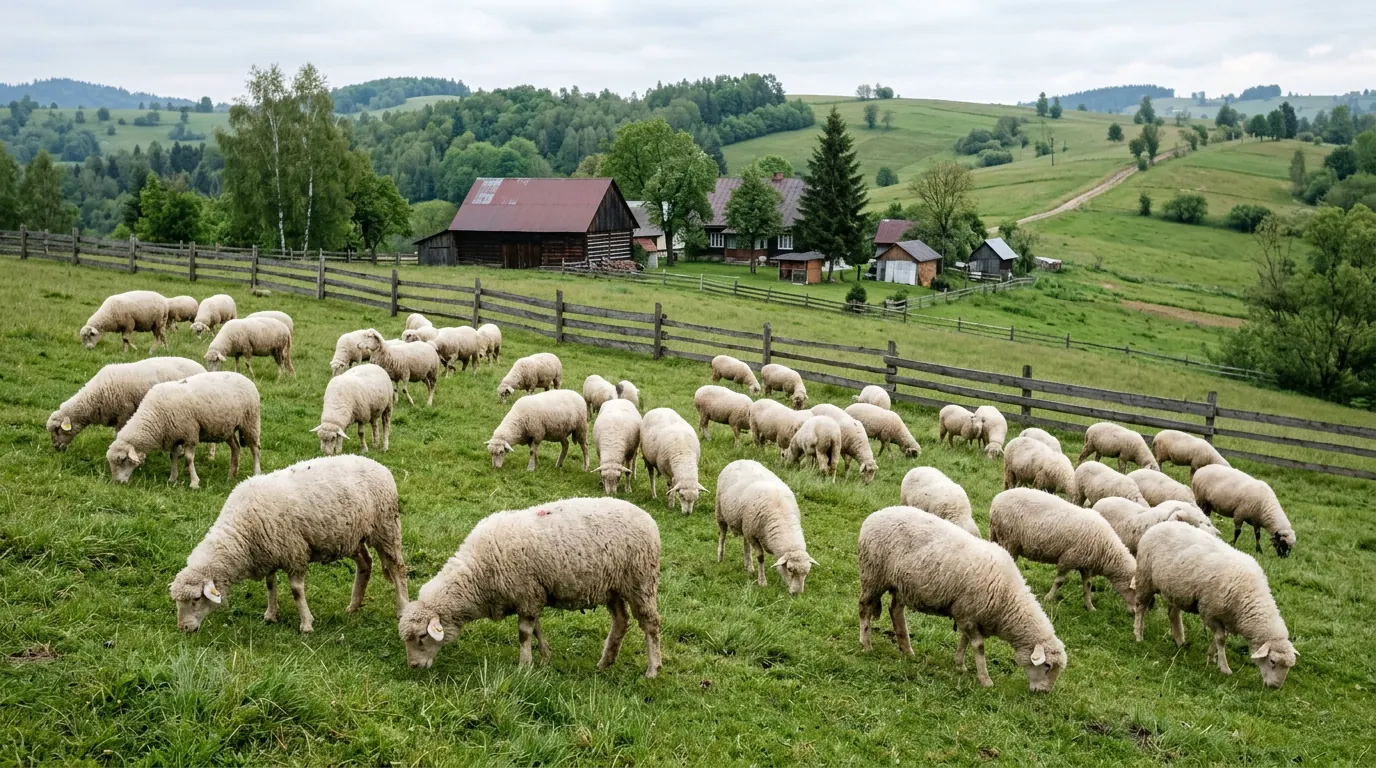
Slaughter lambs are raised for meat and usually sold after weaning, once their weight matches what the buyer wants. In a meat flock they bring in most of the income. How to start a flock is covered in sheep farming: where to start and whether it pays. Here we cover the last stage: from weaning to sale.
Lamb is a product of the whole flock
According to an IZ PIB monograph (Poland's Institute of Animal Production) on native breeds, in many countries mutton is a by-product of sheep farming and usually makes up 25–35% of total meat output in the system. The same publication says that in Poland the buying price of sheep over one year old is around 31% of the buying price of slaughter lambs. So lambs are the main source of income, and culled adult ewes bring in little. Every lamb lost and every week of delay in finishing shows up in the result for the whole year.
How long finishing takes and what it depends on
Data from Irish flocks
In materials from Sheep Open Day 2022, Teagasc gives flock results by the ewe's age at first lambing. For ewes that first lambed at 1 year old, lambs weighed 30.6 kg at weaning and went to slaughter at 199 days of age. For ewes that first lambed at 2 years and older (from the 3rd lambing), lambs were sold at about 170 days with a weaning weight of 34.0 kg. These are Irish figures, so use them as a reference point, not as a standard for your flock.
What shortens finishing
The Teagasc table shows that older ewes give lambs that reach slaughter weight faster. Young ewes had fewer lambs per ewe (1.44 at first lambing at 1 year old, about 1.98 for ewes three years and older). Lambs also grow faster on good pasture and with a good start after birth. We describe rearing rules in lamb rearing: colostrum, artificial feeding, weaning.
Selling weight of lambs
There is no single weight for everyone
Selling weight depends on breed, sex, sales channel and the requirements of the particular buyer or abattoir. We do not give one number, because it comes from the contract, not from a regulation. Ask your buyer what live or carcass weight they expect, how they judge fat cover and what their collection schedule is. Only then plan which lambs to weigh and how often.
Weighing and sorting batches
Lambs from one lambing group grow unevenly. Weighing every few weeks on a cattle or sheep scale lets you pick out those that have reached weight and sell them earlier, while slower ones stay longer. Record results against each animal's number: after a few batches you will see which ewes and rams produce fast growth. Feed slower lambs separately so they do not lose out on feed.
Losses and parasites during finishing
Nematodirus and liver fluke
AHDB guidance (the UK's Agriculture and Horticulture Development Board) explains that lambs can pick up liver fluke in summer on farms where it occurs, and then grow more slowly and miss the planned weight date. AHDB advises treating lambs in autumn, with the product chosen together with a vet. Nematodirus usually hits lambs in spring (April–May) and is more dangerous when warm weather follows a cold spell. The risk is highest on pastures grazed by lambs the year before.
Pasture as a tool
The HCC, AHDB and QMS material on worm control recommends keeping the sward at a suitable height and not grazing below 4 cm, because most infective larvae sit at the base of the sward. Good pasture supports growth rate and lamb immunity. Treat fields where ewes with lambs grazed this year as risky for weaned lambs. A vet always decides the treatment and dose.
Withdrawal period before sale
Every medicine has a withdrawal period during which the animal must not be sent for slaughter. Record the date, product and animal number, and check before dispatch that the withdrawal period has passed. You can keep these records in the treatment and withdrawal period module.
How to reduce lamb losses
Record the causes
AHDB suggests keeping a simple lamb loss table on paper or a board. You enter the cause: stillbirth, difficult birth, large or weak lamb, starvation, hypothermia, predator, disease, crushing by the ewe. After the season you can see what took the most lambs and make a change, for example closer supervision of lambing or different ewe feeding before birth.
Flock biosecurity
Lambs arriving and leaving all season move across the same ground, so watch outside visitors. You keep the entry and exit register in the QR entry and exit book module, and you can prepare a hygiene plan in the biosecurity plan generator.
Selling lambs and lamb meat
Where to sell and what sets the price
You can sell slaughter lambs to a buying station, directly to an abattoir or to a retail buyer. We give no amounts, because quotes change from week to week. Price depends on weight, conformation class and fat cover, season and transport costs. Before selling, ask several buyers about their rate, payment term and weighing method. Cattle prices in the region are in cattle prices and buying in Mazowieckie.
Regional brand
The IZ PIB monograph describes the regional brand "Jagnięcina z Lubelszczyzny" (Lamb from the Lublin region), created by breeders from the Regional Association of Sheep and Goat Breeders in Lublin and the University of Life Sciences in Lublin. It began as an attempt to solve the problem of selling sheep meat in the region. If there is no buyer near you, selling under a shared brand with other breeders may give you a steady one.
Wool and other income
Besides lambs, the flock gives wool and sales of culled ewes, though rates for adult sheep are lower than for lambs. What to do with wool is in sheep wool: buying and prices.
Frequently asked questions
What are slaughter lambs?add
They are lambs raised for slaughter and meat, sold after weaning and a short finishing period. Age and weight are agreed with the buyer.
How long does it take to finish lambs?add
It depends on breed, age of the ewe and feeding. In the Irish flocks described by Teagasc, lambs went to slaughter at about 170 to 204 days, depending on the ewe's age at first lambing.
What is the selling weight of lambs?add
There is no single weight that applies everywhere. The buyer or abattoir sets the requirements, so ask for the expected weight and fat class before you plan the selling date.
How much do buyers pay for lambs?add
Rates change often and depend on weight, carcass quality, season and buyer. Check current offers with several buying stations and abattoirs, because differences can be large.
How can I reduce lamb losses?add
Record the cause of each loss, for example in a table like the AHDB guidance, and change your practice based on it. Look after pasture, prevent parasites and report disease to a vet.
Do I have to check the withdrawal period before selling lambs?add
Yes. A medicine given to a lamb has a withdrawal period during which it must not go to slaughter. The vet gives the length based on the rules for that product.
Sources & resources
- linkTeagasc — Teagasc Sheep Open Day 2022
- linkAHDB — Reducing lamb losses for Better Returns (Sheep Manual 14)
- linkIZ PIB (monograph) — Potential of native sheep breeds in natural food production: tradition, regionality, quality
- linkHCC / AHDB / QMS — Worm control in sheep – for better returns
- linkChief Veterinary Inspectorate (Główny Inspektorat Weterynarii) — gov.pl/web/wetgiw
Prepared by: DlaFerm Team based on data from the sources listed · Publisher: INSTA-TECH sp. z o.o.
Track withdrawal periods before you sell lambs
In the DlaFerm "Treatment and withdrawal period" module you record treatment, product and the end date of the withdrawal period, so you never send an animal to the buyer too early. Create a free farm account or get in touch.
Phone
+48 796 258 151