Chicken Feeders: Types and How Many You Need
Feeder, feed trough and feed hopper are different answers to the same need: getting feed to your hens without waste and without crowding. For chickens, the usual choices are trough feeders and closed feeders. You pick the number of feeding places by bird age and flock size. Below we describe the types and how to choose.
verifiedFrom the team that has organised work on poultry farms for years.
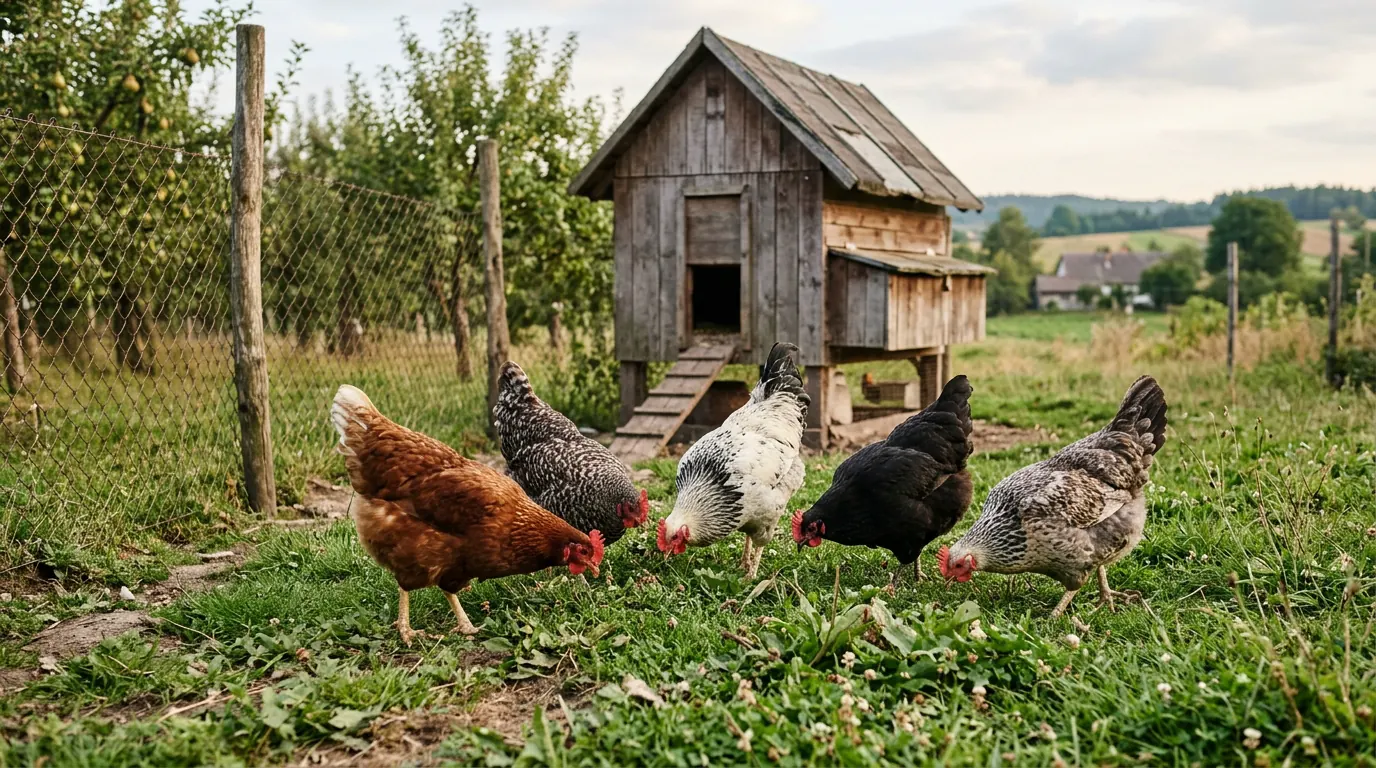
"Feeder" is the general word for any device chickens eat from. A feed pan is a smaller container that stands on the floor or hangs. In Polish farming, the word paśnik comes from cattle and other ruminants and is used mainly for bulky feed; it is rarely used for poultry. A trough is a long, shallow container. In practice these names are often mixed up, so when you buy, ask the seller about the construction: what the opening looks like, how you fill the hopper and whether you can adjust the lip height. Feed type matters too. Loose rapeseed meal needs a different container than pelleted feed.
Where to start
Before you choose a type, settle three things: the age of the birds, the flock size and the housing system, meaning litter, cage or run. Young hens and adult hens peck at different heights, so the feeder must suit both groups or be replaced as the birds grow. In a large flock, several small feeders work better than one big one. Birds spread out through the house instead of crowding at a single point, and one broken unit does not stop all feeding. For a general overview, see our page on poultry feeders.
Trough, closed feeder, hopper and feed pan: the differences in practice
Trough feeder
A trough feeder is a long, open channel. Birds eat from it along the whole edge at the same time. It is easy to clean and easy to fill by hand or from a feed line. The weak point is spillage: hens scratch in the trough and throw grain onto the litter, so losses grow when the lip is low. That is why many coops use troughs with a raised lip or a grid that limits throwing. A trough works well in flocks where all birds eat at the same time.
Closed feeder
A closed feeder, also called a pan or bucket feeder, cuts losses because the feed sits in a hopper covered by a lid or collar. Hens eat through an opening or slot. This type suits loose and pelleted feed and small flocks. With a closed feeder, check regularly that the feed does not cake and the openings are not blocked. Moisture from the litter and feed leftovers spoil quality fast, and spoiled feed puts birds off eating.
Hopper and feed pan
The hopper (paśnik) and the feed pan are used mainly for bulky feed such as green fodder or chaff. A pan is a flat container that you fill along its whole length. In a coop with an earth floor, put it on a raised platform or stands so birds do not scratch in feed fouled with droppings. Remember that a pan needs cleaning more often, because birds step into it.
How many feeders for a flock: counting feeding places
Places per feeder
The first question is how many birds can reach the feed at the same time. For a trough, the length of the edge counts. For a closed feeder, count the openings or pecking places. Equipment makers and breeding manuals give a rough number of birds per place for each type. Do not guess this number. Check it in the documentation of the specific feeder and ask which age group it was given for. Manual data often covers other breeds and systems, so treat it as a starting point.
How many feeders for the flock
With several feeders, space them evenly across the house, not in one corner. It helps to have feed near the perches and where hens gather. If part of the flock crowds at one feeder while other birds do not eat, add a feeding point or move an existing one. Watching the flock tells you this faster than tables do, especially after you place a new batch.
Age and height
Young hens need feeders set low, matched to their size. For adult hens, the edge should be about at the height of the bird's back. When the age group changes, adjust the height or swap the feeder. An edge that is too high makes pecking hard, and one that is too low raises losses. A good habit is to check the height each time you place a new batch.
Feed waste and clean feeders
Where losses come from
The biggest losses occur when birds throw the feed out, when droppings foul it, or when rain and water from drinkers wet it. Fouled feed can also be a source of infection. Keep feeders away from drinkers and place them so birds do not have to walk on wet litter. Damp spots near a feeder soon turn moldy, so check the ground together with the feed.
Cleaning
Clean feeders regularly. Remove leftovers, throw away caked feed, and wash and disinfect the containers following the disinfectant maker's instructions. Agree the scope and frequency of cleaning with your vet as part of your biosecurity program. When you change flocks, empty the hopper and replace all the feed instead of topping up old feed with new. That way you do not mix batches of different freshness.
Biosecurity plan
Feeders are one point that is easy to miss in a biosecurity plan. Decide who fills them, in what order you walk through the house, and where you store feed so that you do not carry infection between buildings. The person who feeds should start with healthy birds and leave sick or suspect birds for last, if your plan provides for it.
Choosing a feeder for the coop and the run
Coop
In the coop, place the feeder where staff can reach it easily and away from the perches where hens sleep. Birds that eat under the perches take less feed and get dirty more often. We cover the building itself in a separate guide on coop requirements for laying hens.
Run
On the run, protect the feeder with a roof so rain does not soak the feed. Put it on dry, firm ground, not in mud. Fix an outdoor feeder down so wind and birds cannot knock it over. After every rain, check that the feed in the hopper is dry and not stuck in the openings.
Automatic feeders
Feeders with an automatic doser cut manual work, but you must check that the doser works and that feed does not clog the line. Automation does not replace daily observation of the flock. If the doser fails, birds cannot eat, so check the feed level and the mechanism at set times each day.
How much a feeder costs and what sets the price
What sets the price
The price depends on the material, for example plastic or galvanized steel, the capacity, the type of closure, the dimensions and whether the feeder has height adjustment. Transport and spare parts add to the cost. Compare feeders by usable capacity and durability, not only by price per unit. A cheap feeder that cracks quickly or cannot be washed thoroughly can cost more to run.
Where to check prices
Check current prices in farm equipment shops, with distributors and on manufacturers' websites. Prices change often, so before you buy, ask for the price on the day of the order and for the delivery date. Collect experience on the durability of a given type from other keepers in a club or trade group. Before you buy a large batch, order one feeder and test it in practice. Your whole purchase plan, including a farm management program, lets you record expenses and compare them with flock results.
Frequently asked questions
What is the best feeder for chickens?add
For a small backyard flock, a closed feeder often does the job, because it limits waste and takes little space. For a larger flock on litter, a trough feeder with a raised lip is often more practical. The choice depends on the type of feed and how you work.
How many feeders do I need for my flock?add
Work out the number from the documentation of the specific feeder, the age of the birds and the size of the coop. Space the feeders evenly so every hen can reach feed without crowding. If some birds do not eat, add a feeding point or move an existing one.
Can I put a chicken feeder outside?add
Yes, but on the run you must protect the feeder from rain and damp and set it on dry ground. Wet feed loses quality fast and can harm the birds. After rain, check the feed in the hopper.
How often should I clean a chicken feeder?add
It depends on the feeder type, the kind of feed and the flock size. Remove leftovers and caked feed regularly, and wash and disinfect the containers following the disinfectant maker's instructions. Agree the cleaning program with your vet.
What is the difference between a feeder and a hopper (paśnik)?add
A feeder is the general container for bird feed. A paśnik is a term used mainly for bulky feed and for ruminants, and is rarely used for poultry. When you buy, ask the seller about the construction, not just the name.
Sources & resources
- linkChief Veterinary Inspectorate (Główny Inspektorat Weterynarii) — gov.pl/web/wetgiw
- linkNational Research Institute of Animal Production (Instytut Zootechniki PIB) — izoo.krakow.pl
- linkEFSA — efsa.europa.eu
- linkMinistry of Agriculture and Rural Development (Ministerstwo Rolnictwa i Rozwoju Wsi) — gov.pl/web/rolnictwo
Prepared by: DlaFerm Team based on data from the sources listed · Publisher: INSTA-TECH sp. z o.o.
Keeping a flock of hens and want to keep feeding under control?
The DlaFerm.pl farm management program lets you record your flock, age groups and feeding in one place. Create a free farm account in DlaFerm.pl or get in touch, and we will show you how it works for your flock.
Phone
+48 796 258 151